
SNDK Crashes 22%: Is the AI Storage Boom Losing Steam?

 Prefer us on Google

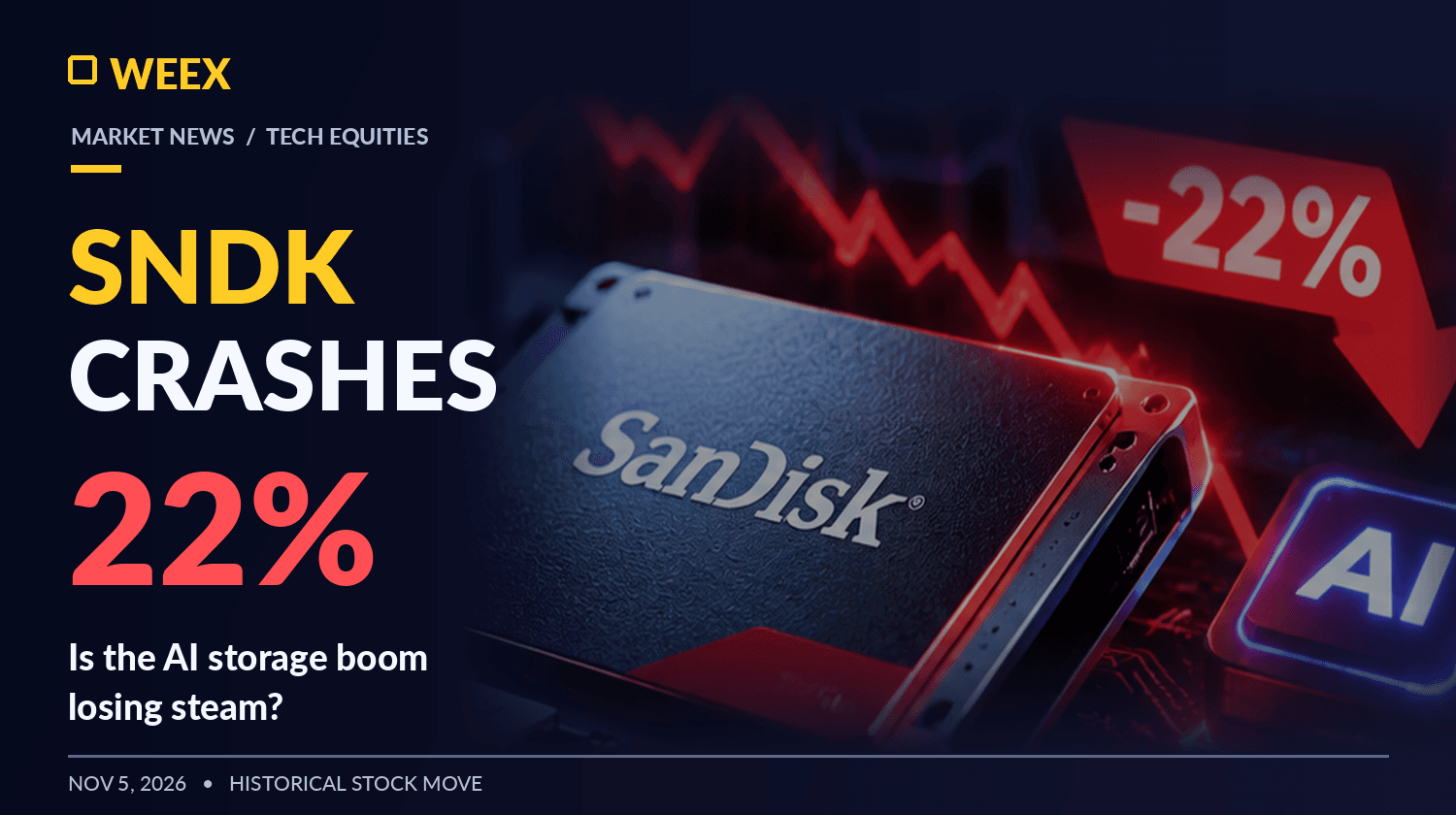
Sandisk (NASDAQ: SNDK) suffered a dramatic selloff on November 5, 2026, with its shares falling approximately 22.26% to $806.43 during the U.S. regular trading session. The decline occurred as semiconductor and AI infrastructure stocks faced broad selling pressure, raising questions about whether investor expectations for the AI storage market had become too optimistic.
The SNDK stock drop was particularly striking because Sandisk had reported strong financial results only a week earlier. Its fiscal first-quarter 2027 revenue reached approximately $11.03 billion, up 23% sequentially, while data center revenue increased 61% quarter over quarter.
The SNDK stock drop therefore exposes a major tension in the AI investment story: companies can report substantial current growth while investors simultaneously question whether that pace can continue.
According to a WEEX market snapshot recorded on November 6 at 13:57 Beijing time, the SNDK stock-related product showed a closed-market reference quotation of 844.99 USDT. The corresponding SNDK/USDT perpetual futures quotation was approximately 848.39 USDT, with a 24-hour change of -15.23%.
These prices refer to different products and comparison periods. The U.S. stock's November 5 decline should not be confused with the futures product's rolling 24-hour movement.
The central question is whether the selloff signals a deterioration in real AI storage demand or a reassessment of valuation, expectations and risks after a powerful rally.
Why Did SNDK Stock Fall More Than 22%?
Sandisk shares came under heavy pressure during a broader decline in technology and semiconductor stocks on November 5.
The Nasdaq Composite fell approximately 5.5%, while semiconductor-related shares experienced even sharper losses.
Sandisk's decline reflected a market environment in which investors were increasingly questioning the pace, profitability and financing requirements of AI infrastructure expansion.
According to November 5 market coverage of the technology selloff, concerns included data center development, capital spending expectations and broader market uncertainty.
Was the Decline Caused by Weak Sandisk Earnings?
The available evidence does not support treating weak quarterly earnings as the primary explanation.
Sandisk had already reported strong fiscal Q1 results on October 29, including higher revenue and expanding data center sales.
The November 5 decline occurred amid a sector-wide market reaction rather than a new announcement showing that Sandisk's reported quarterly sales had collapsed.
This distinction matters because a sharp stock decline is not the same as a sudden decline in actual product shipments or recognized revenue.
Why Did the Semiconductor Sector Sell Off?
AI infrastructure companies depend on expectations about large investments in computing facilities, networking, memory and power systems.
Investors became more concerned about the economic and political conditions surrounding future data center construction.
Potential constraints include financing costs, electricity availability, permitting and the ability of customers to generate returns on substantial AI-related spending.
These concerns may affect market valuations even before they appear in corporate revenue.
A company can therefore experience strong near-term demand while facing lower investor expectations for future growth.
What Role Did Market Valuation Play?
High-growth technology stocks can become sensitive to even modest changes in expectations.
When investors assign a premium valuation to anticipated future earnings, concerns about slower growth or lower profitability can produce large price adjustments.
Sandisk had previously benefited from enthusiasm around NAND flash supply conditions and AI data center demand.
The sharp selloff may partly reflect a reassessment of those expectations, but it does not establish that the company's long-term demand outlook has already weakened.
What Did Sandisk Report in Its Latest Earnings?
Sandisk published its fiscal first-quarter 2027 results on October 29, 2026, several days before the selloff.
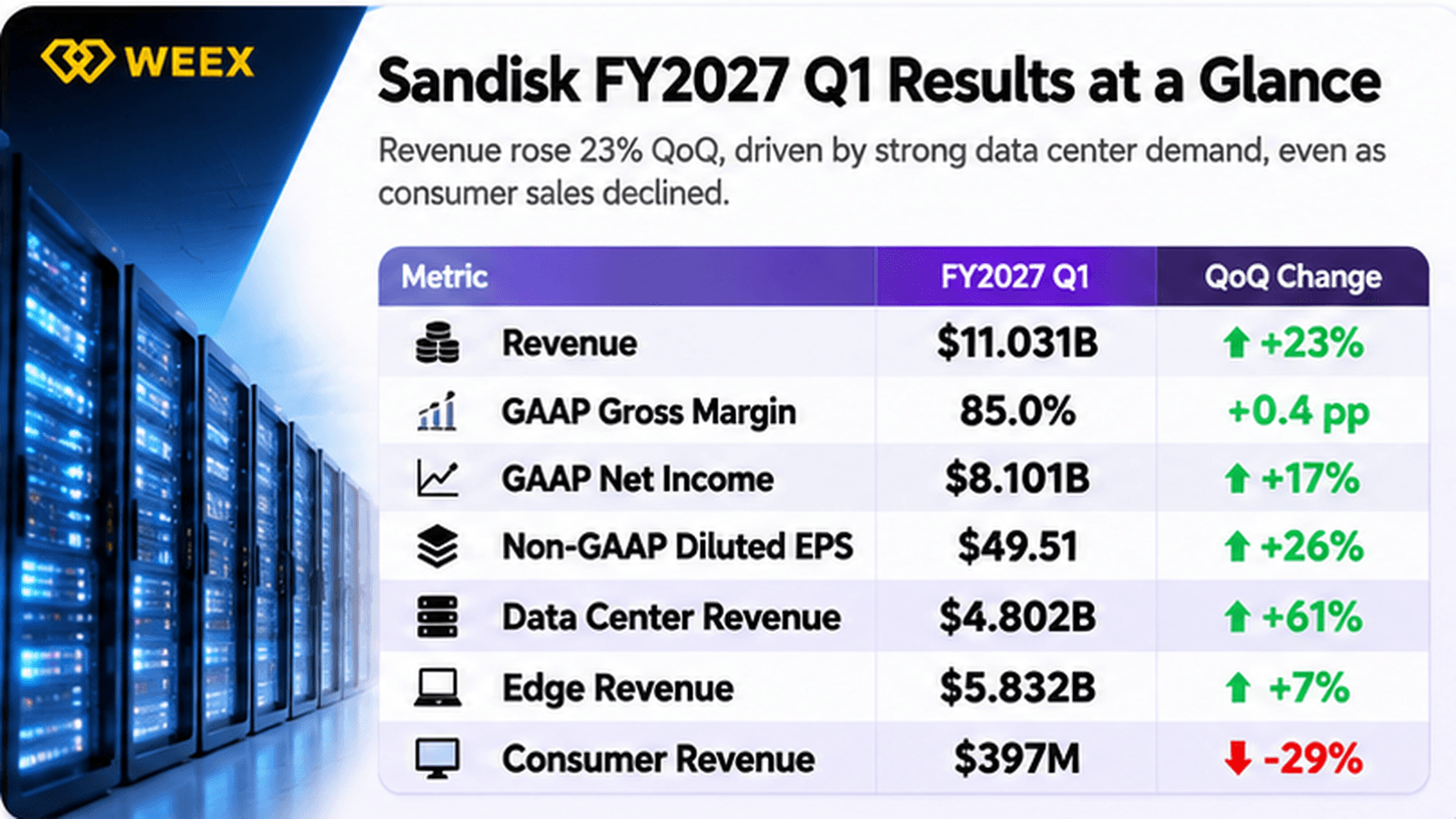
According to the official Sandisk earnings announcement, the company reported quarterly revenue of approximately $11.03 billion.
This represented a 23% increase from the preceding quarter.
| Financial Metric | FY2027 Q1 | FY2026 Q4 | Change |
|---|---|---|---|
| Revenue | $11.031B | $8.965B | +23% |
| GAAP gross margin | 85.0% | 84.6% | +0.4 percentage points |
| GAAP net income | $8.101B | $6.903B | +17% |
| Non-GAAP diluted EPS | $49.51 | $39.25 | +26% |
| Data center revenue | $4.802B | $2.977B | +61% |
| Edge revenue | $5.832B | $5.432B | +7% |
| Consumer revenue | $397M | $556M | -29% |
Source: Sandisk fiscal Q1 2027 earnings release, October 29, 2026. Sequential comparisons are against fiscal Q4 2026. Per-share figures are reported on a pre-split basis.
The data presents a business benefiting from strong demand in certain segments while experiencing weakness in others.
Why Did Data Center Revenue Rise 61%?
Sandisk's data center business supplies storage technologies used in enterprise computing and cloud infrastructure.
AI data centers process and store large quantities of information, including training datasets, application data and other workloads.
Demand for high-performance storage can increase as computing infrastructure expands.
The 61% sequential rise in data center revenue highlights the strength of this segment during the quarter.
However, a single quarter of growth does not establish that the same rate can continue indefinitely.
Investors should assess customer concentration, future capacity commitments and whether demand remains stable as the market evolves.
Why Did Consumer Revenue Fall 29%?
Sandisk's consumer business declined from approximately $556 million in the previous quarter to $397 million.
The contrast illustrates how demand can vary significantly across end markets.
Consumer storage purchases depend on factors such as device replacement cycles, retail demand and product pricing.
A company can therefore experience strong data center demand alongside weaker consumer sales.
For investors, the changing mix between business segments may influence future growth and profitability.
Did Sandisk's Profitability Improve?
Sandisk reported a GAAP gross margin of approximately 85.0%, compared with 84.6% in the previous quarter.
GAAP net income also increased sequentially.
These results indicate that the company maintained substantial reported profitability during the quarter.
However, the unusually strong margin environment should be evaluated in the context of memory pricing and supply conditions.
Investors need to determine whether current profitability represents a sustainable level or a particularly favorable point in the memory-industry cycle.
Is the AI Storage Boom Losing Momentum?
The November 5 selloff raised concerns about the durability of AI-related demand.
However, a decline in share prices cannot, on its own, establish that demand for storage products has started to contract.
The most useful approach is to separate confirmed operating performance from forward-looking market expectations.
AI Infrastructure Still Requires Storage
AI systems depend on more than graphics processing units and specialized accelerators.
Large-scale computing infrastructure also requires storage for datasets, intermediate outputs, model deployment and operational workloads.
NAND flash and solid-state storage products serve important roles in this environment.
Sandisk participates in that market through its storage technology portfolio.
Its latest data center sales suggest that demand was strong during the reported quarter.
The question is whether future capacity expansion and customer spending will sustain that momentum.
Could NAND Pricing Change?
The memory industry has historically experienced cycles of supply constraints and excess capacity.
When supply is limited relative to demand, pricing conditions can improve.
When manufacturers increase output or customers reduce purchases, pricing pressure may return.
Sandisk's future revenue and profitability therefore depend partly on market supply, demand and product mix.
Investors should avoid assuming that favorable memory pricing will remain unchanged.
What Could Slow Data Center Expansion?
Large AI computing projects require capital, electricity, real estate and permitting.
Higher financing costs, changes in regulation or delays in infrastructure development could slow deployment schedules.
Such delays may influence the timing of storage purchases, even when the long-term need for computing capacity remains substantial.
However, potential delays should not be described as confirmed cancellations unless supported by specific company disclosures.
For additional context on the business and its market drivers, see WEEX Learn's Sandisk Stock: Price, Outlook and How to Buy.
-- Price
What Is Sandisk's Outlook for Fiscal Q2 2027?
Despite the stock selloff, Sandisk's latest published guidance remained an important reference point.
The company projected revenue of approximately $12.2 billion to $12.6 billion for fiscal Q2 2027.
It also provided non-GAAP diluted EPS guidance of approximately $55 to $57 on a pre-split basis.
These forecasts suggest that management anticipated continued strong financial performance.
However, guidance is not the same as completed revenue.
Actual results will depend on customer demand, manufacturing conditions, product pricing and execution.
Why Does Guidance Matter More After a Selloff?
A sharp share-price decline can signal that investors have become less confident about the future.
Subsequent earnings reports provide an opportunity to test those expectations against actual operating results.
If Sandisk meets or exceeds its guidance, investors may reassess the strength of its business.
If revenue or profitability weakens materially, the concerns reflected in the selloff could gain further support.
Neither outcome should be treated as guaranteed.
What About Sandisk's Planned Stock Split?
Sandisk announced an eight-for-one forward stock split, expected to become effective on November 19, 2026.
Under an eight-for-one split, each existing share is replaced by eight shares, with the per-share price adjusted proportionally.
The split does not increase the company's total economic value or an investor's proportional ownership.
Users tracking SNDK-related tokens or derivatives should check how their specific trading products handle stock splits and other corporate actions.
SNDK Shares vs. WEEX Stock Tokens and Futures
Investors following Sandisk's market performance should distinguish among ordinary U.S.-listed shares, synthetic stock-related products and perpetual futures.
These instruments can reference the same company while providing different ownership rights and risk exposures.
| Feature | SNDK Common Shares | WEEX Stock-Related Product | SNDK Perpetual Futures |
|---|---|---|---|
| Instrument | Corporate equity | Stock-linked trading product | Derivative contract |
| Direct share ownership | Yes | Not necessarily | No |
| Shareholder rights | As applicable | Product-specific, generally limited | No ordinary shareholder rights |
| Price exposure | Nasdaq share price | Reference-price and product mechanism | Contract pricing |
| Leverage | Depends on brokerage arrangements | Product-specific | May be available |
| Key risks | Equity-market volatility | Tracking, issuer and liquidity risks | Funding, margin and liquidation |
WEEX's Tokenized Stocks Explained provides background on why price-linked tokens should not be confused with legal ownership of ordinary shares.
Why Can Quoted Returns Differ?
The WEEX stock-related quotation and its perpetual futures price may be recorded at different times or under different trading mechanisms.
The underlying U.S. equity market has defined trading sessions, while derivative contracts may follow separate schedules.
Consequently, the 22.26% decline in SNDK shares on November 5 and the -15.23% rolling movement in the WEEX futures snapshot are not contradictory.
They refer to different instruments and comparison windows.
What Should SNDK Investors Watch Next?
Several factors will help determine whether Sandisk's selloff reflects a temporary valuation adjustment or a more persistent change in expectations.
Data center revenue: Whether the company can sustain strong growth in enterprise storage.
Memory pricing: Whether NAND supply and demand remain favorable.
Consumer demand: Whether weakness in the consumer segment stabilizes or continues.
AI capital expenditure: Whether major customers maintain their infrastructure expansion plans.
Profitability: Whether gross margins and earnings remain strong as the business mix evolves.
Fiscal Q2 guidance: Whether actual results align with management's latest projections.
Corporate actions: How the November 19 stock split is implemented across the underlying shares and related products.
These indicators provide more substantive evidence than the stock's performance over a single trading session.
How to Trade SNDK-Related Products on WEEX
WEEX provides market interfaces for selected U.S. stock-related assets and derivatives.
Users should understand the specific instrument they are trading before opening a position.
Step 1: Sign In to WEEX
Access your WEEX account and complete applicable account verification requirements.
Confirm that SNDK-related products are available in your region.
Step 2: Prepare the Required Balance
Check that sufficient USDT or supported collateral is available in the appropriate account.
Review product specifications before transferring funds.
Step 3: Choose the SNDK Product
To review stock-linked exposure, visit the SNDK stock-related market on WEEX.
Eligible derivatives users can also check the SNDK/USDT perpetual futures market.
These products should not be treated as equivalent to purchasing SNDK shares through a conventional brokerage account.
Step 4: Check Market Hours and Trading Risks
Review live prices, fees, order types and available liquidity.
Stock-related products can be subject to market closures, session restrictions and price gaps.
Perpetual futures may involve leverage, funding costs, margin requirements and liquidation.
WEEX's U.S. Stock Token Trading Hours Guide explains why session timing matters when trading stock-linked instruments.
Step 5: Confirm and Monitor Your Position
Review the transaction details before submitting an order.
After execution, monitor your balance or derivative position.
Pay particular attention to earnings announcements, corporate actions and sudden changes in underlying stock-market liquidity.
Conclusion
Sandisk's 22.26% share-price decline on November 5 reflected a sharp reassessment of AI and semiconductor-related market expectations.
The selloff came despite strong fiscal Q1 results, including $11.03 billion in revenue and 61% sequential growth in data center sales.
That contrast does not prove the AI storage market has entered a downturn. Instead, it highlights the difference between current operating performance and expectations about future growth.
For SNDK investors, the decisive indicators will be data center spending, NAND pricing, customer demand, profitability and the company's ability to deliver on its fiscal Q2 guidance.
The next earnings results will offer more evidence about whether market concerns are becoming visible in Sandisk's business.
FAQ
1. Why Did SNDK Stock Fall Around 22% on November 5?
Sandisk fell during a broad selloff in semiconductor and AI infrastructure stocks. Investors were reassessing valuations and the outlook for future data center spending.
2. Did Sandisk Report Weak Earnings Before the Selloff?
No. Its October 29 fiscal Q1 earnings showed approximately $11.03 billion in revenue, up 23% sequentially, alongside strong reported profitability.
3. How Fast Is Sandisk's Data Center Business Growing?
Data center revenue increased 61% quarter over quarter to approximately $4.80 billion in fiscal Q1 2027.
4. Does the Stock Decline Mean AI Storage Demand Is Falling?
Not necessarily. A share-price decline reflects market expectations and trading conditions. Confirmed changes in demand must be assessed through company results and industry data.
5. Are WEEX SNDK Products Equivalent to Owning Sandisk Shares?
No. Stock-linked products and perpetual futures may provide price exposure without direct equity ownership or ordinary shareholder rights. Users should check the applicable product terms.
This content is provided for general informational purposes only and doesn't constitute financial, investment, legal, or tax advice. Any events, rewards, online promotions, or related information mentioned herein should not be considered a recommendation, solicitation, or invitation to purchase, sell, trade, or otherwise deal in any crypto assets. Crypto assets are highly volatile and may result in loss. The availability of WEEX services, products, and related events may vary by region. You are responsible for ensuring that your participation is in accordance with applicable local laws and regulations.
You may also like
Stock Tokens vs ETFs: Key Differences Beginners Should Know

WEEX Stock Spot 2.0 Rewards Guide: Trade & Share $100K
Stock Spot vs Perpetuals vs Real Stocks: Key Differences
INJ Staking ETF Goes Live: Can 90% Staking Drive Demand?

Circle Revenue Hits $865M, But Can CRCL Sustain Growth?

Is GM on BSC a CZ Token? What Is Confirmed and What Is Not

What Is GM on BSC? GREEN MORNING Jumps Over 400% on a Reported Musk–CZ Meme Moment
Polygon Proposes Hard Fork to Recover 70.49M POL
Zcash NU7 Upgrade: 25-Second Blocks, Same 21M ZEC Supply
Hyperliquid ICE Deal: What US Perps Mean for HYPE Holders
Ripple National Trust Bank: What OCC Approval Means for XRP
Why Is Bitcoin Down Today? BTC's Slide to $76K Explained
Binance Hack Explained: What the $6.3B Theft Means for Users
CC Spot vs Futures on WEEX: Trading Canton's SEC Headline Risk

How to Buy USOE? What DEX Access Involves, Which Wallet and Contract Risks Apply and What an Exchange Listing Would Require

Is USOE Legit? What the Website Claims, What Independent Sources Found and What Is Still Missing

Crypto Passive Income: What $1,000 Earns in Each WEEX Product
NEAR Protocol HSP-029: Max Issuance Falls From 2.5% to 1.6%, but When Does the Change Take Effect?
SMCI Reports $19.9B Revenue as Margin Falls

NEAR Up 4.8% After HSP-029 Issuance Vote Passes
RUNE Up 7% as THORChain Restores Swaps

What Is USOE (United States Oil Exchange)? Claims, Contract Checks and Liquidity Risks
BTC Price Above $78,000 After the Midterms: What Is Confirmed, What Moved and What to Check Next
StandX Airdrop: Claim Your DUSD and Redeem It Before January 31
WXT Rewards Season 9: How to Claim Your Share of 660,000 WXT

WEEX Rewards Guide: Lucky Eggs Tasks, Prizes and a 22-Day Plan
ONDO Token Unlock Schedule 2026: Is There Another Unlock This Year?

Binance Incident Report: How the Attack Chain Worked and What to Check
What Is Project Cortex (XTX) Crypto? How to Identify the Token Behind the Trending Name

Is United States Oil Exchange (USOE) Really Oil-Backed? Reserve Claims and Token Holder Rights
Stock Tokens vs ETFs: Key Differences Beginners Should Know
WEEX Stock Spot 2.0 Rewards Guide: Trade & Share $100K
Stock Spot vs Perpetuals vs Real Stocks: Key Differences
INJ Staking ETF Goes Live: Can 90% Staking Drive Demand?
Circle Revenue Hits $865M, But Can CRCL Sustain Growth?
Is GM on BSC a CZ Token? What Is Confirmed and What Is Not


