
INJ Staking ETF Goes Live: Can 90% Staking Drive Demand?

 Prefer us on Google

The INJ staking ETF has officially entered the U.S. market after Canary Capital launched the Canary Staked INJ ETF (Nasdaq: INJC) on November 5, 2026. The fund offers investors exposure to Injective's native cryptocurrency, INJ, through exchange-traded shares while seeking to generate additional INJ through blockchain staking.
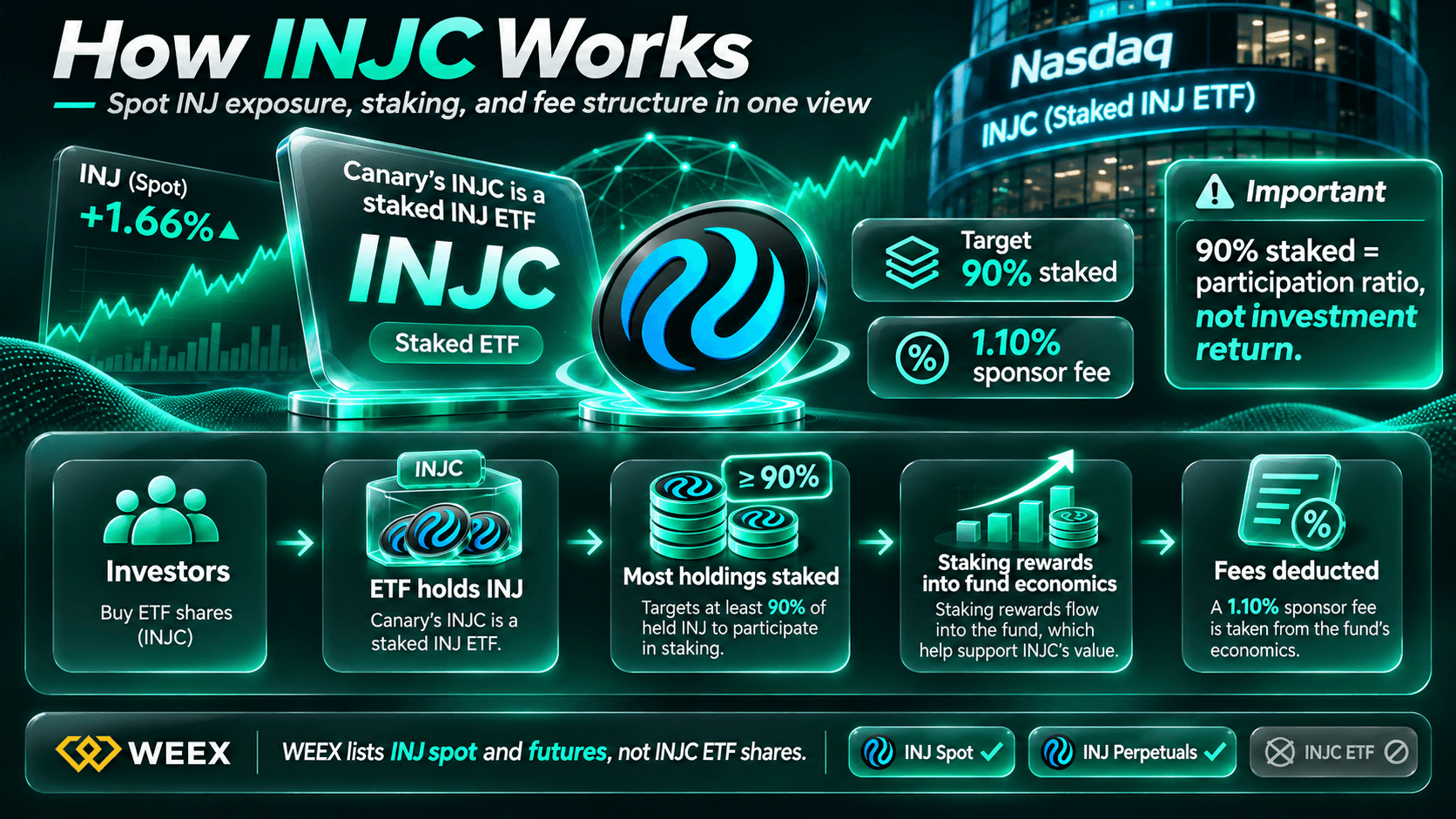
Unlike a conventional cryptocurrency fund focused solely on price exposure, the INJ staking ETF is designed to participate in the Injective network's proof-of-stake validation process. Under normal circumstances, its sponsor anticipates staking at least 90% of the fund's INJ holdings.
The INJ staking ETF introduces an important distinction for investors: 90% refers to the portion of assets intended for staking, not an annual return. Actual staking rewards fluctuate, and the fund's fees and operating expenses reduce the economic benefit ultimately reflected in its share value.
According to the November 6 WEEX market snapshot at 13:59 Beijing time, INJ spot traded at approximately 8.155 USDT, up 1.66% over 24 hours. INJ perpetual futures were quoted around 8.158 USDT, up 1.72%. These historical figures do not establish that the ETF launch caused the rebound.
The key questions are how INJC works, whether a staking-oriented ETF could affect INJ demand, and what costs investors must consider before comparing the fund with direct token ownership.
What Is the Canary Staked INJ ETF?
The Canary Staked INJ ETF is an exchange-traded product designed to hold INJ and provide exposure to its market price through shares listed on Nasdaq.
Canary Capital announced the fund's launch on November 5, following Nasdaq's official listing notice.
According to the Canary Capital launch announcement, the fund seeks to combine two investment objectives: tracking the value of the underlying INJ holdings and earning additional INJ through staking.
The fund's net asset value, or NAV, is affected by the price of INJ, its holdings, earned staking rewards and applicable expenses.
| ETF Feature | INJC Details |
|---|---|
| Fund name | Canary Staked INJ ETF |
| Nasdaq ticker | INJC |
| Trading launch | November 5, 2026 |
| Underlying asset | Injective (INJ) |
| Intended staking allocation | At least 90% of INJ under normal conditions |
| Annual sponsor fee | 1.10% |
| Digital asset custodian | BitGo Bank & Trust |
| Staking exposure | Rewards reflected in fund NAV |
| Direct investor ownership of INJ | No |
Sources: Nasdaq listing notice, Canary Capital fund information and the fund's SEC prospectus. Actual staking allocation and holdings can change.
INJC should not be confused with Injective's native cryptocurrency itself.
Investors purchasing ETF shares acquire an interest in the fund according to its governing documents, not unrestricted control of the underlying tokens.
How Is INJC Different From a Conventional Spot Crypto ETF?
A spot cryptocurrency ETF generally provides market exposure through holdings of the underlying digital asset.
INJC also seeks to participate in proof-of-stake validation.
This creates the possibility of accumulating additional INJ through staking activity.
However, that mechanism introduces extra considerations, including validator performance, reward variability, custody arrangements and liquidity requirements.
The fund does not promise a fixed yield, and its return depends on more than staking rewards alone.
How Does INJC's 90% Staking Strategy Work?
Staking is a process through which eligible digital assets help support the security and operation of a proof-of-stake blockchain.
Network participants delegate or commit tokens to validators that participate in transaction verification and consensus.
Successful participation may generate rewards, although the amount is not guaranteed.
For background, see WEEX Learn's What Is Staking? Four Myths to Clear Up Before You Stake Crypto.
Why Does the ETF Target at Least 90%?
The Canary Staked INJ ETF prospectus filed with the SEC states that the sponsor anticipates staking at least 90% of the trust's INJ under normal circumstances.
A portion may remain unstaked to support redemptions, expenses or other operational needs.
For example, if a fund hypothetically held 100,000 INJ and staked 90%, approximately 90,000 INJ would participate in staking while 10,000 INJ remained unstaked.
This example describes an allocation percentage, not the size of INJC's actual holdings.
The sponsor can adjust the proportion depending on operational conditions.
Does 90% Staking Mean a 90% Yield?
No.
The staking allocation and staking yield measure entirely different things.
Staking allocation describes how much of the fund's INJ is committed to the network.
Staking yield describes the rewards generated relative to the eligible assets over a particular period.
A fund could stake a large percentage of its tokens while receiving a much smaller annual reward rate.
Moreover, staking rewards can fluctuate and may be affected by validator performance, network rules and fees.
It would therefore be inaccurate to market INJC as offering a 90% annual return.
How Are Rewards Reflected in ETF Shares?
INJC seeks to receive additional INJ through participation in the staking program.
Rather than distributing those tokens directly to individual shareholders, the economic value of net staking rewards is intended to be reflected in the fund's NAV.
A shareholder's return is still affected by changes in INJ's market price.
If the token declines substantially, staking rewards may not offset the loss in value.
The existence of staking therefore does not make the fund a low-risk income product.
What Fees and Risks Come With INJC?
The fund's advertised staking mechanism should be evaluated alongside its expenses.
Canary Capital lists an annual 1.10% sponsor fee.
The fund's documentation also describes staking-related costs that can reduce the rewards retained by the trust.
Sponsor Fee Versus Staking Costs
The sponsor fee is a fund-level operating expense.
Staking expenses relate to the services required to participate in the validator process and manage associated assets.
According to the fund's offering materials, up to 30% of staking rewards may be used for applicable staking-service costs.
Consequently, gross network rewards are not equivalent to the net economic benefit reflected in the ETF's NAV.
The actual benefit depends on reward levels, costs and the fund's holdings.
Liquidity and Redemption Considerations
Staked assets may be subject to unbonding periods, operational restrictions or delays before becoming available for transfer.
The fund must manage these constraints while supporting its share-creation and redemption arrangements.
Maintaining an unstaked portion of its holdings can help address these requirements, but it cannot eliminate every liquidity risk.
ETF shares can also trade at a premium or discount to NAV when supply and demand differ from the underlying portfolio's calculated value.
Custody and Validator Risk
The fund depends on custodial and staking-service arrangements.
Operational failures, security incidents or validator-related penalties could negatively affect its holdings.
The fund's regulatory and structural protections also differ from those of ordinary bank deposits or conventional securities funds.
Investors should consult the prospectus rather than assume that a U.S. exchange listing removes cryptocurrency-related risk.
-- Price
Could a Staking ETF Increase Demand for INJ?
An ETF can create an additional investment channel for investors who prefer brokerage accounts to direct cryptocurrency wallets.
If investors purchase newly created fund shares and the trust acquires additional INJ, that activity may contribute to demand for the underlying token.
However, the magnitude and persistence of any effect depend on actual subscriptions, redemptions and trading activity.
ETF Launch Does Not Equal Net Inflows
A product becoming available for trading is not proof that significant capital has entered the fund.
Exchange trading volume can involve existing shares changing hands without a corresponding increase in the fund's INJ holdings.
To evaluate INJC's potential impact, investors should monitor net assets, actual INJ holdings, share creations and redemptions.
These measures provide more useful evidence of fund-related token demand than launch headlines alone.
Can Staking Affect Circulating Liquidity?
If the fund acquires and stakes INJ, the tokens involved may be less immediately available for trading during the applicable staking period.
In theory, that can influence liquid supply.
However, the effect depends on the size of the fund relative to the broader market and how many tokens would otherwise have remained inactive.
The 90% target does not imply that 90% of all circulating INJ is being removed from the market.
What Could Limit the Price Impact?
INJ's price is determined by buyers and sellers across cryptocurrency markets.
Even if the ETF attracts investors, broader market conditions, token supply, staking behavior and investor sentiment may counteract the effect.
A fund could also experience redemptions that require reducing its holdings.
The launch creates a new potential channel for demand, not a guaranteed upward price trend.
INJ Token vs. INJC ETF vs. INJ Futures
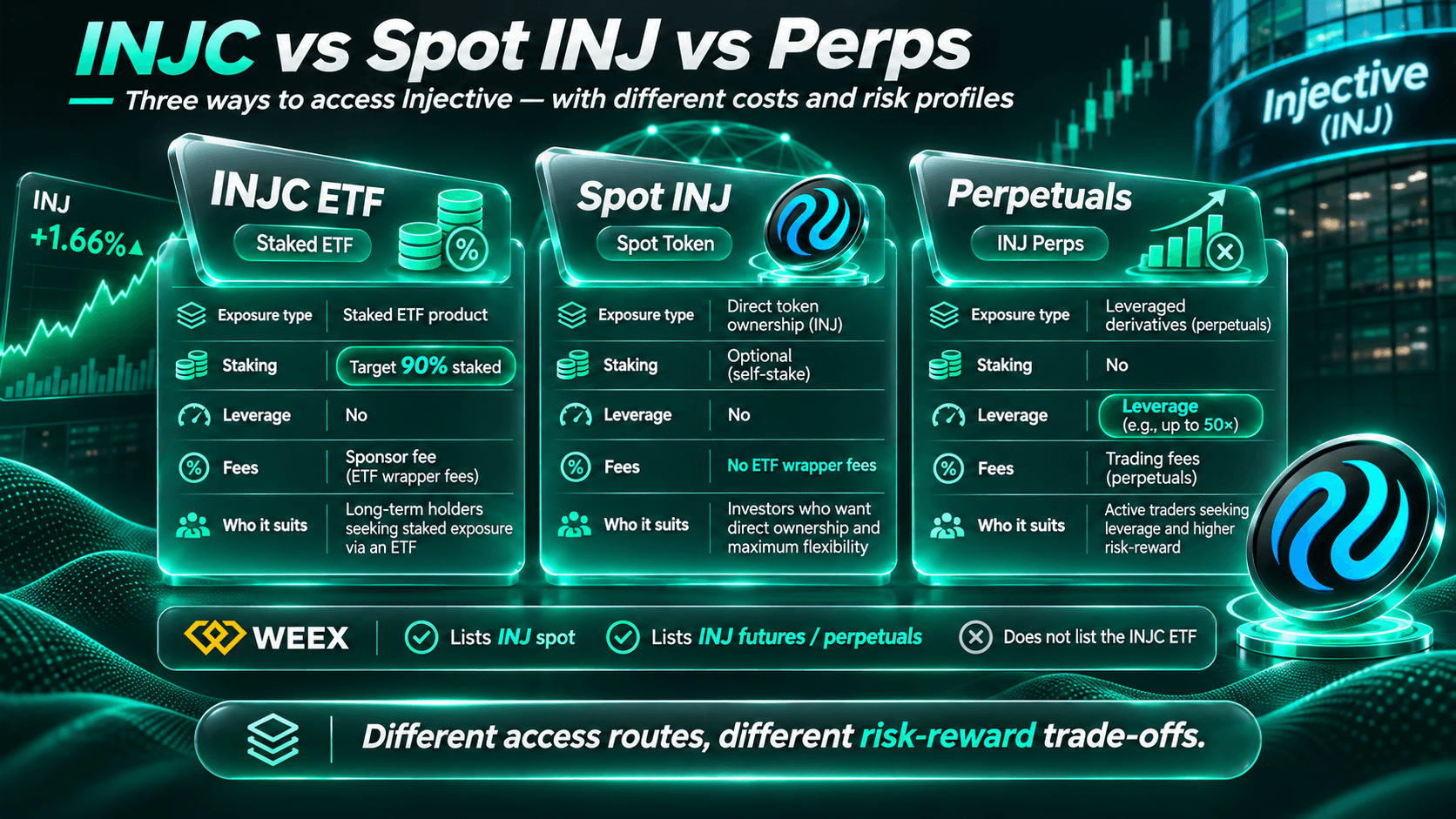
These three instruments can expose investors to changes in INJ's value, but their ownership structures and risk profiles differ.
| Feature | Direct INJ | INJC ETF | INJ Perpetual Futures |
|---|---|---|---|
| What is held? | Native cryptocurrency | Shares of a fund | Derivative position |
| Direct token control | Possible with self-custody | No | No |
| Staking participation | Possible through supported methods | Managed by the fund | Not inherent |
| Main costs | Trading, transfer and possible staking costs | Sponsor and fund expenses | Trading fees, funding and margin |
| Price risk | INJ market volatility | INJ price plus fund structure | INJ volatility, potentially magnified by leverage |
| Main additional risk | Custody and network risk | Fund, custody and tracking risk | Liquidation and funding risk |
Directly holding INJ can allow users to transfer or stake the tokens subject to network rules.
INJC shareholders do not obtain equivalent direct control over the fund's underlying tokens.
Perpetual futures provide synthetic price exposure and may involve leverage, making them structurally different from both token ownership and ETF shares.
WEEX previously published an announcement covering INJ perpetual futures, providing additional background on the exchange's INJ derivatives market.
Why Did INJ Rise Around 1.66%?
The November 6 WEEX snapshot showed INJ spot rising approximately 1.66% over the prior 24 hours.
The ETF launch may have attracted attention, especially because it introduces staking-based exposure through a Nasdaq-listed product.
Nevertheless, market reactions often reflect several factors.
ETF Expectations
Investors may anticipate future fund demand or greater recognition of Injective's ecosystem.
Those expectations can influence speculative activity before meaningful ETF flows become available.
Broader Market Conditions
INJ remains exposed to cryptocurrency-market volatility, liquidity conditions and derivative positioning.
A rise around the time of a fund launch does not establish a direct causal relationship.
What Data Matters Next?
Useful indicators include INJC's assets under management, INJ holdings, daily net flows, actual staking allocation and rewards after expenses.
On-chain activity and adoption of Injective-based applications also matter for the token's broader economic outlook.
Users can follow the WEEX Injective market information page for token-specific background and price data.
How to Buy and Trade INJ on WEEX
WEEX provides spot and perpetual futures markets for Injective, subject to availability and account eligibility.
The tokens traded on WEEX are INJ, not shares of the Nasdaq-listed INJC fund.
Step 1: Sign In to WEEX
Log in to your WEEX account and complete applicable verification requirements.
Check whether INJ trading is supported in your region.
Step 2: Prepare Your USDT Balance
Ensure that the relevant account contains sufficient USDT.
When depositing funds, verify the correct network and address before transferring assets.
Step 3: Choose INJ Spot or Futures
To buy the underlying cryptocurrency, visit the INJ/USDT spot market on WEEX.
Eligible users seeking derivatives exposure can review the INJ/USDT perpetual futures market.
These are cryptocurrency trading products, not the INJC ETF.
Step 4: Review Costs and Trading Risks
Choose an order type and check the latest quotation, liquidity and fees.
Futures positions may involve leverage, funding payments, margin requirements and liquidation.
Direct INJ ownership does not automatically provide staking rewards unless the assets are actually staked through a supported arrangement.
Step 5: Confirm and Monitor
Review the order before submission.
Monitor your position and follow official Injective and Canary Capital announcements for developments affecting the ecosystem and ETF.
Conclusion
The launch of Canary's INJC ETF marks an important development for investment products linked to Injective.
By combining INJ holdings with a staking strategy, the fund offers a structure that differs from both ordinary token ownership and perpetual futures.
Its target of staking at least 90% of INJ holdings may influence how the fund manages its assets, but it is not a yield guarantee.
For INJ investors, the crucial next indicators are actual ETF inflows, token holdings, staking rewards after expenses and broader network adoption.
The product's launch creates a potential source of demand; whether that demand becomes meaningful remains to be demonstrated.
FAQ
1. What Is the Canary Staked INJ ETF?
INJC is a Nasdaq-listed fund designed to provide exposure to Injective's native token while seeking additional INJ through staking.
2. Does the INJC ETF Offer a 90% Annual Return?
No. The 90% figure describes the intended proportion of the fund's INJ holdings allocated to staking under normal conditions, not the return investors receive.
3. How Much Does INJC Charge in Fees?
The fund lists an annual sponsor fee of 1.10%. Staking-related costs and other expenses can further affect returns.
4. Does an INJ ETF Listing Guarantee Higher INJ Prices?
No. Market impact depends on actual demand, net inflows, fund holdings, broader liquidity and cryptocurrency-market conditions.
5. Can Users Buy INJC Through WEEX's INJ Markets?
No. WEEX's INJ spot and futures markets provide exposure to the underlying cryptocurrency or its derivatives, not ownership of INJC ETF shares.
This content is provided for general informational purposes only and doesn't constitute financial, investment, legal, or tax advice. Any events, rewards, online promotions, or related information mentioned herein should not be considered a recommendation, solicitation, or invitation to purchase, sell, trade, or otherwise deal in any crypto assets. Crypto assets are highly volatile and may result in loss. The availability of WEEX services, products, and related events may vary by region. You are responsible for ensuring that your participation is in accordance with applicable local laws and regulations.
You may also like
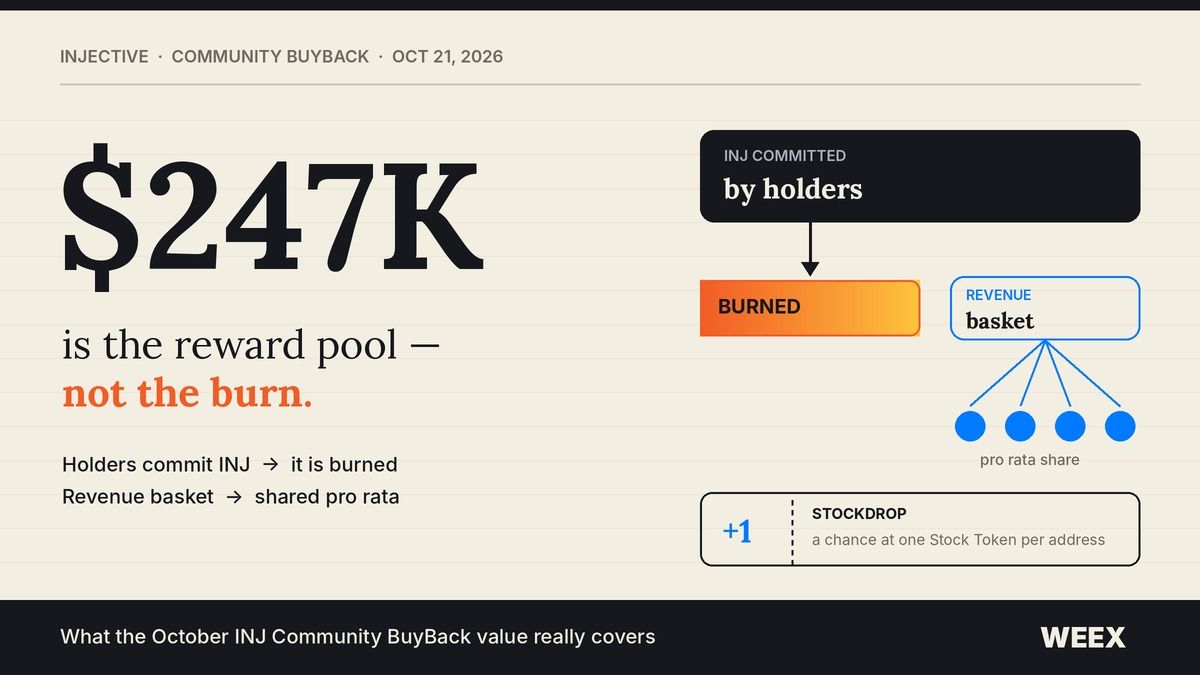
INJ Community BuyBack: What the $247K October Pool Really Means

How Do Pre-IPO Perpetual Futures Allow On-Chain Exposure to OpenAI Stock? 2026

Trade to Earn: How Your Everyday Trades Can Start Earning for You
What Is Injective (INJ) and How Does It Work?

SNDK Crashes 22%: Is the AI Storage Boom Losing Steam?

Circle Revenue Hits $865M, But Can CRCL Sustain Growth?

Is GM on BSC a CZ Token? What Is Confirmed and What Is Not

What Is GM on BSC? GREEN MORNING Jumps Over 400% on a Reported Musk–CZ Meme Moment
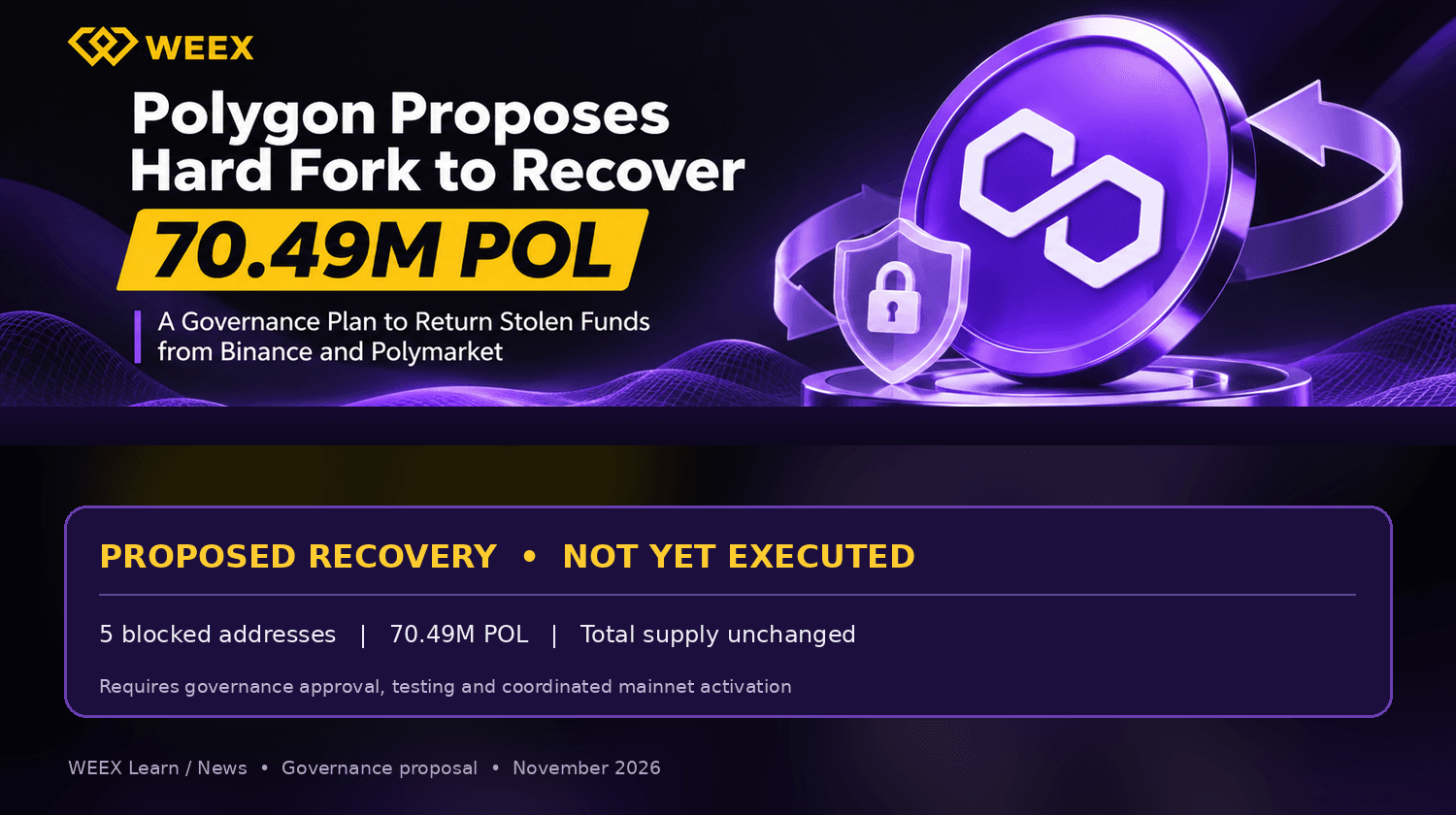
Polygon Proposes Hard Fork to Recover 70.49M POL
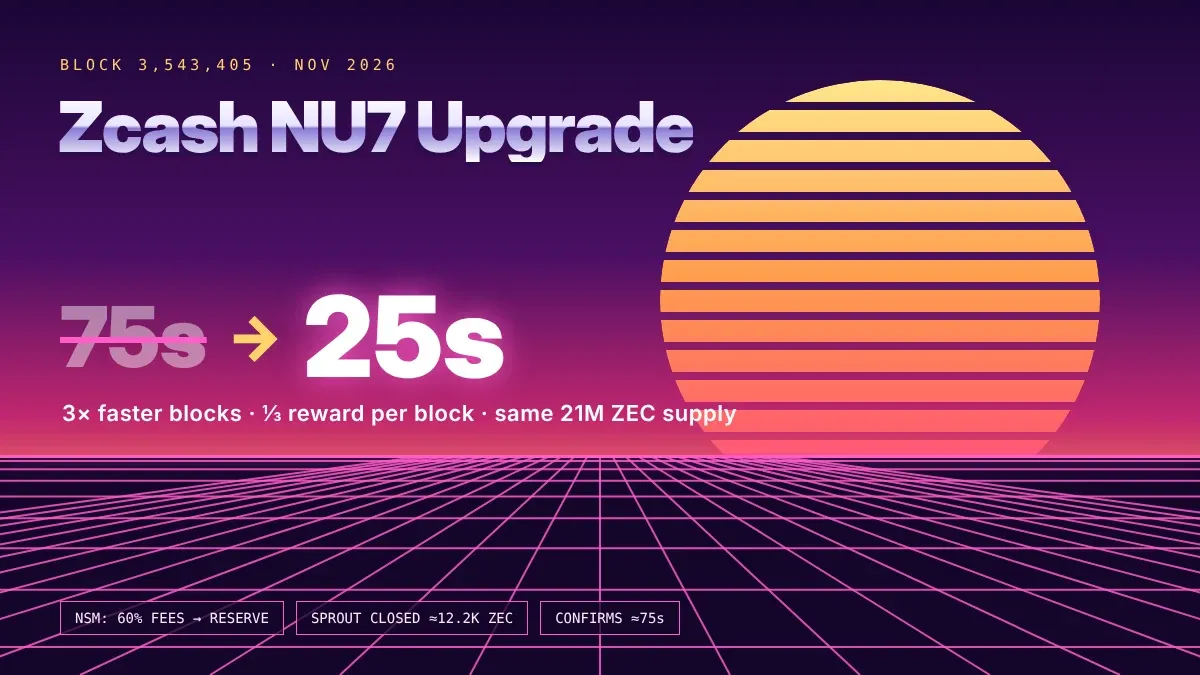
Zcash NU7 Upgrade: 25-Second Blocks, Same 21M ZEC Supply
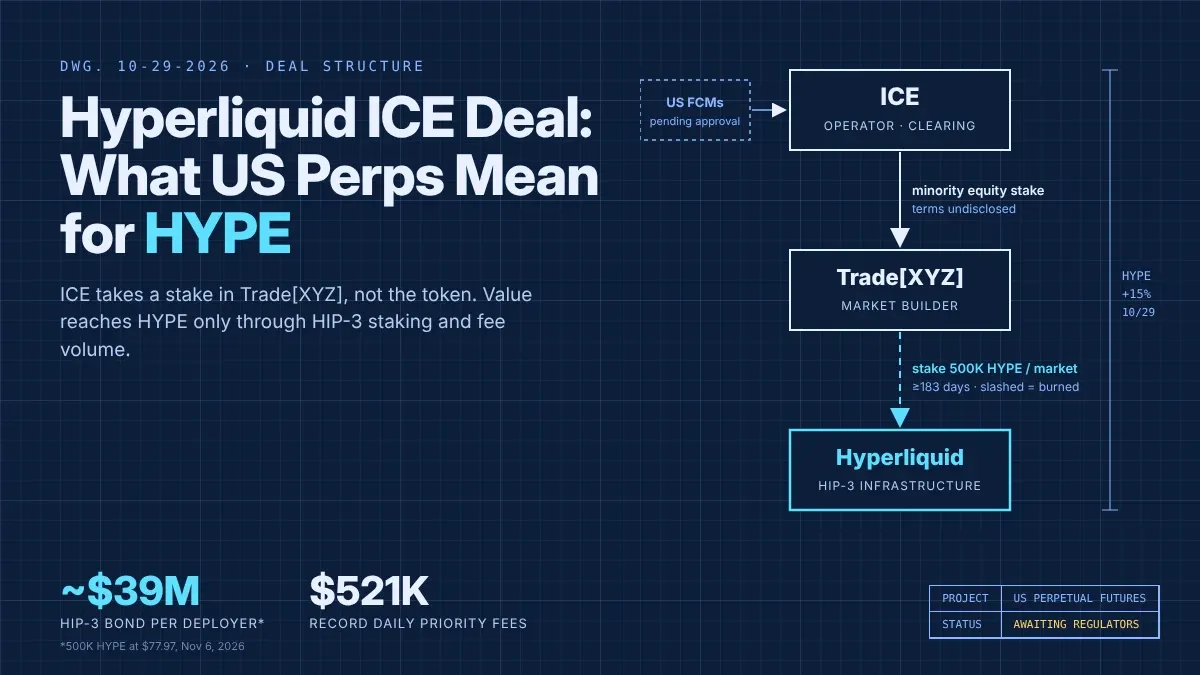
Hyperliquid ICE Deal: What US Perps Mean for HYPE Holders
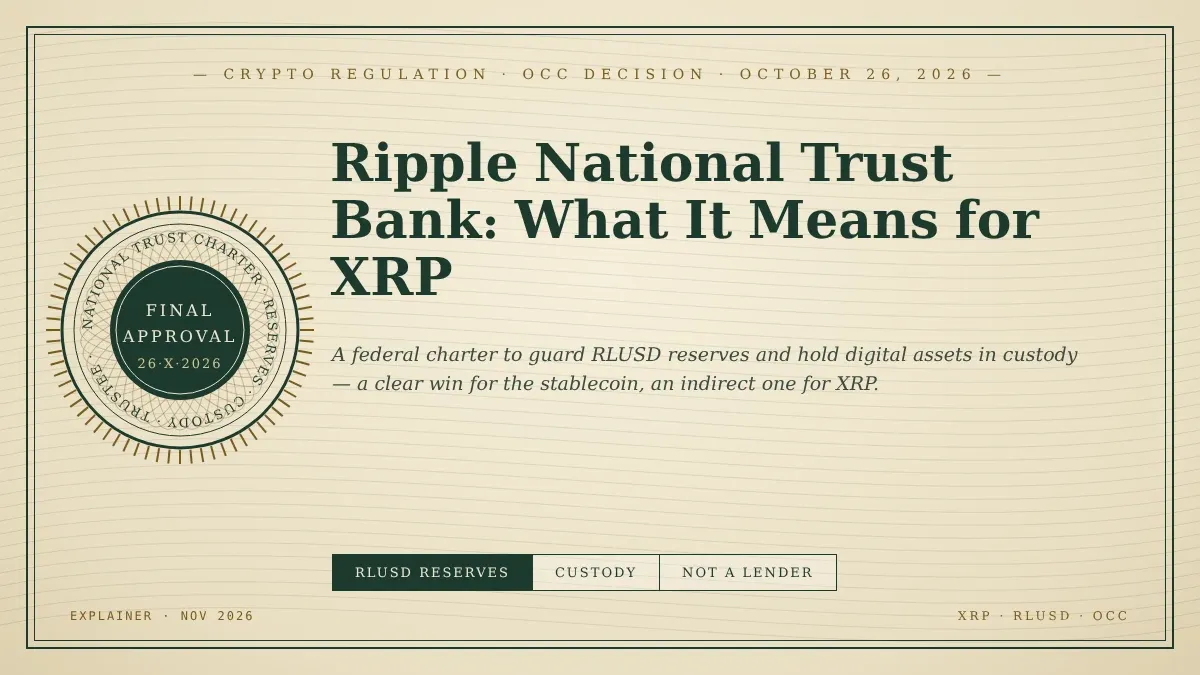
Ripple National Trust Bank: What OCC Approval Means for XRP
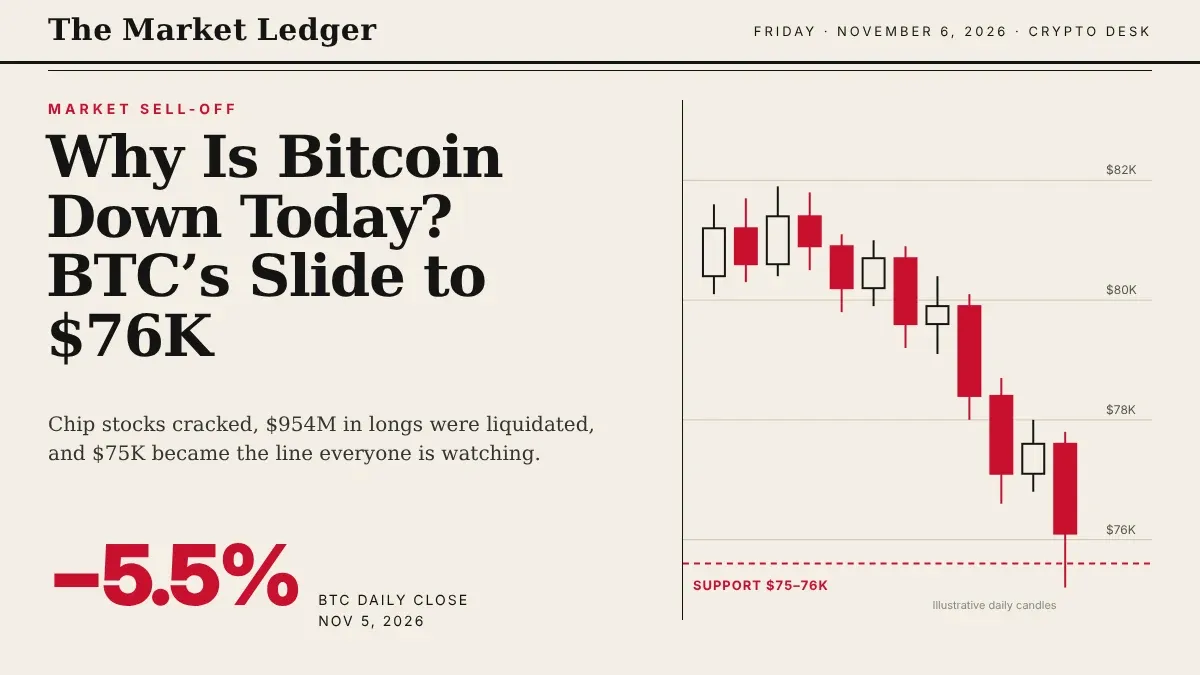
Why Is Bitcoin Down Today? BTC's Slide to $76K Explained
Binance Hack Explained: What the $6.3B Theft Means for Users
CC Spot vs Futures on WEEX: Trading Canton's SEC Headline Risk

How to Buy USOE? What DEX Access Involves, Which Wallet and Contract Risks Apply and What an Exchange Listing Would Require

Is USOE Legit? What the Website Claims, What Independent Sources Found and What Is Still Missing
Crypto Passive Income: What $1,000 Earns in Each WEEX Product
NEAR Protocol HSP-029: Max Issuance Falls From 2.5% to 1.6%, but When Does the Change Take Effect?

SMCI Reports $19.9B Revenue as Margin Falls

NEAR Up 4.8% After HSP-029 Issuance Vote Passes
RUNE Up 7% as THORChain Restores Swaps

What Is USOE (United States Oil Exchange)? Claims, Contract Checks and Liquidity Risks
BTC Price Above $78,000 After the Midterms: What Is Confirmed, What Moved and What to Check Next
StandX Airdrop: Claim Your DUSD and Redeem It Before January 31
WXT Rewards Season 9: How to Claim Your Share of 660,000 WXT

WEEX Rewards Guide: Lucky Eggs Tasks, Prizes and a 22-Day Plan
ONDO Token Unlock Schedule 2026: Is There Another Unlock This Year?

Binance Incident Report: How the Attack Chain Worked and What to Check
What Is Project Cortex (XTX) Crypto? How to Identify the Token Behind the Trending Name
INJ Community BuyBack: What the $247K October Pool Really Means
How Do Pre-IPO Perpetual Futures Allow On-Chain Exposure to OpenAI Stock? 2026
Trade to Earn: How Your Everyday Trades Can Start Earning for You
What Is Injective (INJ) and How Does It Work?
SNDK Crashes 22%: Is the AI Storage Boom Losing Steam?
Circle Revenue Hits $865M, But Can CRCL Sustain Growth?
Contents
Popular coins
Latest articles





