
Binance Hack Explained: What the $6.3B Theft Means for Users

 Prefer us on Google

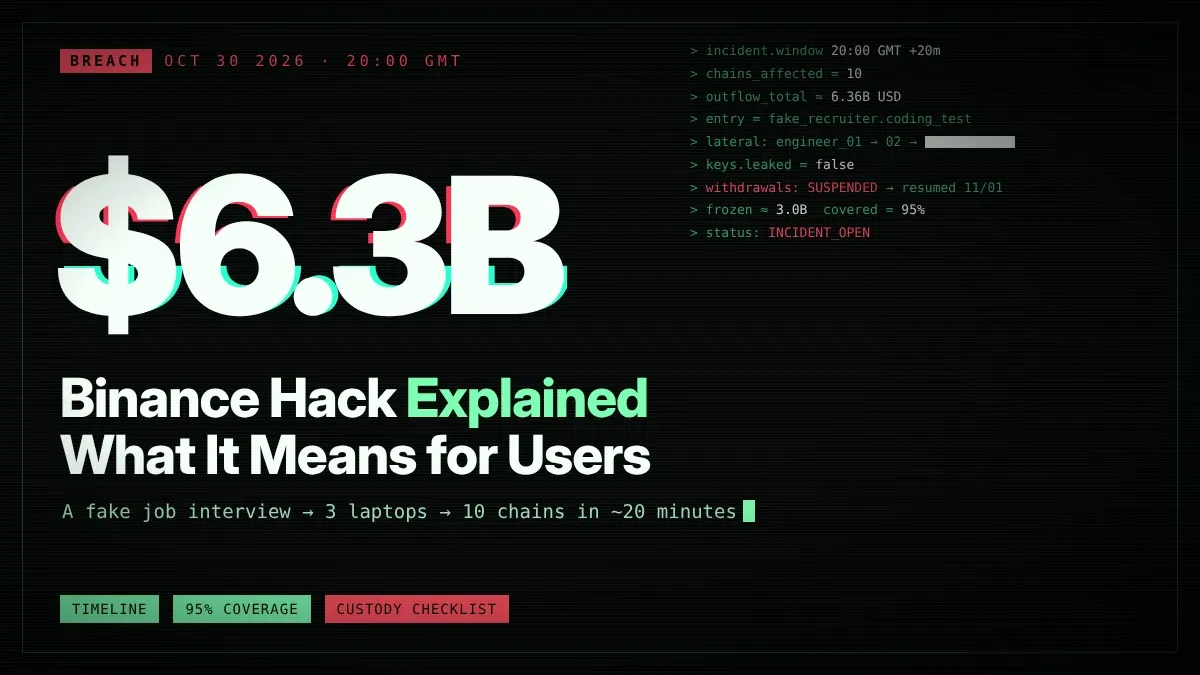
The Binance hack of late October 2026 is the largest crypto theft on record: roughly $6.3 billion left Binance-controlled wallets across 10 blockchains in about 20 minutes, and the attackers got in through a fake job interview, not a broken blockchain. Binance has since resumed withdrawals and says it will cover 95% of the stolen assets. This article walks through how the attack worked, what that 95% pledge does and does not settle, and the custody checks that matter for anyone holding funds on a centralized exchange.
How the Binance Hack Happened: A Recruiter, a Coding Test, Three Laptops
The breach did not start with a smart-contract bug or a cracked private key. According to TechCrunch's reporting on November 3, attackers posing as recruiters approached a software engineer on Binance's wallet team. After two interview rounds, they sent a coding assignment that carried malicious code. Opening it compromised the engineer's work laptop, and Binance says its security tooling did not catch the malware.
That first foothold was only the entry point. From there, the attackers reached an internal tool that could take control of other engineers' machines. A second engineer had earlier installed a tampered app containing password-stealing malware, and those stolen credentials let the attackers move to a third engineer whose computer could reach the systems that control customer crypto.
Binance's early findings point to a compromised DevOps machine giving access to a service container, which was then used to push unauthorized withdrawal transactions. The exchange says it has found no evidence that wallet private keys leaked. That detail matters: the keys held, but the machinery allowed to use them was hijacked.
The FBI and blockchain analysts attribute the attack to North Korea. Blockchain analytics firm TRM Labs names TraderTraitor, a North Korean unit, and puts the outflow at about $6.36 billion. North Korea denies involvement.
The Binance Hack Timeline, in Order
Reporting across outlets is consistent on the sequence, though local-time dates vary by a day depending on the source.
- October 30, shortly after 20:00 GMT: Most of the outflows hit the chain within roughly 20 minutes, across 10 networks.
- Immediately after: Binance suspends deposits and withdrawals while it runs security checks.
- October 31: Binance says about 90% of the stolen user assets are covered.
- November 1: Withdrawals reopen in stages. DefiLlama data cited by BigGo Finance shows net outflows of more than $6.7 billion in the following 24 hours.
- November 2: Binance raises the coverage figure to 95%, funded from its own capital, part of its futures insurance fund, and part of its SAFU user-protection fund. It pledges not to pass losses on to customers.
- November 3: Binance publicly says the attack "should not have happened" and promises an outside security review.
Binance also says it has located and frozen about $3 billion of the stolen funds. Public statements do not account for the remaining $3.3 billion or so, which is the portion most likely already moving through laundering routes.
For scale: TRM counted about $2.9 billion stolen across nearly 150 crypto attacks in the prior year. This single incident is more than twice that.
Are Funds Safe After the Binance Hack? What the 95% Pledge Leaves Open
The headline promise is reassuring, and the fast reopening of withdrawals suggests real liquidity behind it. But three questions remain open as of November 6, 2026, and they are the ones a careful user should weigh.
- 95% of what? Coverage has been described as 95% of stolen assets. On a $6.3 billion base, the uncovered 5% is roughly $315 million. Binance has also pledged not to pass losses to customers, so the gap may be absorbed elsewhere, but the exact mechanics have not been published.
- Who verifies it? Binance has said it will publish a reserves snapshot and a proof-of-reserves report. Critics point out that the company does not release audited financial statements, so outsiders cannot independently confirm how much buffer remains after the payout.
- What about the frozen $3 billion? Frozen is not recovered. Returning those funds typically depends on issuers, other exchanges, and law enforcement cooperating across jurisdictions, and that process can take months.
The more useful reading is this: the coverage pledge addresses the immediate solvency question, but the incident's real lesson is about operational security. Every exchange depends on people, laptops, and internal tools, and that layer is now the attack surface North Korean groups target first.
-- Price
What Experienced Traders Check Before Leaving Funds on Any Exchange
The Binance hack is a reminder that "not your keys, not your coins" is an operational risk, not a slogan. People rarely lose money in these events because a chain breaks. They lose it when a platform freezes withdrawals at the wrong moment, or when the loss is larger than the platform's buffer.
A practical checklist, which applies to every centralized platform:
- Look for current proof of reserves. A reserves report should show customer liabilities matched by on-chain assets, with a date and a block height. On WEEX, the proof of reserves page lists the exchange's reserve disclosures alongside its 1,000 BTC protection fund.
- Check whether a protection fund exists and can be verified. A fund that is announced but not addressable on-chain is a marketing claim, not a backstop.
- Keep only trading balances on exchange. Long-term holdings belong in self-custody, where an exchange-side breach cannot freeze them.
- Expect withdrawal queues after any incident. The $6.7 billion in net outflows after Binance reopened shows how fast users rush the exit, and queues can stretch for hours or days.
- Watch the platform token. Exchange tokens tend to absorb incident risk first. BNB, for reference, was quoted at $693.67 on the WEEX BNB price page as of 04:46 UTC on November 6, 2026.
Binance Hack: The Bottom Line
The Binance hack rewrote the record book, but its mechanism is familiar: social engineering against an employee, then lateral movement to the systems that sign withdrawals. Binance's 95% coverage pledge and staged reopening contain the damage for now, while the uncovered amount, the fate of the frozen $3 billion, and the lack of audited financials keep the story open.
For users, the takeaway is about habits more than headlines. Split trading balances from long-term holdings, check reserve disclosures before depositing, and treat any platform's protection fund as something to verify rather than assume. If you are reviewing where to trade, start with WEEX's published reserve and protection-fund disclosures.
FAQ
1. How much was stolen in the Binance hack?
About $6.3 billion, according to Binance. TRM Labs puts the outflow at roughly $6.36 billion across 10 blockchains, which makes it the largest crypto theft on record.
2. Who was behind the Binance hack?
The FBI and blockchain investigators attribute it to North Korea, and TRM Labs names the TraderTraitor group. North Korea denies involvement.
3. Did Binance users lose their money?
Binance says it will cover 95% of the stolen assets using its own funds, part of its futures insurance fund, and its SAFU fund, and has pledged not to pass losses to customers. How the remaining 5% is handled has not been detailed as of November 6, 2026.
4. Are Binance withdrawals working again?
Yes. Withdrawals reopened in stages starting November 1, 2026, about three days after they were suspended, with more Ethereum and Solana tokens restored in the following days.
This content is provided for general informational purposes only and doesn't constitute financial, investment, legal, or tax advice. Any events, rewards, online promotions, or related information mentioned herein should not be considered a recommendation, solicitation, or invitation to purchase, sell, trade, or otherwise deal in any crypto assets. Crypto assets are highly volatile and may result in loss. The availability of WEEX services, products, and related events may vary by region. You are responsible for ensuring that your participation is in accordance with applicable local laws and regulations.
You may also like
Is GM on BSC a CZ Token? What Is Confirmed and What Is Not
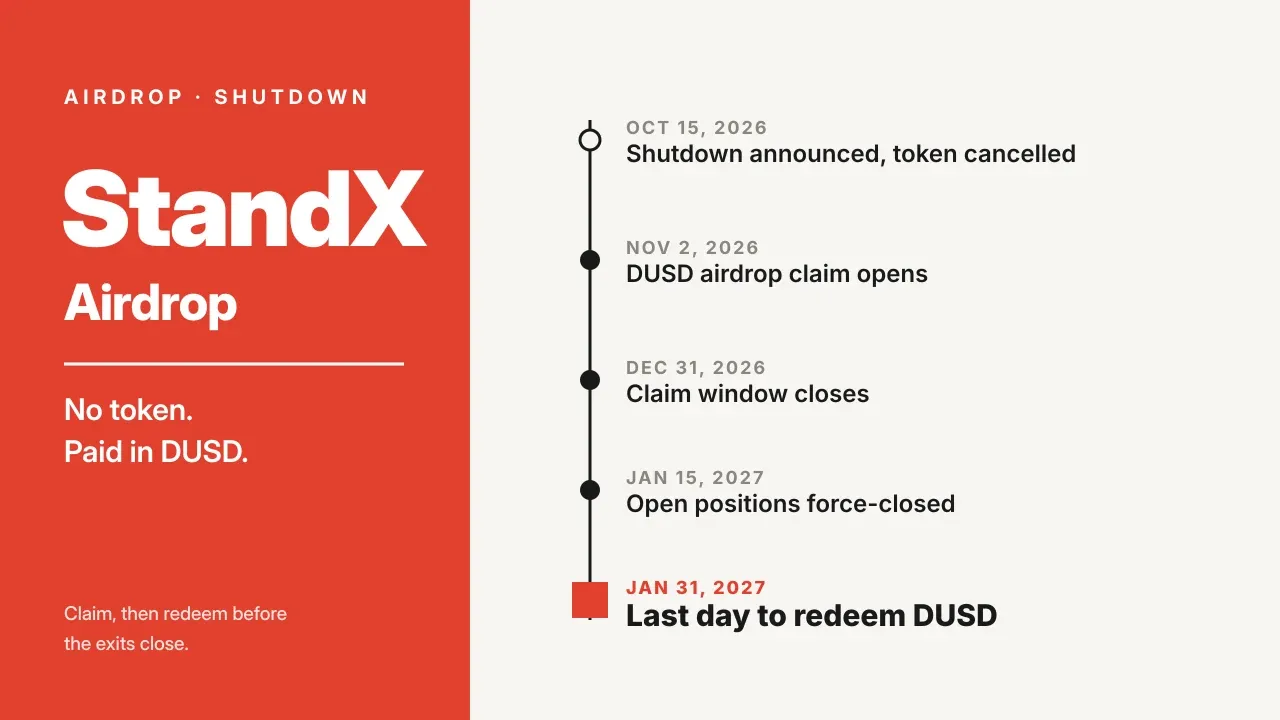
StandX Airdrop: Claim Your DUSD and Redeem It Before January 31
BNB Down 2%: Binance Verifies Reserves for 10 Assets
Binance Hack Scams: How to Spot Fake Refund and Recovery Offers
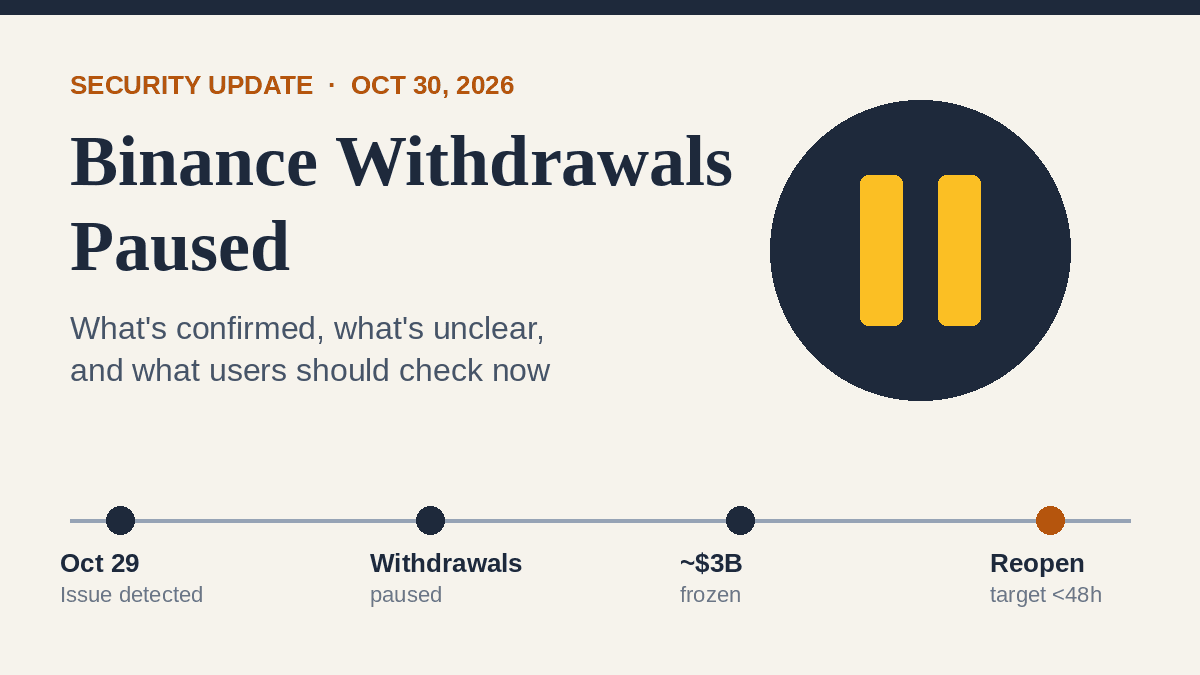
Binance Withdrawals Paused: What Users Should Check Right Now

Is XTruth Oil (XTO) a Stock or Crypto? How Its Oil Rewards Actually Work
Which Cryptocurrencies Can You Convert on WEEX? How to Check Supported Assets

Macro Protocol (MTP): Listing Status and a Safe Verification Guide

What Is ArithFi (ATF)? Why It Is Not Listed on WEEX

What Is Trust Wallet? A Complete Beginner's Guide
Hunter Biden's Laptop Token Is Now Live on Base: Watch Out for Copycat Tokens

What Is Niulai Coin? How a 342 Yuan Chinese Animated Film Spawned a Viral BNB Chain Meme Token

What is BINANCELIFE (BINANCELIFE) Coin?
What is BNB SZN (SZN) Coin?
What is BNB SZN (SZNBSC) Coin?
What is BNB Upside Down (PUP) Coin?
With OpenClaw taking the world by storm, what can the Agentic economy bring to Web3?
What Is Audiera (BEAT)? Audiera (BEAT) Price Prediction 2025–2030
What is OASIS Coin? OASIS Price Analysis
What is AgentLISA (LISA) and How Does It Work?
What Is Lucidum (LUCIC)?
What is 黄果之年 (YEAROFYELLOWFRUIT)? The New Trending Chinese Meme Coin
ASTER Airdrop on WEEX Exchange: Claim Your Share of 50,000 USDT in the New User Welcome Reward
What Is APRO (AT) and How Does It Work?
Is GM on BSC a CZ Token? What Is Confirmed and What Is Not
StandX Airdrop: Claim Your DUSD and Redeem It Before January 31
BNB Down 2%: Binance Verifies Reserves for 10 Assets
Binance Hack Scams: How to Spot Fake Refund and Recovery Offers
Binance Withdrawals Paused: What Users Should Check Right Now
Is XTruth Oil (XTO) a Stock or Crypto? How Its Oil Rewards Actually Work


