
Circle Revenue Hits $865M, But Can CRCL Sustain Growth?

 Prefer us on Google

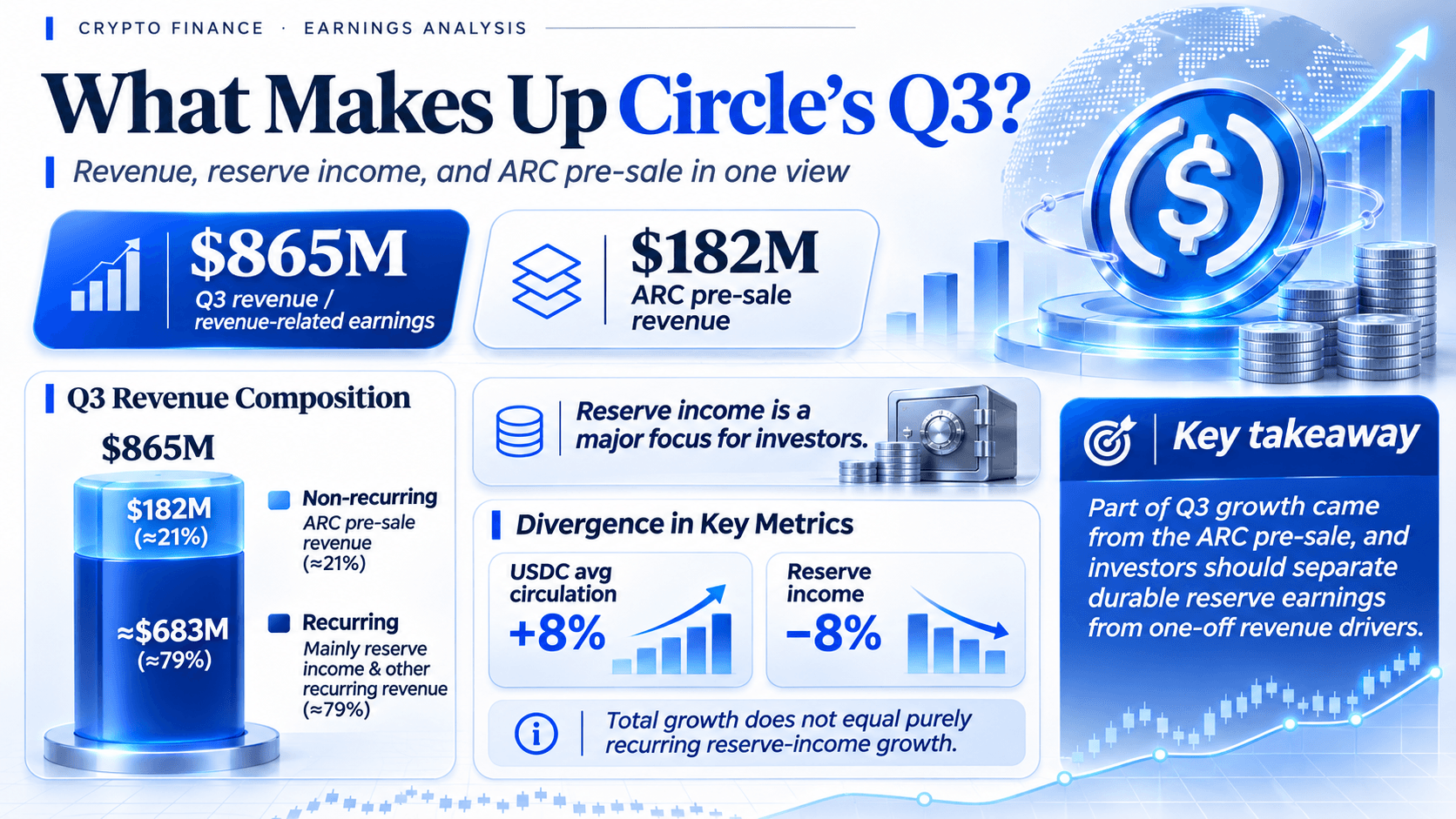
Circle Q3 earnings revealed a striking contrast between headline revenue growth and the underlying economics of the USDC stablecoin business. Circle Internet Group (NYSE: CRCL) reported approximately $865 million in total revenue and reserve income for the third quarter of 2026, up 17% year over year, but the figure included around $182 million in recognized Arc token presale revenue.
Announced on November 4, the Circle Q3 earnings report showed average USDC circulation climbing 8% to $73.3 billion. Nevertheless, reserve income declined approximately 8% to $658 million, reflecting the pressure of lower yields on the assets backing USDC.
That divergence makes the Circle Q3 earnings particularly important for understanding CRCL's business model. The company's reported growth remains substantial, yet investors must distinguish recurring reserve economics from revenue recognized through specific Arc presale arrangements.
According to a WEEX market snapshot recorded on November 5 at 16:38 Beijing time, the CRCL stock-related product showed a closed-market reference price of 76.01 USDT. The CRCL/USDT perpetual futures quotation was approximately 75.72 USDT at 16:39, with a 24-hour change of +0.19%. These are historical quotations for different products, not current CRCL share prices.
The key question is whether Circle can build a more diversified, durable revenue model while USDC adoption continues expanding.
What Did Circle Report in Q3 2026?
According to Circle's official Q3 2026 results filed with the SEC, the company's total revenue and reserve income rose from approximately $740 million a year earlier to $865 million.
Adjusted EBITDA increased to $317 million, while net income from continuing operations reached $226 million. However, the composition of revenue changed materially during the quarter.
| Financial Metric | Q3 2026 | Comparison or Context |
|---|---|---|
| Total revenue and reserve income | $865M | +17% YoY |
| Reserve income | $658M | Approximately -8% YoY |
| Other revenue | $207M | Includes Arc token presales |
| Recognized Arc presale revenue | $182M | Included in the $207M |
| Revenue excluding Arc presales | Approximately $683M | Analytical subtraction, not separate GAAP revenue |
| Adjusted EBITDA | $317M | +85% YoY |
| Average USDC circulation | $73.3B | +8% YoY |
| USDC on-chain transaction volume | $13.9T | +49% YoY |
Source: Circle Q3 2026 earnings release and investor presentation. Figures rounded. The revenue excluding Arc figure is calculated from disclosed totals.
The headline numbers demonstrate that Circle's business is becoming more diversified. Yet they also show why revenue quality matters: a quarter supported by transaction-specific token sales may not be directly comparable with one driven primarily by reserve interest.
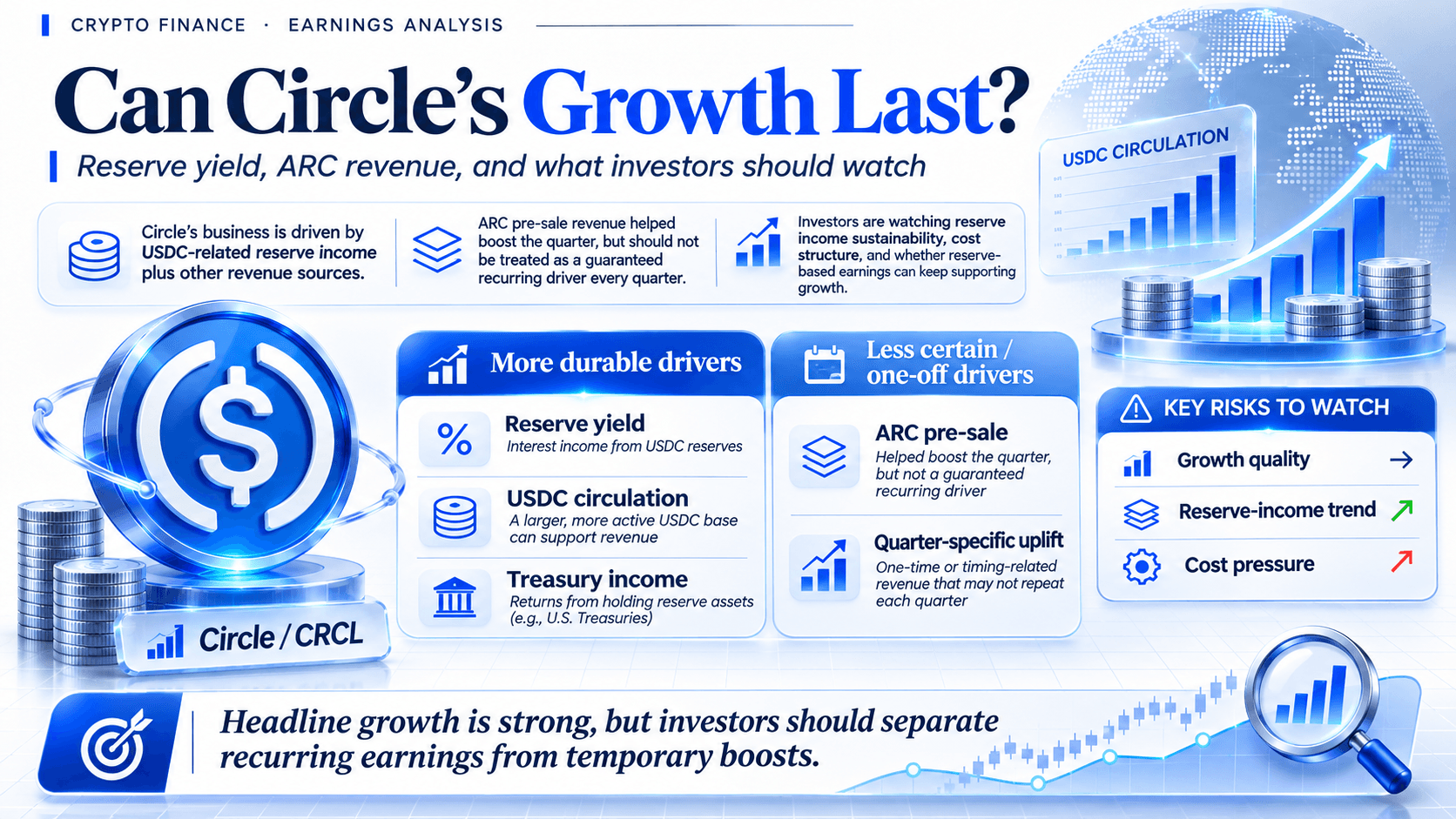
How Much Did Arc Contribute to Revenue?
Circle recognized approximately $181.8 million from Arc token presale arrangements in Q3, accounting for roughly 21% of total reported revenue and reserve income.
Without that contribution, the remaining reported total would have been approximately $683 million.
This calculation does not imply that Arc revenue is invalid or should be removed from official accounts. Instead, it separates a significant new component so that investors can better evaluate the underlying reserve business.
Recognition of presale revenue depends on contractual conditions and accounting treatment. The fact that revenue was recognized this quarter does not guarantee that an equivalent amount will appear in subsequent quarters.
Did Profitability Improve?
Circle reported adjusted EBITDA of $317 million, representing an 85% year-over-year increase.
However, adjusted EBITDA is a non-GAAP measure and should be interpreted alongside net income, operating costs and the underlying revenue composition.
Circle's investor presentation also shows approximately $135 million in adjusted EBITDA when the Arc presale contribution is excluded through a simplified reconciliation.
This illustrates how a large revenue-recognition event can materially influence a company's adjusted performance.
Why Did Circle's Reserve Income Fall Despite USDC Growth?
Circle earns much of its income from cash and highly liquid reserve assets held to support USDC.
When institutions create new USDC through Circle's issuance framework, corresponding reserve assets are maintained under the applicable arrangements. Interest generated by these assets contributes to Circle's financial performance.
For a detailed explanation of the business model, see WEEX Learn's How Do Stablecoin Issuers Make Money?.
Two variables are especially important: the average amount of reserves held and the yield those reserves generate.
Higher Circulation Does Not Guarantee Higher Income
Average USDC circulation increased 8% year over year to $73.3 billion.
Yet reserve income fell from approximately $711 million to $658 million.
The main distinction is that USDC circulation measures the amount of stablecoins outstanding, while reserve income depends on both reserve balances and prevailing investment yields.
When yields decline, higher stablecoin circulation may not fully compensate for the lower amount earned per dollar of reserves.
Consequently, a growing USDC ecosystem and declining reserve revenue can occur at the same time.
What Happens if Interest Rates Keep Falling?
Lower short-term interest rates can put additional pressure on the returns earned from reserve assets.
Circle may respond through larger reserve balances, distribution improvements or new sources of revenue, but those developments cannot be assumed to offset every rate change.
The company's exposure to interest rates is an important part of the CRCL investment thesis.
A broader WEEX analysis, Circle: From Issuance to Infrastructure, examines the strategic challenge of reducing dependence on reserve yields.
Why Do USDC Distribution Costs Matter?
Circle's reserve income is not equal to the profit retained by the company.
USDC reaches users through exchanges, wallets, financial institutions and other distribution partners. Some partners receive compensation under commercial arrangements.
In Q3, Circle reported approximately $409 million in distribution and transaction costs, with total distribution, transaction and other costs of roughly $412 million.
These costs reduce the economic value Circle retains from its reported revenue.
Understanding Net Reserve Margin
Net reserve margin compares reserve income with the amount retained after relevant distribution and transaction costs.
Circle reported a net reserve margin of approximately 38% for Q3 2026.
A lower reserve yield can create pressure on this margin, especially when distribution agreements limit how quickly partner-related costs adjust.
This explains why investors should look beyond both total USDC supply and gross reserve income.
Can Greater USDC Adoption Improve Margins?
Additional USDC distribution can help expand Circle's ecosystem and support larger reserve balances.
However, new distribution arrangements may also require compensation for partners.
Whether scale improves profitability depends on the economics of those arrangements, not simply on the number of USDC transactions.
The company's challenge is to expand adoption while improving the amount of value it captures from the ecosystem.
-- Price
Can Arc Become a Sustainable Revenue Source?
Arc is part of Circle's effort to expand beyond stablecoin issuance into blockchain-based financial infrastructure.
The project seeks to support applications such as payments, settlement and other financial transactions.
The recognized token presale revenue gave Arc a substantial role in Circle's Q3 reported results.
However, token presales and recurring network activity represent different commercial models.
Presale Revenue Versus Recurring Revenue
A token presale can produce revenue when the relevant recognition conditions are satisfied.
Recurring business revenue typically requires ongoing customer payments, network activity or service usage that continues across multiple periods.
Future Arc development may create opportunities for recurring commercial activity, but investors must wait for evidence of actual adoption and monetization.
It would be misleading to assume that every quarter will contain another $182 million in similar recognized revenue.
What Would Demonstrate Long-Term Arc Adoption?
Useful indicators include real application deployments, active customers, sustainable transaction activity, operational fees and the costs associated with running the infrastructure.
These metrics could eventually help investors determine whether Arc is developing into an independent business rather than primarily an ecosystem development initiative.
Circle's ability to convert infrastructure adoption into durable earnings will remain a key question in future financial reports.
Is USDC Adoption Still Growing?
Despite pressure on reserve income, USDC activity continued to expand across several indicators.
Average circulation rose 8% year over year, while quarterly on-chain transaction volume increased 49% to approximately $13.9 trillion.
The two metrics measure different things.
Circulation represents the amount of USDC outstanding. Transaction volume represents assets transferred across supported networks during a given period.
A stablecoin can be used repeatedly without creating an equivalent amount of new reserve income.
For readers exploring its underlying mechanism, WEEX's USDC Explained: Issuance, Reserves and Cross-Chain Transfers covers how native USDC is issued, backed and moved across blockchain networks.
Could Payment Services Diversify Circle's Business?
Circle Payments Network reported approximately $41.3 billion in annualized payment volume during the quarter.
This indicates activity across the payment infrastructure, but payment volume should not be confused with recognized revenue.
Circle also announced plans to acquire Tazapay, subject to closing conditions, as part of its broader payments strategy.
The commercial significance of these initiatives will depend on future customer adoption, transaction economics and operating performance.
What Should CRCL Investors Watch Next?
Circle's financial outlook depends on several variables that can move in different directions.
Reserve yields: Continued changes in short-term interest rates could affect income earned on USDC backing assets.
USDC circulation: Growth in the circulating supply may help expand reserve balances, but the relationship with revenue is not one-to-one.
Distribution economics: Partner compensation and transaction costs affect the amount of income Circle retains.
Arc monetization: Future results should distinguish specific token-related revenue recognition from repeatable commercial activity.
Payments adoption: New infrastructure must generate sustainable economic value before it can meaningfully reduce dependence on reserve income.
Valuation: CRCL's share price may reflect expectations about future growth that differ significantly from current financial performance.
Understanding these factors is more useful than treating 17% headline revenue growth as a complete measure of business quality.
How to Trade CRCL-Related Products on WEEX
WEEX provides stock-related and perpetual futures products associated with selected U.S.-listed companies, including Circle.
These products are not necessarily equivalent to purchasing ordinary shares through a securities broker.
Step 1: Access Your WEEX Account
Sign in to your account and complete the applicable verification requirements.
Check that CRCL-related products are supported in your jurisdiction.
Step 2: Prepare Your Trading Balance
Ensure the relevant account contains sufficient USDT or supported collateral.
Review available products and market conditions before attempting a transaction.
Step 3: Choose the CRCL Market
To explore stock-linked exposure, visit the CRCL stock-related trading page on WEEX.
Eligible users interested in derivatives can review the CRCL/USDT perpetual futures market.
The futures interface references a Circle-related tokenized stock product associated with Ondo. This is a derivative product, not a direct purchase of Circle common stock.
Step 4: Review Product Terms and Risks
Check the live quotation, order type and available liquidity.
Stock tokens and perpetual futures may differ in pricing, trading hours, fees, shareholder rights and exposure structure.
Futures also introduce leverage, funding, margin and liquidation risks.
WEEX's Tokenized Stocks Explained provides more information about the rights and limitations of stock-linked tokens.
Step 5: Confirm and Monitor
Review the transaction details before placing an order.
After execution, monitor the position and relevant company announcements.
Earnings releases can create sharp market moves, so historical reference prices should not be treated as current executable quotations.
Conclusion
Circle's Q3 2026 results revealed a business expanding beyond traditional USDC reserve economics.
Total revenue and reserve income reached $865 million, up 17% year over year, while USDC transaction activity continued to grow.
However, approximately $182 million came from Arc token presale revenue, and reserve income declined despite higher average USDC circulation.
The central question for CRCL investors is whether Circle can turn growing infrastructure adoption into durable earnings that offset changes in reserve yields and distribution costs.
Future results will provide a clearer test of that strategy than one quarter's headline revenue alone.
FAQ
1. How Much Revenue Did Circle Report in Q3 2026?
Circle reported approximately $865 million in total revenue and reserve income, an increase of 17% year over year.
2. Why Did Circle's Reserve Income Fall?
Reserve income declined approximately 8% despite higher average USDC circulation, mainly reflecting lower yields on reserve assets.
3. How Much Did Arc Contribute to Circle's Q3 Revenue?
Circle recognized approximately $182 million from Arc token presales. This amount was already included in its reported revenue total.
4. Does Higher USDC Circulation Guarantee Higher Circle Profits?
No. Profitability also depends on reserve yields, distribution costs, operating expenses and income from other products.
5. Are WEEX CRCL Products Equivalent to Owning Circle Shares?
No. Stock-linked tokens and perpetual futures have their own product structures and rights. Users should review the relevant terms before trading.
This content is provided for general informational purposes only and doesn't constitute financial, investment, legal, or tax advice. Any events, rewards, online promotions, or related information mentioned herein should not be considered a recommendation, solicitation, or invitation to purchase, sell, trade, or otherwise deal in any crypto assets. Crypto assets are highly volatile and may result in loss. The availability of WEEX services, products, and related events may vary by region. You are responsible for ensuring that your participation is in accordance with applicable local laws and regulations.
You may also like
INJ Staking ETF Goes Live: Can 90% Staking Drive Demand?

SNDK Crashes 22%: Is the AI Storage Boom Losing Steam?

Is GM on BSC a CZ Token? What Is Confirmed and What Is Not

What Is GM on BSC? GREEN MORNING Jumps Over 400% on a Reported Musk–CZ Meme Moment
Polygon Proposes Hard Fork to Recover 70.49M POL
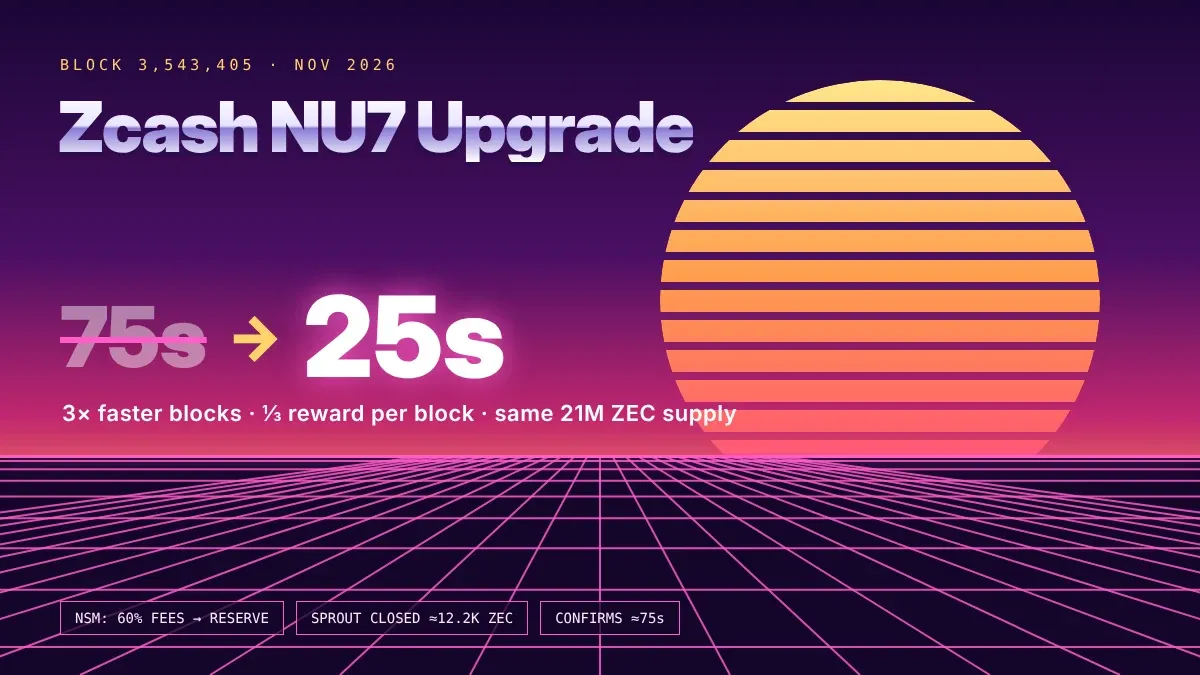
Zcash NU7 Upgrade: 25-Second Blocks, Same 21M ZEC Supply
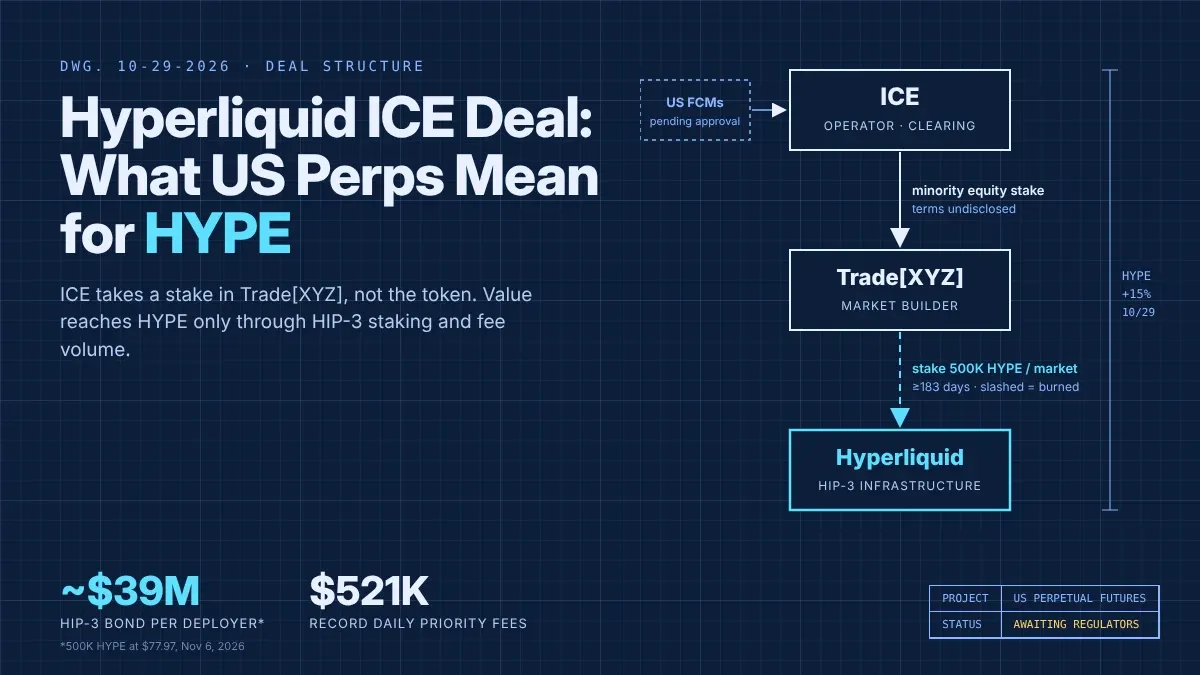
Hyperliquid ICE Deal: What US Perps Mean for HYPE Holders
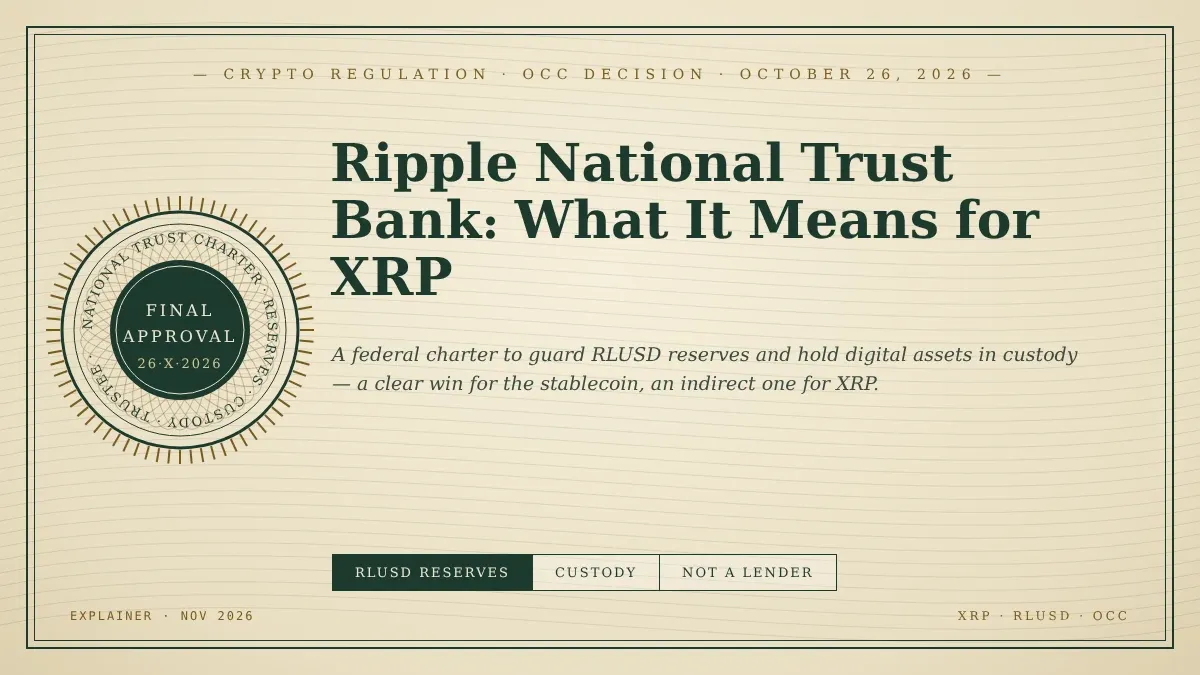
Ripple National Trust Bank: What OCC Approval Means for XRP
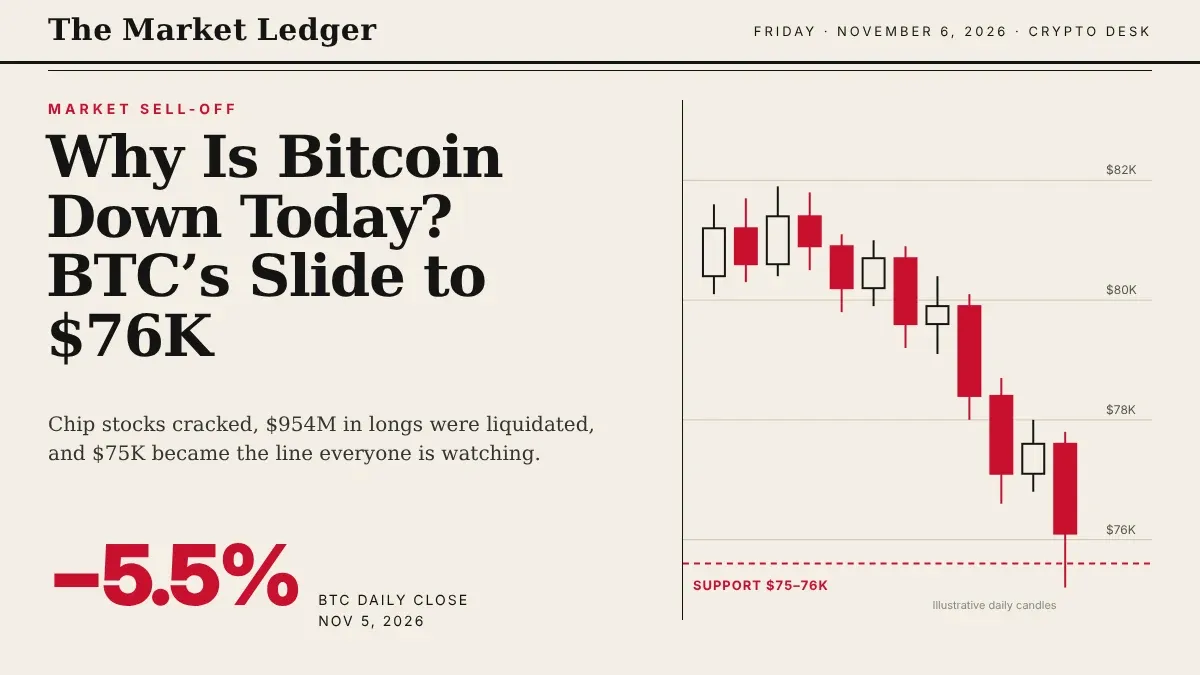
Why Is Bitcoin Down Today? BTC's Slide to $76K Explained
Binance Hack Explained: What the $6.3B Theft Means for Users
CC Spot vs Futures on WEEX: Trading Canton's SEC Headline Risk

How to Buy USOE? What DEX Access Involves, Which Wallet and Contract Risks Apply and What an Exchange Listing Would Require

Is USOE Legit? What the Website Claims, What Independent Sources Found and What Is Still Missing

Crypto Passive Income: What $1,000 Earns in Each WEEX Product
NEAR Protocol HSP-029: Max Issuance Falls From 2.5% to 1.6%, but When Does the Change Take Effect?
SMCI Reports $19.9B Revenue as Margin Falls

NEAR Up 4.8% After HSP-029 Issuance Vote Passes
RUNE Up 7% as THORChain Restores Swaps

What Is USOE (United States Oil Exchange)? Claims, Contract Checks and Liquidity Risks
BTC Price Above $78,000 After the Midterms: What Is Confirmed, What Moved and What to Check Next
StandX Airdrop: Claim Your DUSD and Redeem It Before January 31
WXT Rewards Season 9: How to Claim Your Share of 660,000 WXT

WEEX Rewards Guide: Lucky Eggs Tasks, Prizes and a 22-Day Plan
ONDO Token Unlock Schedule 2026: Is There Another Unlock This Year?

Binance Incident Report: How the Attack Chain Worked and What to Check

What Is Project Cortex (XTX) Crypto? How to Identify the Token Behind the Trending Name

Is United States Oil Exchange (USOE) Really Oil-Backed? Reserve Claims and Token Holder Rights

USDC vs USDT Interest Rates 2026: Which Stablecoin Earns More?

AAPL Stock After Earnings: Why Apple Shares Fell Despite Record Revenue and What the Margin Guidance Means
FOMC Meeting December 2026: Date, Schedule and What to Know Before the Rate Decision
INJ Staking ETF Goes Live: Can 90% Staking Drive Demand?
SNDK Crashes 22%: Is the AI Storage Boom Losing Steam?
Is GM on BSC a CZ Token? What Is Confirmed and What Is Not
What Is GM on BSC? GREEN MORNING Jumps Over 400% on a Reported Musk–CZ Meme Moment
Polygon Proposes Hard Fork to Recover 70.49M POL
Zcash NU7 Upgrade: 25-Second Blocks, Same 21M ZEC Supply





