
Trump Admin's $950 Million Bet on Oil Price Plunge Before Ceasefire Turned Crude Market into Insider Trading Heaven

 Prefer us on Google


On Tuesday, April 7, 2026, at 19:45 GMT, just under three hours from when Trump announced the U.S.-Iran "two-week ceasefire" on Truth Social, a London trader was logging off while Asian traders were not yet in. Typically, only a few hundred contracts of crude oil futures would change hands in a minute during this lull period. However, during this hour, someone unloaded approximately 6,200 lots of Brent crude oil and 2,400 lots of WTI crude oil futures in quick succession, totaling 8,600 lots with a notional value of around $950 million.
The next day, as the Asian session opened, crude oil prices plummeted by about 15%, with WTI dropping below $100. According to Reuters citing LSEG's transaction data, the scale of this short position was "entirely atypical for that time window." Congressman Ritchie Torres penned a letter to the U.S. SEC and CFTC on April 8, requesting an investigation.
This wasn't the first time. More precisely, it was the second recorded instance of the same "playbook" amid the U.S.-Iran conflict.
The same trading signature, hitting the mark twice
The earlier instance on Monday morning, March 22, 2026, didn't gain the same notoriety as the April 7 event because it didn't cause a significant price drop. However, structurally, it was the prototype of this "playbook." As per CBS News and Financial Times-cited trading data, between 6:49 and 6:50 Eastern Time, or 10:49 GMT, a total of 6,200 lots of Brent and WTI futures were traded, amounting to around $580 million.
Fifteen minutes later, Trump posted on Truth Social, stating he was engaged in "constructive dialogue" with Iran and postponing the planned strike on Iranian energy facilities by five days. Crude oil prices plunged that day, the S&P 500 surged, and the Dow gained over 1,000 points in a single day.
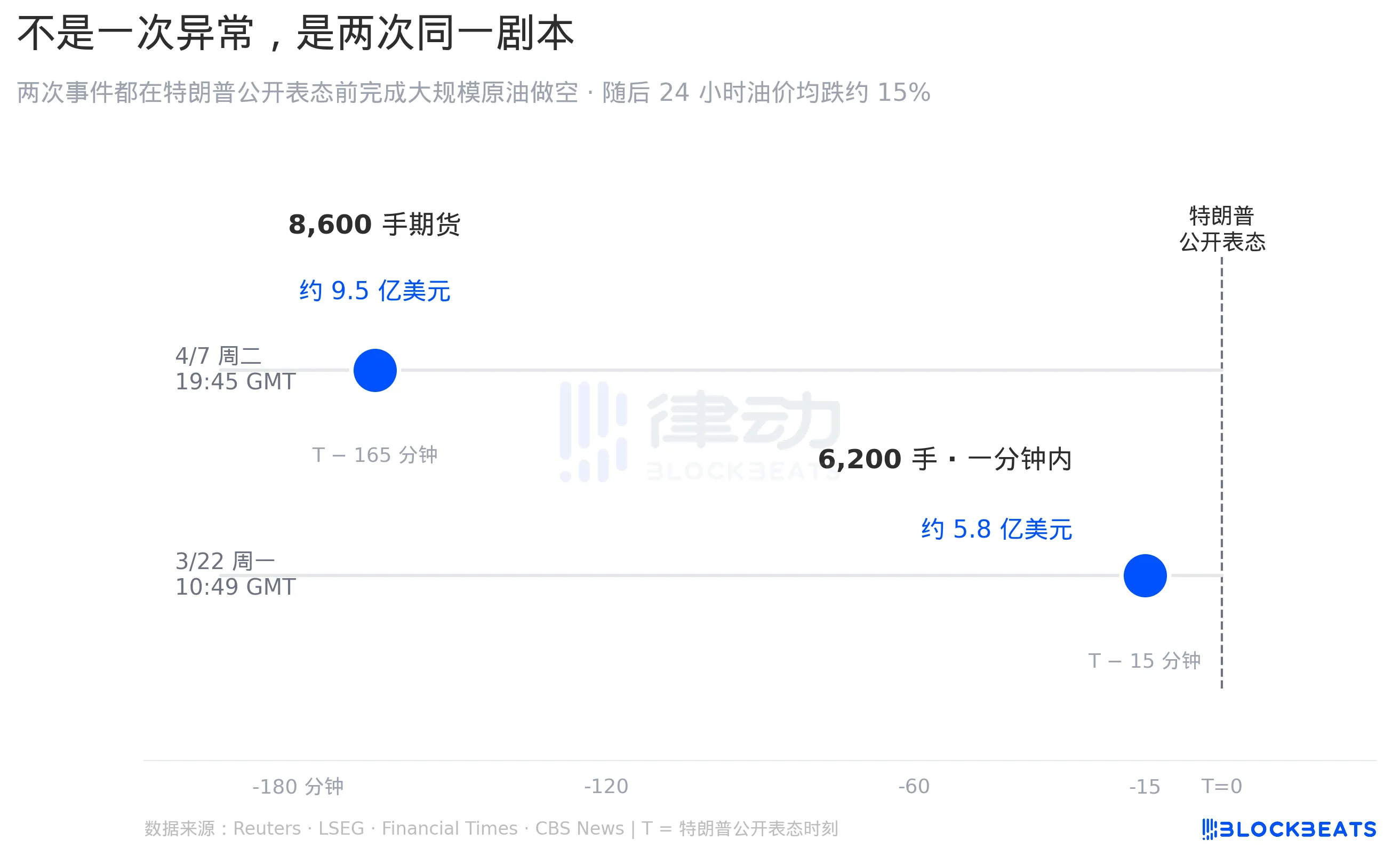
Aligning the timelines of these two events reveals a detail: the "Brent leg" within that 8,600-lot position on April 7 was also exactly 6,200 lots. The repetition of the same number in two entirely different time frames could be a coincidence or an indication of identical position sizing. In trading circles, this type of repetition is called a "signature," referring to a group of traders following a predetermined formula. CBS's report cited two unnamed former CFTC investigators stating that this precise repetition "itself is an investigative signal."
9x the Norm, Happening in an Hour No One Was Watching
Many of the first readers who saw this news thought 19:45 GMT was a "closed market period." It was not. Brent crude oil futures trade almost 24 hours electronically, with only a brief shutdown on weekends. 19:45 GMT marks a more subtle moment. The previous minute (19:28 to 19:30 London time) had just concluded the day's "settlement window," the two minutes the exchange uses to determine the official daily settlement price.
As soon as the settlement window closes, most European professional traders are off work. The Asian trading desks in Tokyo and Singapore won't come online for several hours. This one-hour period is usually one of the least liquid windows of the day. According to ICE's official product specs, Brent's true peak trading volume occurs during the European day session.
If we zoom in on the anomaly of that minute on March 22 and compare, the difference becomes more apparent. According to CBS citing LSEG trade details, the normal trading volume for each minute around that time for the previous and following five days was about 700 contracts. That minute saw 6,200 contracts traded, nearly 9 times the usual amount. The blue bar in the chart represents that minute, while the other gray bars before and after are from the same hour, densely packed at the bottom.
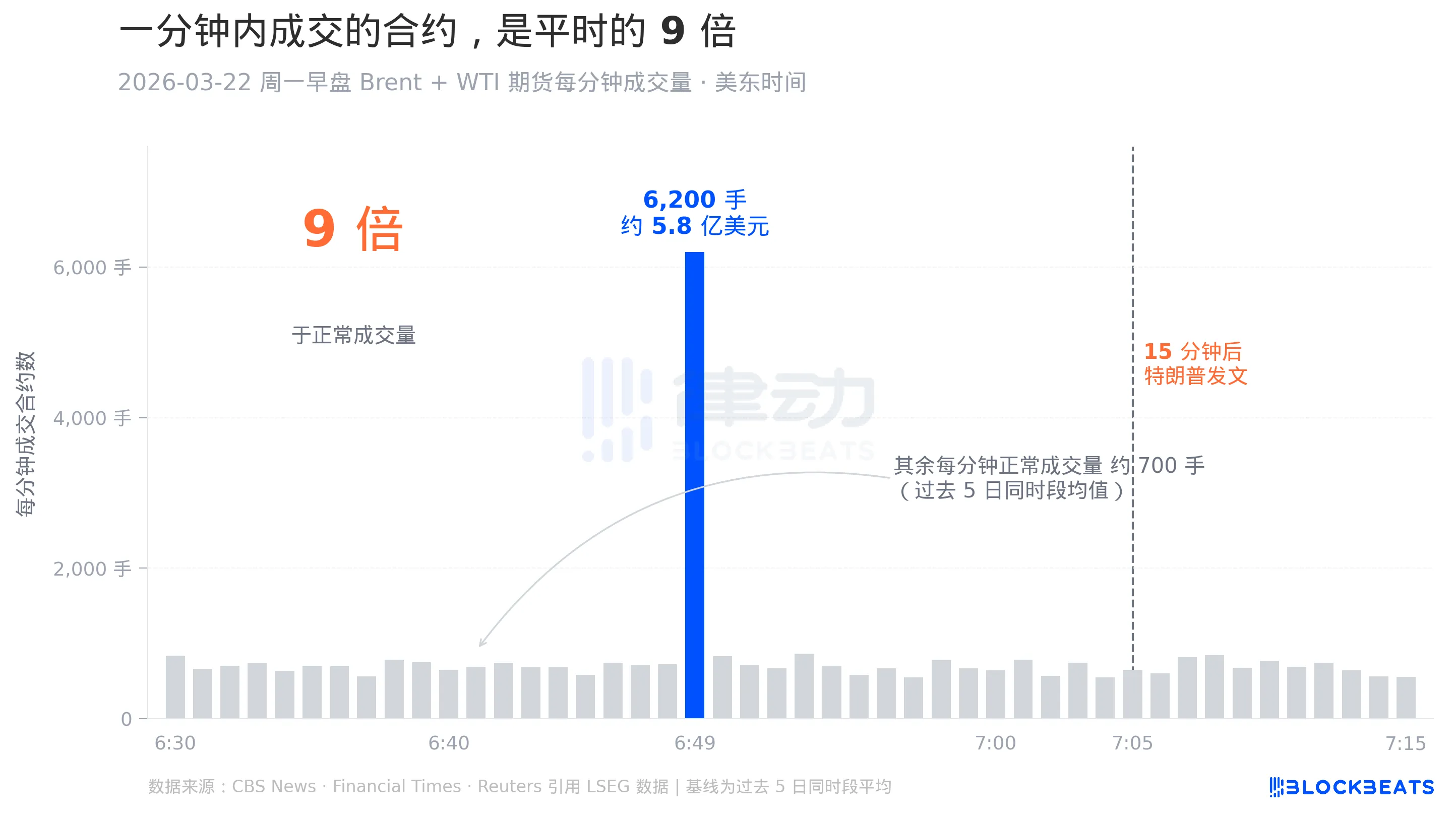
The significance of this comparison is that the 9x surge did not happen during the most liquid trading hours but was concentrated in the thinnest minute of the order book. When writing about this on his Substack, Paul Krugman used a metaphor, saying it was like "honking your horn with no one around on a deserted street at night," either not caring if anyone hears or having a specific reason for acting at that moment.
Three Consistent Trades
This chart shows the other half of the anomaly on March 22 that many reports overlooked. In follow-up articles at the end of March, the Financial Times and Peak Oil mentioned that during the same period as the $580 million crude oil short, there were two other consistent trades: a buy order of approximately $1.5 billion in S&P 500 E-mini futures and an independent short of $192 million on WTI (CL contract).
The "S&P 500 E-mini futures" are the most active stock index futures contract on the exchange, with one contract equating to around $250,000 worth of the S&P 500 index. It is a standard tool for institutions to hedge against the overall direction of the US stock market. "Buying E-mini" is a bet on the US stock market's rise. The "WTI specific short" is an additional short position taken on another futures product line for crude oil (WTI traded in the US). Together, these three trades amounted to a nominal value of around $2.28 billion.
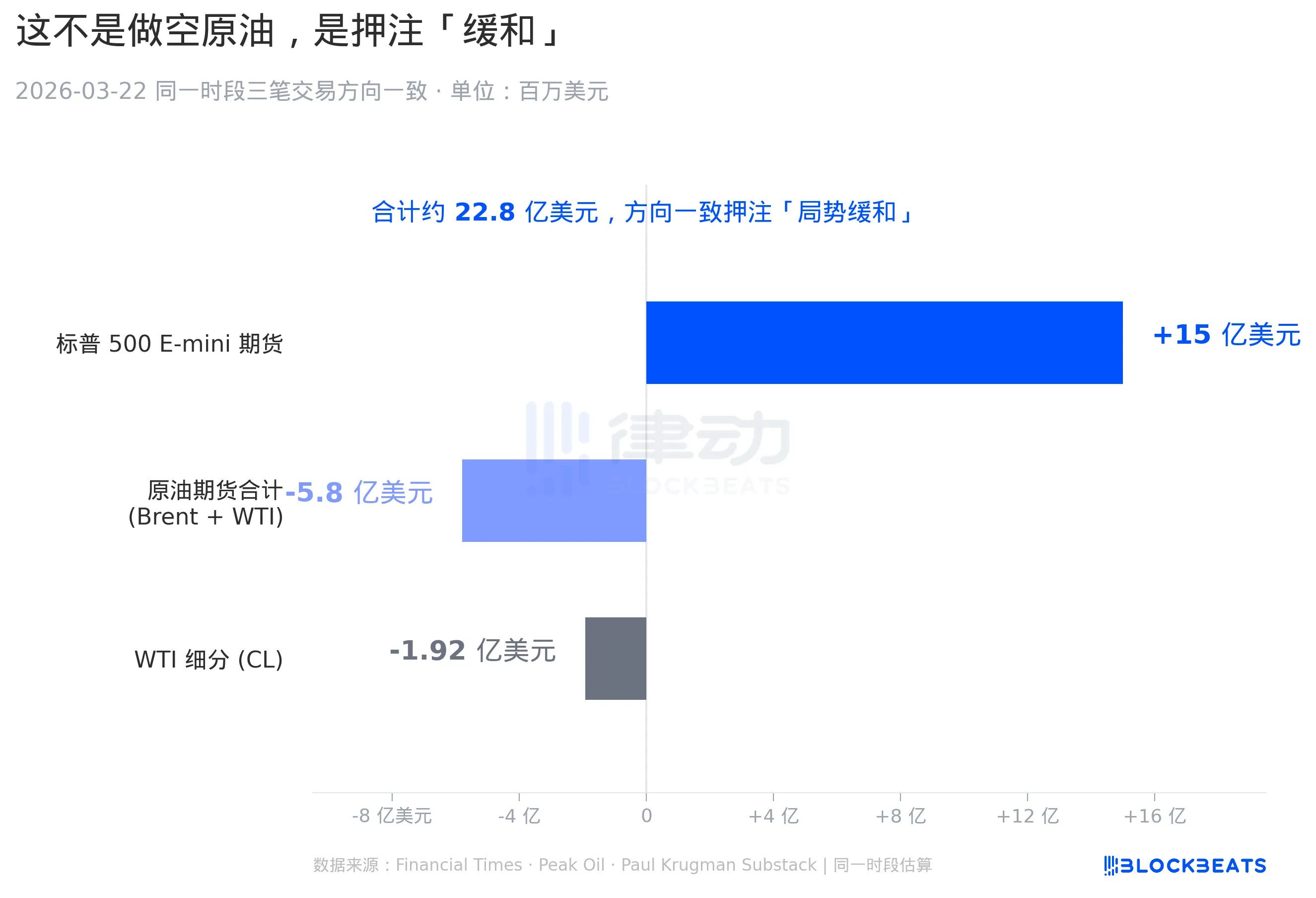
Looking at these three trades together, they appear more like a paired trade, betting on the same macro scenario, which is the easing of US-Iran tensions. How would easing affect the market? The oil supply panic subsides, leading to a fall in oil prices. Geopolitical risk premium diminishes, resulting in a stock market rebound. Combining these three positions creates the cleanest profit combination in this scenario. To paraphrase Paul Krugman, "If you know you will see the words 'constructive dialogue' two hours later, these are the three trades you would make."
-- Price
The Same Script, Also Seen in Prediction Markets
Shifting focus from the futures market to the crypto world's prediction market Polymarket reveals an almost identical mirror image.
Polymarket is a binary prediction market platform built on Ethereum, where users bet on whether an event will occur, with odds determined by market participants themselves. After the event's outcome is confirmed, winners receive a payout. All its transactions are on-chain, and anyone can view the history of each wallet.
According to on-chain data cited by StockTwits, in the final week of the "Will there be a ceasefire between the US and Iran within 30 days on Polymarket" contract, there were 8 accounts with a "normal profile," all being publicly known old accounts, collectively wagering around $70,000. There were wins and losses, and the settlement process had no suspicious points. However, at the same time, 4 other accounts had completely different profiles. These 4 wallets were newly created just before the event, with no prior on-chain transaction history. Their first action upon entry was to heavily bet on "there will be a ceasefire" at very low odds, and in the end, they all won, collectively making over $600,000 in profit.
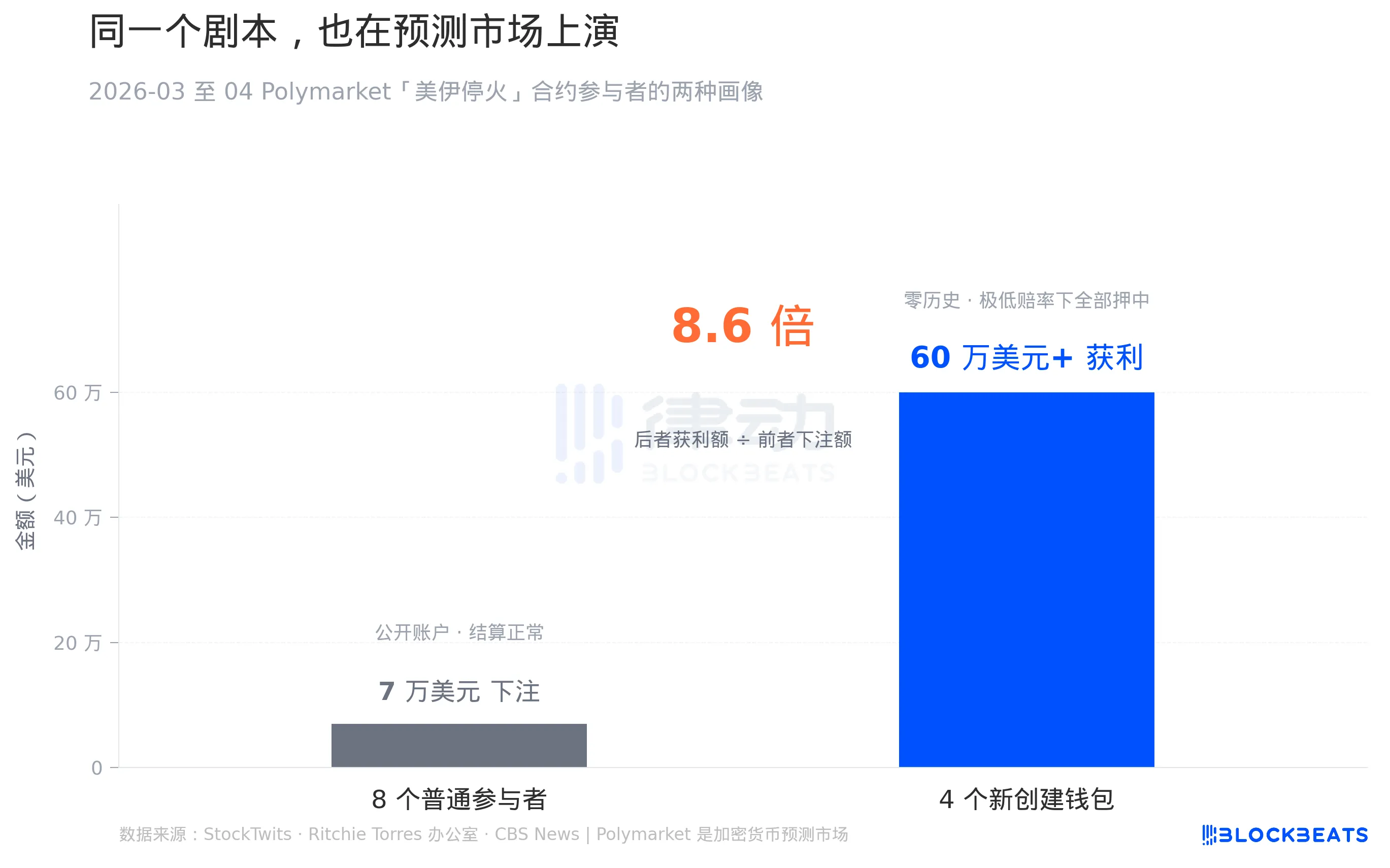
From $70,000 to $600,000, the multiplier in between is 8.6 times, with the latter's profit being nearly nine times the total amount wagered by the former. According to Polymarket's own settlement rules, the winner's amount = bet amount × reciprocal of odds. To earn $600,000 in a week, these 4 wallets either placed a heavy bet at a very low odds point (indicating a high market belief in "no ceasefire"), or they diversified their bets multiple times, with on-chain data indicating the former.
Ritchie Torres's office mentioned this detail in a letter to the SEC and CFTC, aligning it with the anomalous behavior in crude oil futures as evidence of a "cross-market synchronous signal." This is why Torres already introduced legislation against insider trading in prediction markets around the end of March. For him, the crude oil futures side was not an isolated incident.
Will There Really Be an Investigation?
Let's first examine the reality at the federal level. According to the SEC's Enforcement Report for FY 2025 released in early April, the past year saw 313 new SEC enforcement actions, the lowest point in the past decade, a 27% decrease from the 583 cases in FY 2024. On the CFTC side, there was no simultaneous release of an equivalent annual report, but in early April, the law firms Sullivan & Cromwell and Skadden, which track CFTC enforcement trends, noted in their comments that the CFTC's enforcement division had significantly slowed down at the beginning of 2025.
However, just about a week before Torres wrote his letter, the CFTC had announced the 5 key enforcement priorities for FY 2026. According to Sullivan & Cromwell's analysis, the top priority is "Insider Trading, including Market Manipulation," and the second is "Market Manipulation, particularly in the energy markets."
The subtlety here lies in the fact that the CFTC itself verbally placed this issue at the top priority, but historically, the CFTC has initiated very few cases of the type of "single unusual trade" in the futures markets. The significant energy market cases that have been successfully prosecuted in the past, such as the penalties against Trafigura, Freepoint, and TotalEnergies in 2024, were all off-exchange long-term manipulation cases with a duration of 2 to 4 years, not targeting a one-time abnormal short position on the market.
Another line of investigation that could potentially yield results is related to the actions of New York State Attorney General Letitia James. Starting in April 2025, she has been using New York's Martin Act to track a series of "timely, high-return trades related to public statements by Trump."
The Martin Act is New York's securities anti-fraud law, and it has a key feature that federal law lacks: the prosecution does not need to prove that the defendant subjectively intended to defraud, but only that the trading behavior itself objectively exhibits fraudulent characteristics, in order to bring charges. For events like "precise lurking," proving subjective intent is precisely the most challenging aspect in federal insider trading cases.
This content is provided for general informational purposes only and doesn't constitute financial, investment, legal, or tax advice. Any events, rewards, online promotions, or related information mentioned herein should not be considered a recommendation, solicitation, or invitation to purchase, sell, trade, or otherwise deal in any crypto assets. Crypto assets are highly volatile and may result in loss. The availability of WEEX services, products, and related events may vary by region. You are responsible for ensuring that your participation is in accordance with applicable local laws and regulations.
You may also like

RootData: GMT will unlock tokens worth approximately 2.43 million dollars in one week

Best Oil Trading Platform for Crypto Users in 2026

Cook Passes the Baton, Anthropic Gears Up | Rewire News Morning Brief

ChainCatcher Hong Kong Forum officially opens today, focusing on the new paradigm of the integration of cryptocurrency and smart economy
Countdown 5 days | ChainCatcher Hong Kong Forum is about to open, focusing on the new paradigm of the integration of cryptocurrency and smart economy

The ChainCatcher Hong Kong themed forum "Crypto 2026: From Cryptocurrency to Smart Economy," sponsored by Monera Digital, will be held on April 19

ChainCatcher, in collaboration with RootData, will hold the themed forum "Crypto 2026: From Cryptocurrency to Smart Economy" in Hong Kong on April 19

24hr Spot Funding In/Out Rankings: ETH Net Inflow $113M, SOL Net Inflow $23.4M
Virtuals Protocol's inaugural Titan project: ROBO aims to give a wallet to a robot

AI Trading vs Human Crypto Traders: $10,000 Live Trading Battle Results in Munich, Germany (WEEX Hackathon 2026)
Discover how AI trading outperformed human traders in WEEX's live Munich showdown. Learn 3 key strategies from the battle and why AI is changing crypto trading.

Coinbase will delist trading pairs such as MASK-USDT, MINA-USDT, GMT-USDT.

Ardoino’s 24/7 asset plan depends on buyers willing to wait for cash

Wallets, fintechs, and platforms target the freelancer market: why Argentina is a key market

Greece ends years of crypto tax uncertainty with new 10% levy on Bitcoin profits

Ethereum software bug triggers emergency fixes across major layer-2 networks

Kraken Owner Invests in Altcoin, Considers Further Purchases. You Should Recognize Him

Stablecoins offer sub-cent payments, Armstrong says, as critics flag risks

Analysis: Stablecoins, Payments, and Prediction Markets Have Become New Growth Points for Crypto Companies, but Profitability Remains Challenged

Nubank Suspends Crypto Withdrawals: What We Know So Far
Buffett's Successor Faces Setback, Google Holdings Show $3 Billion Unrealized Loss

Banking Outage in Japan: 128 Banks 'Frozen' at Once

Beyond APY: Saying Goodbye to Black Box Trust and Reassessing the Security Logic of ETH Staking

Argentine Bitcoiners Debut “The Genesis Of Satoshi Nakamoto” Artwork In Downtown Buenos Aires

Broadcom (AVGO) : AI Growth, Fund Positioning, and Guarantee Risk
Broadcom (AVGO) recently fell with the semiconductor sector, closing down 10.43% at $291.53 on November 5. The shares rebounded more than 4% in premarket trading on November 6. Concerns that election results could lead to tighter AI rules and slower data center approvals contributed to a broad sell-off, with a semiconductor index falling about 12%. The move appears tied mainly to sector sentiment and policy concerns, with no clear company-specific negative catalyst identified.
Institutional trading and AI growth expectations are also in focus. ARK funds sold about $134 million of Broadcom shares over two sessions while adding to SpaceX. Citi maintained its Buy rating and projected that Broadcom’s AI semiconductor revenue could reach $115 billion in fiscal 2027, roughly doubling year over year. Broadcom had approximately $179.2 billion in signed contracts as of the prior quarter, while analysts estimated fourth-quarter AI chip revenue at about $21.7 billion. These forecasts will need to be tested against future results.
Contingent guarantees are another point for investors to monitor. Broadcom is providing guarantees tied to Anthropic’s AI rack-leasing arrangement, involving about $29 billion in the first phase and a second-phase plan of up to $43 billion. Banks plan to issue $21 billion in bonds to support related chip financing. The guarantee amounts are not the same as debt already incurred, but they add a potential risk to assess. Broadcom is scheduled to report its next quarterly results on December 9, when management’s outlook for fiscal 2027 AI demand will be closely watched. This article is for informational purposes only and is not investment advice.
Netflix (NFLX) Stock Rebounds: Insider Sales, Advertising, and Growth Plans
Several Netflix executives sold company shares in early November 2026. Co-CEO Theodore Sarandos sold 27,312 shares from November 3 to 4, valued at about $1.81 million. CFO Spencer Neumann sold shares worth approximately $612,000. Co-CEO Gregory Peters realized about $1.69 million, including transactions related to tax withholding. Chief Legal Officer David Hyman and director Bradford Smith also reduced their holdings. Executive sales can have different reasons and should not be viewed on their own as a measure of the company’s outlook.
After recent pressure, Netflix shares rebounded more than 4% around November 4. Bill Ackman’s Pershing Square Capital Management allocated about 5% of its portfolio to Netflix, while new AI features and positive views on the company’s technology prospects helped sentiment. Netflix reported third-quarter 2026 revenue of $13.44 billion and earnings per share of $0.87, both above expectations, though its forward outlook remains a key focus.
Advertising is one of Netflix’s main challenges. Delays to key ad product features led the company to reduce its annual advertising revenue outlook from $3 billion to $2.7 billion. Viewer engagement has also faced pressure from changes in content appeal and competition from platforms such as YouTube. Netflix is pursuing growth through live events, gaming, and advertising, with plans to expand its ad-supported offering to 15 markets while adjusting its workforce by about 6% to improve margins. Investors may want to monitor advertising growth, engagement, and profitability. This article is for informational purposes only and is not investment advice.

Carvana Earnings: Record Sales, Strong Profit, and Insider Share Sales
Carvana reported third-quarter net revenue of $8.04 billion, up 42.4% year over year and above the $7.7 billion market estimate. Retail units sold reached a record 217,385, an increase of 39.4%. Net income rose to $483 million, while adjusted EBITDA reached a record $800 million, reflecting gains in both revenue and profitability.
Management expects full-year 2026 adjusted EBITDA to reach the upper end of its $2.7 billion to $3.0 billion range. Needham maintained its Buy rating, named Carvana a top pick in transportation technology, and set a $100 price target. Strong results and guidance have drawn investor attention, though continued performance will depend on sales, margins, and operating costs.
Insider transactions are also on investors’ radar. A regulatory filing indicates that CFO Mark Jenkins planned to sell 63,800 shares on November 2, 2026, valued at approximately $4.35 million. Since August, he has planned sales totaling 191,300 shares. An executive share sale alone does not determine a company’s outlook; investors may also consider earnings, cash flow, and future guidance. This article is for informational purposes only and is not investment advice.

FCEL Stock: Data Center Opportunity, Manufacturing Costs, and Lawsuit Risk
FuelCell Energy (ticker: FCEL) provides fuel-cell power solutions. Growing electricity demand from AI data centers could create new business opportunities, while proposed pauses on new data center approvals in some areas have raised concerns about project timelines. A 75-megawatt power project may be affected, and FCEL shares recently fell as much as about 17% in a single session amid policy concerns.
FCEL signed an agreement with Fit Energy to provide up to 380 megawatts of fuel-cell power solutions. Its backlog is approximately $3.6 billion, with about 97% of its sales pipeline related to data centers. The company also drew the second installment under a $49 million financing arrangement backed by an export credit agency, supporting a green energy project and clean-energy exports. Recent leadership changes include Matthew Latino becoming CFO, digital infrastructure executive Peter Hopper joining the board, and John Dansby leading manufacturing scale-up. Converting orders into revenue will depend on production capacity, costs, and project execution.
FCEL reported third-quarter revenue of about $33 million, down approximately 29% year over year, and a net loss of roughly $45.3 million. Product costs and manufacturing overhead for the Fit Energy agreement exceeded the contract pricing, resulting in an approximately $17 million contract impairment charge. Securities class-action allegations concern disclosures about manufacturing capacity and costs; the case remains in the legal process. The deadline to seek appointment as lead plaintiff is November 10, 2026. FCEL’s growth opportunities come with execution, financing, and litigation risks. This article is for informational purposes only and is not investment advice.

Democratic Party's AI Regulation Push Revealed: Plans for Intensive Legislation and Strict Scrutiny of Tech Giants
PFE Stock: Pfizer’s Q3 2026 Earnings, Business Strategy, and Dividend Outlook
PFE is the New York Stock Exchange ticker for Pfizer Inc. In the third quarter of 2026, Pfizer reported revenue of $16.58 billion and adjusted earnings per share of $0.87, both above market expectations. The company raised its full-year revenue outlook to $62 billion–$64 billion and its adjusted EPS guidance to $2.95–$3.05, pointing to stronger performance than previously expected.
Although demand for COVID-related products continues to decline, Pfizer’s non-COVID business is growing. Third-quarter sales reached $720 million for the cancer drug Padcev and $2.52 billion for Eliquis, up 25% year over year. Revenue from newer and acquired products rose 32%. Pfizer is expanding its oncology pipeline, entering the weight-loss treatment market through its acquisition of Metsera, and targeting approximately $9.7 billion in net cost savings by 2029. Cecile Guegan has also taken over as chief financial officer.
Investors are also watching Pfizer’s dividend and legal developments. The company declared a cash dividend of $0.43 per share, with an ex-dividend date of November 6, 2026. Analysts raised some earnings estimates and price targets following the quarterly results. Pfizer also faces ongoing legal scrutiny related to statements about COVID vaccine safety, while its subsidiary Mylan has sued Novo Nordisk over generic-drug patent issues involving Wegovy. Pfizer’s outlook depends on new-product growth, cost savings, patent matters, and litigation developments. This article is for informational purposes only and is not investment advice.

South Korea’s GOPAX halts crypto trading, withdrawals after hacking threat
RootData: GMT will unlock tokens worth approximately 2.43 million dollars in one week
Best Oil Trading Platform for Crypto Users in 2026
Cook Passes the Baton, Anthropic Gears Up | Rewire News Morning Brief
ChainCatcher Hong Kong Forum officially opens today, focusing on the new paradigm of the integration of cryptocurrency and smart economy
Countdown 5 days | ChainCatcher Hong Kong Forum is about to open, focusing on the new paradigm of the integration of cryptocurrency and smart economy
The ChainCatcher Hong Kong themed forum "Crypto 2026: From Cryptocurrency to Smart Economy," sponsored by Monera Digital, will be held on April 19
Contents
Latest articles


Latest coin listings on WEEX


