
$LAPTOP Price Prediction 2026: Can Hunter Biden's Coin Hit $0.01?

 Prefer us on Google
$LAPTOP entered the market around September 9, 2026 as a Hunter Biden-linked political memecoin on Base, and it immediately attracted the kind of speculation that usually follows headline-driven tokens. That attention also created noise, including copycat contracts on multiple chains and confusion with an older Solana token using the same theme. For traders trying to assess the official Base asset, the key question is simple: can $LAPTOP reach $0.01 before the end of 2026? The answer depends less on slogans and more on supply, liquidity, unlocks, and whether early hype can turn into durable trading demand.
The Bottom Line
- At a fixed supply of 1 billion tokens, $0.001 implies about a $1 million FDV, $0.005 implies about $5 million, and $0.01 implies about $10 million.
- The official $LAPTOP token is on Base, not Solana, and the verified contract is 0xB095274743941e953c746F9C228DA9c18Bb6ec29.
- Its tokenomics include 35% unlocked at TGE and full unlocking over 36 months, which means supply pressure matters.
- A move to $0.01 is mathematically possible, but it likely requires stronger liquidity, sustained attention, and limited large-wallet selling.
- Laptop/USDT Trading Pair has been Listed on WEEX.
What Is Hunter Biden's $LAPTOP Coin?
$LAPTOP is an ERC-20 memecoin launched on Base and tied to the political and internet-native narrative around “Hunter Biden’s Laptop.” According to the verified project data, it is not positioned as a utility token in the usual DeFi sense. It does not promise equity, governance rights, ownership, or guaranteed economic rights. The project’s own description frames it as a memecoin created for entertainment and community participation.
That matters because many beginners look at viral tokens and assume there must be a deeper product or protocol behind them. In this case, the appeal is mostly narrative-driven. The market is trading attention, controversy, and meme momentum rather than cash flow, staking yield, or a broader blockchain ecosystem use case.
The official network is Base, and that distinction is important. Before launch, unrelated LAPTOP tokens appeared across several chains. Bitquery counted 351 contracts across Base, BNB Chain, and Ethereum alone, with even more versions elsewhere. There was also a pre-existing Solana token called “Hunter Biden’s Laptop” that rallied on the news, but it is not the official project.
LAPTOP Price and Market Performance After Launch
Early trading in $LAPTOP should be treated with extra caution because the initial Base pools have shown inconsistent prices and liquidity across different venues. The verified project data specifically notes that early GeckoTerminal listings for official-LAPTOP-labelled pools displayed materially different liquidity and valuation readings. In plain terms, that means one pool can make the token look much stronger or weaker than it really is if it is thinly traded.
Because of that, a single headline price right after launch is not enough to build a serious forecast. Traders need to focus on the most liquid verified Base pool, timestamp the reading, and compare liquidity depth with trading volume rather than relying on ticker-level price snapshots. This is especially important with political memecoins, where rapid price discovery often comes from small pools, aggressive market buys, and fast flips by early participants.
The first stage after launch is usually defined by volatility rather than fair valuation. If $LAPTOP sees strong turnover but shallow liquidity, the FDV can swing sharply in either direction. That may create the appearance of momentum, but not all momentum is durable. For a memecoin to hold value, it usually needs more than launch-day speculation. It needs a stable base of holders, cleaner market structure, and enough real volume to absorb profit-taking.
So far, the best approach is not to treat early prints as a settled price trend. For $LAPTOP, sustainability will depend on whether traders keep engaging after the initial political buzz fades.
LAPTOP Tokenomics and Supply Pressure
The tokenomics are straightforward on paper, but they create a few clear overhangs. Total supply is 1,000,000,000 LAPTOP, with 35% unlocked at TGE and full unlocking over 36 months. The published allocation is 30% for founders, 10% for a Day 1 airdrop, 10% for a future airdrop, 10% for liquidity, 5% for the foundation treasury, 30% for prediction-linked tokens, and 5% for charity.
| Allocation | Share of Supply |
|---|---|
| Founders | 30% |
| Day 1 airdrop | 10% |
| Future airdrop | 10% |
| Liquidity | 10% |
| Foundation treasury | 5% |
| Prediction-linked tokens | 30% |
| Charity | 5% |
CoinDesk reported that the founders’ 30% allocation is initially locked for six months and then released over more than two years. That delayed vesting reduces immediate dump risk, but it does not remove future supply pressure. If the token rallies into year-end, the market will still have to price in the reality that more tokens will eventually come into circulation.
The 20% total airdrop allocation can also cut both ways. Airdrops help distribution and community growth, but they often bring short-term selling, especially when recipients are there for a quick exit rather than long-term participation. The prediction-linked 30% bucket adds another layer of uncertainty, since those tokens can be burned if specified events occur or donated to charity otherwise. That means parts of the future supply path may depend on off-market developments, not just trading demand.
Can LAPTOP Reach $0.01 in 2026?
From a pure arithmetic standpoint, yes. With a 1 billion token supply, a $0.01 price implies about a $10 million fully diluted valuation. That is not an extreme number by memecoin standards. Plenty of political and viral tokens have crossed that line during strong speculative cycles.
But “possible” is not the same as “likely.” To reach $0.01 and hold it into late 2026, $LAPTOP would probably need several conditions to line up at once. First, social attention would need to stay elevated well beyond launch week. Political memecoins tend to move in bursts, and once the news cycle cools, trading volume can disappear fast. Second, liquidity would need to deepen meaningfully. Thin pools can print a $10 million FDV briefly, but without enough buyers and sellers, the level may not be defendable.
Third, access matters. If the token gains wider visibility through more wallets, trackers, or exchange listings, the addressable buyer base grows. Fourth, holder growth has to be genuine. A token can trend on social media while still relying on a small cluster of wallets for most of its volume. That kind of concentration rarely supports a stable breakout. Finally, large-wallet behavior matters. If early holders use every rally to distribute supply, upside can stall well below the $0.01 target.
So the main test is not whether $0.01 looks big on paper. It is whether $LAPTOP can generate enough real demand to support roughly a $10 million FDV in a crowded memecoin market.
LAPTOP Price Prediction for 2026
These are scenario ranges, not model-certified forecasts. They are based on supply math, launch conditions, tokenomics, and the typical behavior of politically themed meme assets.
Bear Case: $0.0002 to $0.001
In the bearish scenario, the launch buzz fades quickly, liquidity remains weak, and copycat confusion keeps new buyers on the sidelines. Airdrop selling or concentrated wallet exits could also weigh on price. In this range, $LAPTOP trades more like a short-lived news token than a durable meme asset.
Base Case: $0.001 to $0.005
This is the most balanced range for now. It assumes the token keeps a speculative community, avoids a complete collapse in volume, and maintains reasonable liquidity on Base. At this level, the market still treats $LAPTOP as an active memecoin, but not one that has broken into the top tier of political meme narratives.
Bull Case: $0.005 to $0.01+
The bullish scenario assumes political attention stays high into the end of 2026, trading access expands, liquidity deepens, and the token develops stronger meme momentum than most launch-day projects manage. Under those conditions, a push toward or above $0.01 becomes credible. Even then, sustaining that level would be harder than reaching it briefly.
Biggest Risks to the LAPTOP Price
The first risk is founder concentration. A 30% founder allocation is large, even with vesting. The second is future unlock pressure. Since only 35% is unlocked at TGE and the rest unlocks over 36 months, the market has to keep absorbing additional supply over time.
The third risk is demand quality. $LAPTOP is a meme-driven asset, so sentiment can change quickly. Political headlines can help, but they can also create sharp reversals. The fourth risk is liquidity. If most trading remains concentrated in a small number of pools, slippage and volatility can stay high. That raises the chance of exaggerated pumps and equally sharp drops.
The fifth risk is contract confusion. With hundreds of LAPTOP-related contracts identified before the official launch, the ticker alone is not enough. Buying the wrong token is a real risk, especially for beginners. And finally, like any memecoin without traditional utility, $LAPTOP can fall to zero if the market loses interest.
How to Verify the Real LAPTOP Token
If you are checking the official asset, start with the chain and contract, not the ticker. The official network is Base, and the official contract is 0xB095274743941e953c746F9C228DA9c18Bb6ec29.
This step is essential because “LAPTOP” by itself is not a reliable identifier. Copycat contracts often use the same name, logo, or social narrative to catch inexperienced traders. The older Solana token tied to the same meme theme is also separate from the official Base launch. In crypto, contract verification is basic risk management.
Final Outlook
$0.01 for $LAPTOP is mathematically realistic because it equals roughly a $10 million FDV at a 1 billion token supply, which is not outlandish for a fast-moving memecoin. The harder part is staying there. For that to happen in 2026, the token would need stronger liquidity, cleaner price discovery, continued social attention, and enough real market participation to offset unlock concerns and profit-taking. Hype can start the move, but it usually cannot finish it on its own.
This content is provided for general informational purposes only and doesn't constitute financial, investment, legal, or tax advice. Any events, rewards, online promotions, or related information mentioned herein should not be considered a recommendation, solicitation, or invitation to purchase, sell, trade, or otherwise deal in any crypto assets. Crypto assets are highly volatile and may result in loss. The availability of WEEX services, products, and related events may vary by region. You are responsible for ensuring that your participation is in accordance with applicable local laws and regulations.
You may also like
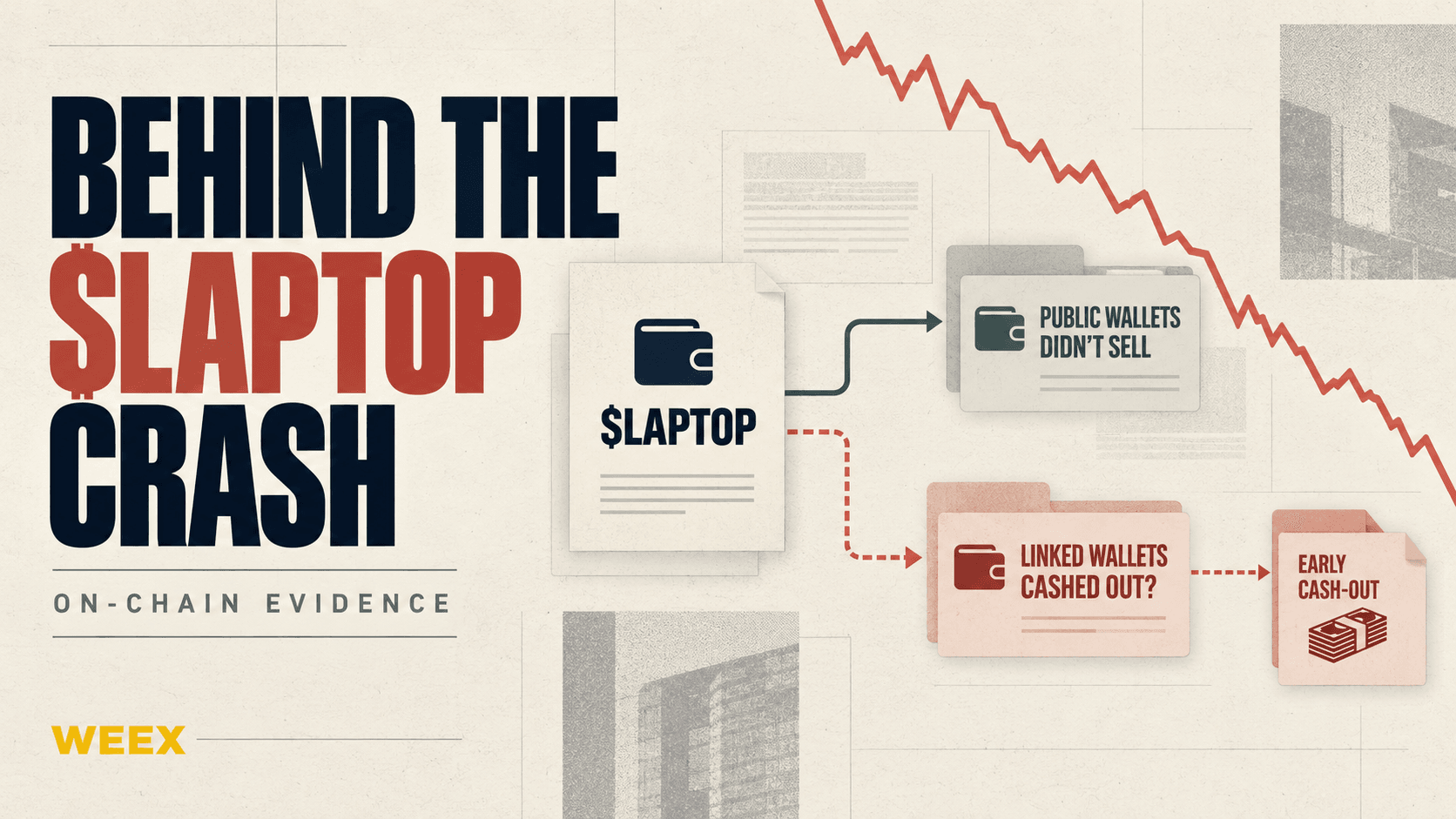
Behind the $LAPTOP Crash: On-Chain Evidence Shows “Public Wallets Did Not Sell, but Linked Wallets Cashed Out Early”

Broadcom (AVGO) : AI Growth, Fund Positioning, and Guarantee Risk
Broadcom (AVGO) recently fell with the semiconductor sector, closing down 10.43% at $291.53 on November 5. The shares rebounded more than 4% in premarket trading on November 6. Concerns that election results could lead to tighter AI rules and slower data center approvals contributed to a broad sell-off, with a semiconductor index falling about 12%. The move appears tied mainly to sector sentiment and policy concerns, with no clear company-specific negative catalyst identified.
Institutional trading and AI growth expectations are also in focus. ARK funds sold about $134 million of Broadcom shares over two sessions while adding to SpaceX. Citi maintained its Buy rating and projected that Broadcom’s AI semiconductor revenue could reach $115 billion in fiscal 2027, roughly doubling year over year. Broadcom had approximately $179.2 billion in signed contracts as of the prior quarter, while analysts estimated fourth-quarter AI chip revenue at about $21.7 billion. These forecasts will need to be tested against future results.
Contingent guarantees are another point for investors to monitor. Broadcom is providing guarantees tied to Anthropic’s AI rack-leasing arrangement, involving about $29 billion in the first phase and a second-phase plan of up to $43 billion. Banks plan to issue $21 billion in bonds to support related chip financing. The guarantee amounts are not the same as debt already incurred, but they add a potential risk to assess. Broadcom is scheduled to report its next quarterly results on December 9, when management’s outlook for fiscal 2027 AI demand will be closely watched. This article is for informational purposes only and is not investment advice.

Netflix (NFLX) Stock Rebounds: Insider Sales, Advertising, and Growth Plans
Several Netflix executives sold company shares in early November 2026. Co-CEO Theodore Sarandos sold 27,312 shares from November 3 to 4, valued at about $1.81 million. CFO Spencer Neumann sold shares worth approximately $612,000. Co-CEO Gregory Peters realized about $1.69 million, including transactions related to tax withholding. Chief Legal Officer David Hyman and director Bradford Smith also reduced their holdings. Executive sales can have different reasons and should not be viewed on their own as a measure of the company’s outlook.
After recent pressure, Netflix shares rebounded more than 4% around November 4. Bill Ackman’s Pershing Square Capital Management allocated about 5% of its portfolio to Netflix, while new AI features and positive views on the company’s technology prospects helped sentiment. Netflix reported third-quarter 2026 revenue of $13.44 billion and earnings per share of $0.87, both above expectations, though its forward outlook remains a key focus.
Advertising is one of Netflix’s main challenges. Delays to key ad product features led the company to reduce its annual advertising revenue outlook from $3 billion to $2.7 billion. Viewer engagement has also faced pressure from changes in content appeal and competition from platforms such as YouTube. Netflix is pursuing growth through live events, gaming, and advertising, with plans to expand its ad-supported offering to 15 markets while adjusting its workforce by about 6% to improve margins. Investors may want to monitor advertising growth, engagement, and profitability. This article is for informational purposes only and is not investment advice.

Carvana Earnings: Record Sales, Strong Profit, and Insider Share Sales
Carvana reported third-quarter net revenue of $8.04 billion, up 42.4% year over year and above the $7.7 billion market estimate. Retail units sold reached a record 217,385, an increase of 39.4%. Net income rose to $483 million, while adjusted EBITDA reached a record $800 million, reflecting gains in both revenue and profitability.
Management expects full-year 2026 adjusted EBITDA to reach the upper end of its $2.7 billion to $3.0 billion range. Needham maintained its Buy rating, named Carvana a top pick in transportation technology, and set a $100 price target. Strong results and guidance have drawn investor attention, though continued performance will depend on sales, margins, and operating costs.
Insider transactions are also on investors’ radar. A regulatory filing indicates that CFO Mark Jenkins planned to sell 63,800 shares on November 2, 2026, valued at approximately $4.35 million. Since August, he has planned sales totaling 191,300 shares. An executive share sale alone does not determine a company’s outlook; investors may also consider earnings, cash flow, and future guidance. This article is for informational purposes only and is not investment advice.

FCEL Stock: Data Center Opportunity, Manufacturing Costs, and Lawsuit Risk
FuelCell Energy (ticker: FCEL) provides fuel-cell power solutions. Growing electricity demand from AI data centers could create new business opportunities, while proposed pauses on new data center approvals in some areas have raised concerns about project timelines. A 75-megawatt power project may be affected, and FCEL shares recently fell as much as about 17% in a single session amid policy concerns.
FCEL signed an agreement with Fit Energy to provide up to 380 megawatts of fuel-cell power solutions. Its backlog is approximately $3.6 billion, with about 97% of its sales pipeline related to data centers. The company also drew the second installment under a $49 million financing arrangement backed by an export credit agency, supporting a green energy project and clean-energy exports. Recent leadership changes include Matthew Latino becoming CFO, digital infrastructure executive Peter Hopper joining the board, and John Dansby leading manufacturing scale-up. Converting orders into revenue will depend on production capacity, costs, and project execution.
FCEL reported third-quarter revenue of about $33 million, down approximately 29% year over year, and a net loss of roughly $45.3 million. Product costs and manufacturing overhead for the Fit Energy agreement exceeded the contract pricing, resulting in an approximately $17 million contract impairment charge. Securities class-action allegations concern disclosures about manufacturing capacity and costs; the case remains in the legal process. The deadline to seek appointment as lead plaintiff is November 10, 2026. FCEL’s growth opportunities come with execution, financing, and litigation risks. This article is for informational purposes only and is not investment advice.

PFE Stock: Pfizer’s Q3 2026 Earnings, Business Strategy, and Dividend Outlook
PFE is the New York Stock Exchange ticker for Pfizer Inc. In the third quarter of 2026, Pfizer reported revenue of $16.58 billion and adjusted earnings per share of $0.87, both above market expectations. The company raised its full-year revenue outlook to $62 billion–$64 billion and its adjusted EPS guidance to $2.95–$3.05, pointing to stronger performance than previously expected.
Although demand for COVID-related products continues to decline, Pfizer’s non-COVID business is growing. Third-quarter sales reached $720 million for the cancer drug Padcev and $2.52 billion for Eliquis, up 25% year over year. Revenue from newer and acquired products rose 32%. Pfizer is expanding its oncology pipeline, entering the weight-loss treatment market through its acquisition of Metsera, and targeting approximately $9.7 billion in net cost savings by 2029. Cecile Guegan has also taken over as chief financial officer.
Investors are also watching Pfizer’s dividend and legal developments. The company declared a cash dividend of $0.43 per share, with an ex-dividend date of November 6, 2026. Analysts raised some earnings estimates and price targets following the quarterly results. Pfizer also faces ongoing legal scrutiny related to statements about COVID vaccine safety, while its subsidiary Mylan has sued Novo Nordisk over generic-drug patent issues involving Wegovy. Pfizer’s outlook depends on new-product growth, cost savings, patent matters, and litigation developments. This article is for informational purposes only and is not investment advice.

What Is TLT? Long-Term Treasury Bonds After the Midterm Election

A Look at the S&P 500 ETF After the Midterm Election

AI Trading: Start With a Review of Your Own Trades

CLARITY Act Faces Setback. Why Is Bitcoin Above $80K?

How Many iPhone 18 Pro Max Can 1 BTC Buy Right Now?

How Do Crypto Exchanges Build Security? A Look at WEEX’s Security Practices

AMD Earnings Preview: Can AI Demand Translate Into Stronger Margins?

Why Is AMD Stock Down 11%? What to Expect From Nov. 3 Earnings

Bitcoin ETF Flows: How to Identify BTC Support & Resistance
After the October FOMC Meeting: What Could Drive Bitcoin and Stocks Next?

WEEX Dice Rush Stock Matchup Rules: How Winners Are Decided

Google Earnings Preview: What Would It Take to Lift the Stock?
What could lift Google stock after earnings? Review Alphabet’s Q3 expectations, Cloud margins and AI cash flow, and explore WEEX’s GOOGL prediction round.
FOMC Decision Oct 28, 2026: Scenarios for Stocks, Bitcoin and Gold

Bitcoin Price Ahead of October 28 Fed Decision: What 2026 Data Shows

Oil Pulls Back After Last Week’s Rally. What Does It Mean for Bitcoin and Stocks?
Google Earnings on Oct 28: Will the Fed Decision Move GOOGL Stock?
Meta Beat Earnings. Why Did Its Stock Fall 7%?
Zcash NU7 Upgrade: 3 Things ZEC Holders Must Know Before November 5
October 28: The Fed, Big Tech Earnings and What to Watch in Bitcoin, Stocks and Gold

Crypto Exchange Security in 2026: How to Verify WEEX Reserves and Protection Fund

Tesla Delivered More Cars Than Expected. Does That Mean It Made More Money?

Tokenized Stocks vs. Stock ETFs: What’s the Difference?

Why Is SpaceX Stock Down 34% From Its Peak? Q3 Earnings & Lockup Risks Ahead

What Is the Market Expecting From Tesla Q3 Earnings Now?
Behind the $LAPTOP Crash: On-Chain Evidence Shows “Public Wallets Did Not Sell, but Linked Wallets Cashed Out Early”
Broadcom (AVGO) : AI Growth, Fund Positioning, and Guarantee Risk
Broadcom (AVGO) recently fell with the semiconductor sector, closing down 10.43% at $291.53 on November 5. The shares rebounded more than 4% in premarket trading on November 6. Concerns that election results could lead to tighter AI rules and slower data center approvals contributed to a broad sell-off, with a semiconductor index falling about 12%. The move appears tied mainly to sector sentiment and policy concerns, with no clear company-specific negative catalyst identified.
Institutional trading and AI growth expectations are also in focus. ARK funds sold about $134 million of Broadcom shares over two sessions while adding to SpaceX. Citi maintained its Buy rating and projected that Broadcom’s AI semiconductor revenue could reach $115 billion in fiscal 2027, roughly doubling year over year. Broadcom had approximately $179.2 billion in signed contracts as of the prior quarter, while analysts estimated fourth-quarter AI chip revenue at about $21.7 billion. These forecasts will need to be tested against future results.
Contingent guarantees are another point for investors to monitor. Broadcom is providing guarantees tied to Anthropic’s AI rack-leasing arrangement, involving about $29 billion in the first phase and a second-phase plan of up to $43 billion. Banks plan to issue $21 billion in bonds to support related chip financing. The guarantee amounts are not the same as debt already incurred, but they add a potential risk to assess. Broadcom is scheduled to report its next quarterly results on December 9, when management’s outlook for fiscal 2027 AI demand will be closely watched. This article is for informational purposes only and is not investment advice.
Netflix (NFLX) Stock Rebounds: Insider Sales, Advertising, and Growth Plans
Several Netflix executives sold company shares in early November 2026. Co-CEO Theodore Sarandos sold 27,312 shares from November 3 to 4, valued at about $1.81 million. CFO Spencer Neumann sold shares worth approximately $612,000. Co-CEO Gregory Peters realized about $1.69 million, including transactions related to tax withholding. Chief Legal Officer David Hyman and director Bradford Smith also reduced their holdings. Executive sales can have different reasons and should not be viewed on their own as a measure of the company’s outlook.
After recent pressure, Netflix shares rebounded more than 4% around November 4. Bill Ackman’s Pershing Square Capital Management allocated about 5% of its portfolio to Netflix, while new AI features and positive views on the company’s technology prospects helped sentiment. Netflix reported third-quarter 2026 revenue of $13.44 billion and earnings per share of $0.87, both above expectations, though its forward outlook remains a key focus.
Advertising is one of Netflix’s main challenges. Delays to key ad product features led the company to reduce its annual advertising revenue outlook from $3 billion to $2.7 billion. Viewer engagement has also faced pressure from changes in content appeal and competition from platforms such as YouTube. Netflix is pursuing growth through live events, gaming, and advertising, with plans to expand its ad-supported offering to 15 markets while adjusting its workforce by about 6% to improve margins. Investors may want to monitor advertising growth, engagement, and profitability. This article is for informational purposes only and is not investment advice.
Carvana Earnings: Record Sales, Strong Profit, and Insider Share Sales
Carvana reported third-quarter net revenue of $8.04 billion, up 42.4% year over year and above the $7.7 billion market estimate. Retail units sold reached a record 217,385, an increase of 39.4%. Net income rose to $483 million, while adjusted EBITDA reached a record $800 million, reflecting gains in both revenue and profitability.
Management expects full-year 2026 adjusted EBITDA to reach the upper end of its $2.7 billion to $3.0 billion range. Needham maintained its Buy rating, named Carvana a top pick in transportation technology, and set a $100 price target. Strong results and guidance have drawn investor attention, though continued performance will depend on sales, margins, and operating costs.
Insider transactions are also on investors’ radar. A regulatory filing indicates that CFO Mark Jenkins planned to sell 63,800 shares on November 2, 2026, valued at approximately $4.35 million. Since August, he has planned sales totaling 191,300 shares. An executive share sale alone does not determine a company’s outlook; investors may also consider earnings, cash flow, and future guidance. This article is for informational purposes only and is not investment advice.
FCEL Stock: Data Center Opportunity, Manufacturing Costs, and Lawsuit Risk
FuelCell Energy (ticker: FCEL) provides fuel-cell power solutions. Growing electricity demand from AI data centers could create new business opportunities, while proposed pauses on new data center approvals in some areas have raised concerns about project timelines. A 75-megawatt power project may be affected, and FCEL shares recently fell as much as about 17% in a single session amid policy concerns.
FCEL signed an agreement with Fit Energy to provide up to 380 megawatts of fuel-cell power solutions. Its backlog is approximately $3.6 billion, with about 97% of its sales pipeline related to data centers. The company also drew the second installment under a $49 million financing arrangement backed by an export credit agency, supporting a green energy project and clean-energy exports. Recent leadership changes include Matthew Latino becoming CFO, digital infrastructure executive Peter Hopper joining the board, and John Dansby leading manufacturing scale-up. Converting orders into revenue will depend on production capacity, costs, and project execution.
FCEL reported third-quarter revenue of about $33 million, down approximately 29% year over year, and a net loss of roughly $45.3 million. Product costs and manufacturing overhead for the Fit Energy agreement exceeded the contract pricing, resulting in an approximately $17 million contract impairment charge. Securities class-action allegations concern disclosures about manufacturing capacity and costs; the case remains in the legal process. The deadline to seek appointment as lead plaintiff is November 10, 2026. FCEL’s growth opportunities come with execution, financing, and litigation risks. This article is for informational purposes only and is not investment advice.
PFE Stock: Pfizer’s Q3 2026 Earnings, Business Strategy, and Dividend Outlook
PFE is the New York Stock Exchange ticker for Pfizer Inc. In the third quarter of 2026, Pfizer reported revenue of $16.58 billion and adjusted earnings per share of $0.87, both above market expectations. The company raised its full-year revenue outlook to $62 billion–$64 billion and its adjusted EPS guidance to $2.95–$3.05, pointing to stronger performance than previously expected.
Although demand for COVID-related products continues to decline, Pfizer’s non-COVID business is growing. Third-quarter sales reached $720 million for the cancer drug Padcev and $2.52 billion for Eliquis, up 25% year over year. Revenue from newer and acquired products rose 32%. Pfizer is expanding its oncology pipeline, entering the weight-loss treatment market through its acquisition of Metsera, and targeting approximately $9.7 billion in net cost savings by 2029. Cecile Guegan has also taken over as chief financial officer.
Investors are also watching Pfizer’s dividend and legal developments. The company declared a cash dividend of $0.43 per share, with an ex-dividend date of November 6, 2026. Analysts raised some earnings estimates and price targets following the quarterly results. Pfizer also faces ongoing legal scrutiny related to statements about COVID vaccine safety, while its subsidiary Mylan has sued Novo Nordisk over generic-drug patent issues involving Wegovy. Pfizer’s outlook depends on new-product growth, cost savings, patent matters, and litigation developments. This article is for informational purposes only and is not investment advice.


