
Binance Wants 74.56M ARB Back: Will ArbitrumDAO Approve?

 Prefer us on Google

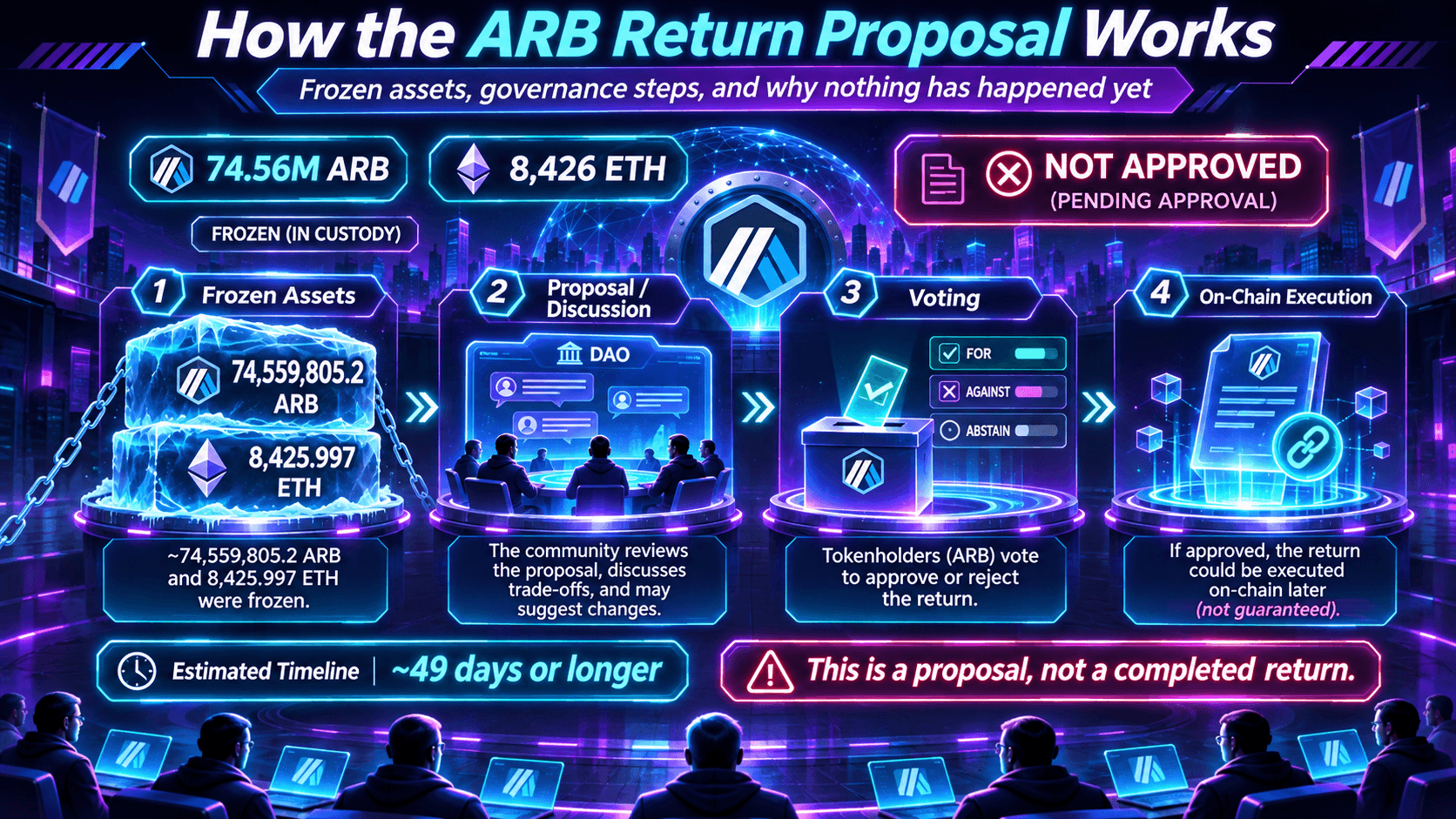
Arbitrum frozen asset recovery has become a major governance issue after Binance formally requested the return of approximately 74.56 million ARB and 8,426 ETH held in a frozen address on Arbitrum One. The assets were immobilized following the October 29, 2026 Binance hot-wallet exploit, and the exchange now wants ArbitrumDAO to authorize their release.
The Arbitrum frozen asset recovery proposal, submitted on November 5, asks the DAO to approve a coordinated on-chain transaction that would transfer the seized assets to a designated Binance recovery address. Binance says the returned funds would help replenish reserves used to cover losses associated with the incident.
However, the Arbitrum frozen asset recovery is not complete. The assets were secured through an emergency intervention, but their return requires a separate governance process. Binance estimates that the process could take approximately seven weeks or longer.
In a WEEX market snapshot recorded on November 6 at 14:04 Beijing time, ARB spot traded at approximately 0.1668 USDT, up 2.21% over 24 hours. ARB perpetual futures were quoted near 0.16653 USDT, up 2.17%. These historical prices show a modest rebound but do not establish that the proposal caused it.
The central question is whether ArbitrumDAO will approve the recovery, and what the decision could mean for decentralized governance, network security and ARB holders.
Why Does Binance Want 74.56 Million ARB Returned?
The proposed recovery follows a Binance hot-wallet security incident on October 29, 2026.
Assets connected to the exploit were identified on Arbitrum One, an Ethereum layer-2 network. Acting under its emergency powers, the Arbitrum Security Council implemented a temporary intervention to prevent the affected assets from being moved further.
According to the official Arbitrum Security Council announcement, the frozen funds were transferred to a holding address on October 30.
The subsequent constitutional recovery proposal asks for those assets to be returned to Binance.
What Assets Are Included in the Proposal?
| Asset | Frozen Amount | Proposed Destination |
|---|---|---|
| ARB | 74,559,805.2 ARB | Binance recovery address |
| ETH | 8,425.997 ETH | Binance recovery address |
| Current holding address | 0x...0DA0 | DAO-controlled recovery process |
| Governance route | Constitutional AIP | Requires formal approval |
Source: Arbitrum Security Council announcement and Binance's ArbitrumDAO recovery proposal, October 30–November 5, 2026.
The amount requested is the complete frozen balance specified in the proposal.
Importantly, Binance is asking for the return of assets associated with the exploit, not requesting a new allocation of tokens from the ArbitrumDAO treasury.
That distinction is essential for understanding the potential economic impact.
Why Were the Assets Frozen in the First Place?
The Security Council identified an emergency involving funds transferred to an address associated with the Binance exploit.
Under the emergency intervention, the council temporarily upgraded an Ethereum-side Inbox contract, executed transactions to move the affected assets into a restricted holding address, and restored the original contract implementation.
The operation was designed to affect the identified funds without disrupting ordinary applications or unrelated user balances.
After the emergency action, the assets were secured but not returned to Binance.
The original Security Council announcement stated that a formal ArbitrumDAO governance action would be required for the next transfer.
How Would ArbitrumDAO Return the Frozen Assets?
ArbitrumDAO is responsible for governance decisions affecting key aspects of the Arbitrum ecosystem.
The proposed return is classified as a constitutional Arbitrum Improvement Proposal, or AIP, meaning it requires the applicable formal governance process rather than informal agreement alone.
For background on the network's structure, see WEEX Learn's What Is Arbitrum (ARB) and How Does This Ethereum Layer 2 Work?.
Step 1: Community Discussion and Proposal Review
The first stage involves community review of the request.
Delegates and token holders can examine the evidence, the proposed transaction and the justification for returning the assets.
The discussion is important because the original emergency intervention used exceptional security powers.
Moving the funds again requires the community to consider the legitimacy, scope and consequences of the requested action.
Step 2: Formal Governance Approval
A constitutional proposal must satisfy Arbitrum's governance requirements before execution.
A published proposal does not mean a vote has passed.
Even if Binance presents evidence of ownership and commits to covering affected users' losses, the DAO still has to evaluate the requested on-chain action through its governance framework.
The decision therefore remains subject to community approval and any relevant procedural or legal constraints.
Step 3: Technical Recovery Transaction
If the proposal receives the necessary approval, its technical specification calls for an atomic operation using the Ethereum-side Inbox contract.
The proposed sequence is:
- Temporarily upgrade the Inbox contract to enable a specialized recovery function.
- Execute the transaction transferring the frozen ETH and ARB to the designated recovery address.
- Restore the Inbox contract by removing the temporary function.
The process is designed to limit the duration of the exceptional capability.
However, the procedure should be assessed for technical and governance risk before activation.
Step 4: Verify the Returned Funds
Following a successful execution, observers could verify the asset transfers on-chain.
Binance would then receive the funds at its specified recovery address.
Only after that transfer would it be accurate to describe the assets as returned under this proposal.
Neither the original freeze nor the publication of the AIP establishes that the return has already taken place.
When Could Binance Recover the Frozen ARB and ETH?
Binance states that the governance process may take approximately seven weeks or longer.
This estimate reflects the need for formal proposal stages and execution rather than an immediate administrative decision.
The process involves several distinct steps.
| Stage | Current Meaning |
|---|---|
| October 29 | Binance exploit and associated asset movements |
| October 30 | Security Council emergency freeze |
| November 5 | Binance recovery proposal submitted |
| Governance discussion | Community and delegate review |
| Voting process | Formal decision on the AIP |
| Technical execution | Transfer if approved and legally permitted |
| Recovery confirmation | On-chain verification of returned balances |
Source: Arbitrum Security Council announcement and constitutional recovery proposal.
The timeline is conditional.
If voting, technical review or applicable legal procedures require additional time, the transfer may be delayed.
Does Seven Weeks Mean a Guaranteed Return Date?
No.
The seven-week estimate is a planning assumption, not a confirmed date on which Binance will receive the funds.
Approval cannot be presumed, and technical execution may be subject to additional conditions.
The proposal also acknowledges potential legal restrictions that could prevent an on-chain transfer while relevant proceedings remain in effect.
For users tracking the case, the meaningful milestone is a successfully executed transfer, not merely the passage of time.
-- Price
Is This a DAO Treasury Payment or an ARB Buyback?
Neither description accurately captures the proposal.
The assets are already held in a frozen address following the emergency intervention.
Binance is requesting their release, rather than asking ArbitrumDAO to purchase ARB on the open market or distribute newly issued tokens.
Why Is This Different From a Buyback?
A buyback generally involves using capital to purchase an asset from the market.
The Binance proposal does not request such a purchase.
It concerns an existing amount of ARB and ETH that was transferred into a restricted address.
The proposed operation would change who controls those assets, not create new market demand through a DAO-funded purchase.
Will Returning the Assets Increase ARB Supply?
The proposed return does not involve minting additional ARB.
The existing frozen tokens would move to a recovery address.
Therefore, it would not directly increase ARB's total token supply.
However, the eventual location and use of those assets could affect balances available to market participants. That is different from changing token issuance.
How Would Binance Use the Returned Funds?
Binance states that it has committed to covering affected users' losses through its SAFU Fund and corporate treasury.
Recovered assets could help replenish the resources used for that purpose.
The proposal does not mean that ArbitrumDAO would be responsible for financing Binance's user compensation.
It also does not establish that a separate payment to every affected user would occur automatically when the assets are released.

Why Is the ARB Recovery Proposal a Governance Test?
The proposal raises questions about emergency powers and decentralized oversight.
The Security Council acted rapidly to protect funds during a security incident. The later recovery request must move through a broader governance process.
This separation illustrates the difference between emergency intervention and ordinary DAO authority.
Security Council Powers Versus Token Holder Governance
Emergency councils may be designed to respond when waiting for a lengthy vote could expose the network or users to immediate harm.
However, extraordinary powers create concerns about oversight, accountability and precedent.
The Arbitrum approach seeks to distinguish an urgent protective action from the later decision about where the assets should go.
The DAO's review process is therefore part of the broader governance question.
Could This Set a Precedent for Future Recovery Requests?
Potentially.
A successful recovery could encourage future requests involving assets immobilized after major security incidents.
That does not mean similar actions would automatically be authorized.
Each request could involve different evidence, technical risks, legal considerations and governance conditions.
The key issue is whether exceptional interventions remain narrowly defined and subject to credible oversight.
What Does the Proposal Mean for ARB Price?
ARB's price increased by approximately 2.21% in the November 6 WEEX market snapshot.
The governance proposal may have attracted market attention, but a short-term price movement cannot be attributed exclusively to the announcement.
Does the Proposal Create New ARB Demand?
The recovery request does not involve the purchase of additional ARB.
That limits the basis for treating it as a direct buyback or supply-reduction catalyst.
Its potential market relevance lies more in governance confidence, security expectations and future control of the frozen assets.
Could Governance Uncertainty Affect Sentiment?
Yes.
Some participants may view the recovery process as evidence that the network can respond to significant security incidents while respecting DAO oversight.
Others may be concerned about the scope of emergency powers or the possibility of similar interventions in the future.
The eventual governance decision could influence expectations, but it does not guarantee a sustained price trend.
For broader token-specific context, WEEX's ARB Utility, Supply and Risk Analysis explains how governance rights differ from direct ownership of network revenue.
What Should ARB Holders Watch Next?
The next developments are procedural rather than purely market-based.
Proposal progress: Whether the constitutional AIP moves through formal governance stages.
Voting outcome: Whether the DAO grants authorization for the recovery.
Legal conditions: Whether any relevant restrictions affect the timing of execution.
Technical preparation: Whether the required transaction can be implemented without unintended network effects.
On-chain verification: Whether the frozen funds are ultimately transferred to the specified Binance recovery address.
Market liquidity: Whether trading activity changes as the governance process advances.
For now, describing the assets as frozen and subject to a return proposal is more accurate than reporting them as recovered.
How to Buy and Trade ARB on WEEX
WEEX provides ARB spot and perpetual futures market interfaces for eligible users.
The two products involve different rights and risks.
Step 1: Log In to WEEX
Access your account and complete the applicable verification requirements.
Check that ARB trading is supported in your region.
Step 2: Prepare Your USDT Balance
Ensure that sufficient USDT is available in the relevant trading account.
Verify the supported network and destination details if depositing funds.
Step 3: Choose Spot or Futures
To purchase the underlying token, review the ARB/USDT spot market on WEEX.
Eligible users seeking derivatives exposure can check the ARB/USDT perpetual futures market.
Spot trading involves exchanging USDT for ARB, while futures provide contractual exposure to price movements.
Step 4: Review Risks and Order Details
Select an available order type and review the transaction size, fees and liquidity.
For perpetual futures, examine leverage, margin, funding costs and liquidation conditions.
Volatile governance news can contribute to rapid price movements and slippage.
Step 5: Confirm and Monitor
Review all order information before submission.
After execution, monitor your holdings or derivative position and follow official Arbitrum governance updates for changes in the proposal's status.
Conclusion
Binance's request for the return of 74.56 million ARB and approximately 8,426 ETH represents an important test of ArbitrumDAO governance.
The assets were secured through an emergency intervention, but their return requires a separate formal process.
Crucially, the proposal does not request new DAO treasury funding, authorize an ARB buyback or create additional tokens.
For ARB holders, the most important developments will be the governance outcome, technical implementation and eventual on-chain verification.
Until those steps are completed, the proposed recovery remains a request rather than a finished transfer.
FAQ
1. Why Does Binance Want 74.56 Million ARB Returned?
The tokens were frozen following a Binance hot-wallet exploit. Binance is seeking their return to help replenish assets and resources associated with covering affected users' losses.
2. Has ArbitrumDAO Approved the Return?
The proposal's submission does not constitute approval. It must pass the applicable governance process before execution.
3. How Long Could the ARB Recovery Take?
Binance estimates approximately seven weeks or longer, depending on governance, technical and legal conditions.
4. Will Returning the ARB Increase Token Supply?
No. The proposal concerns existing frozen ARB tokens, not newly minted tokens or a DAO-funded buyback.
5. Can Users Trade ARB on WEEX?
Eligible users can review ARB spot and perpetual futures markets on WEEX. Availability and trading conditions should be confirmed before placing orders.
This content is provided for general informational purposes only and doesn't constitute financial, investment, legal, or tax advice. Any events, rewards, online promotions, or related information mentioned herein should not be considered a recommendation, solicitation, or invitation to purchase, sell, trade, or otherwise deal in any crypto assets. Crypto assets are highly volatile and may result in loss. The availability of WEEX services, products, and related events may vary by region. You are responsible for ensuring that your participation is in accordance with applicable local laws and regulations.
You may also like
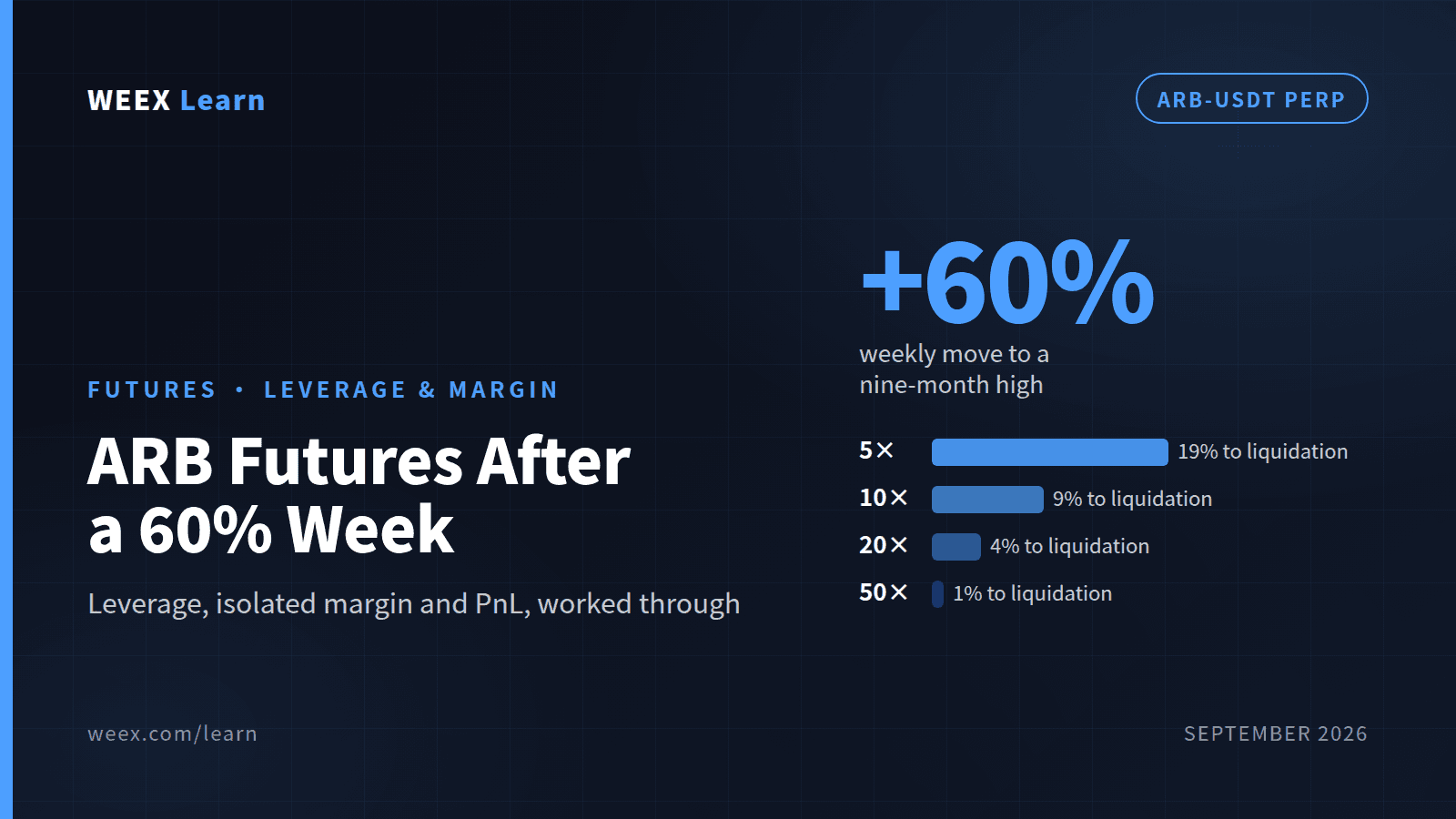
ARB Futures After a 60% Week: Leverage, Isolated Margin and PnL
What Is Arbitrum (ARB) and How Does This Ethereum Layer 2 Work?

What Is CLAN? Is a Dump Coming After Its 100% Surge?

What Is Animecoin (ANIME)? A New Meme Coin With 100% Potential

What is AgentLISA (LISA) and How Does It Work?
ASTER Airdrop on WEEX Exchange: Claim Your Share of 50,000 USDT in the New User Welcome Reward
What is Zerobase (ZBT) and How Does It Work?

What is Enso (ENSO) and How Does It Work?
What is Syndicate (SYND) Coin? A Comprehensive Guide to Appchains
What is Tribe perpetual (TMX) Coin? A Comprehensive Guide
What is NPC WEB3 GAMEFI (NPCR)? A Guide to the New Arbitrum GameFi Token
DTCC on Canton: Will Wall Street Tokenization Lift CC Demand?
CC Price After the SEC Letter: Why a 3.8% Gain Looks So Muted
Canton Coin No-Action Letter: 5 Facts the SEC Relief Rests On

ARM Stock Falls After Arm Q2 FY2027 Revenue Jumps 27% to $1.443 Billion

Ethereum Economic Zone Unveils 3 Rollup Demos With 91% Lower L1 Gas

Canton Coin Gains Attention After SEC No-Action Letter: What Does It Mean for CC?
THORChain Restarts Swaps: Why RUNE Is Up and What Is Still Broken
KITE Token Unlock: Why Trackers Disagree on the November Cliff
Crypto Trading Rewards: What Each Lucky Egg Really Costs in Fees
HYPE Up 12.84%: ICE Invests in Trade[XYZ]
BNB Down 2%: Binance Verifies Reserves for 10 Assets
TRX Up 2% as TRON Stablecoin Supply Averages $92.25B
NEAR Protocol HSP-029 Vote: Can a 36% Issuance Cut Affect NEAR Price?
HOOD Q3 Earnings: Record $1.42B Revenue, So Why Did Crypto Revenue Fall 55%?
How to Buy Crypto Anonymously: 5 Methods, Real Costs and Limits
Crypto Liquidation Price: How to Calculate It From 5x to 50x
Crypto Funding Rate: Who Pays, What It Costs, What It Signals
Stop Loss and Take Profit in Crypto Futures: A 1% Risk Playbook
PEP Earnings: PepsiCo Beats Q3, Cuts Guidance on North America
ARB Futures After a 60% Week: Leverage, Isolated Margin and PnL
What Is Arbitrum (ARB) and How Does This Ethereum Layer 2 Work?
What Is CLAN? Is a Dump Coming After Its 100% Surge?
What Is Animecoin (ANIME)? A New Meme Coin With 100% Potential
What is AgentLISA (LISA) and How Does It Work?
ASTER Airdrop on WEEX Exchange: Claim Your Share of 50,000 USDT in the New User Welcome Reward


