
Zeno's Digital Twin Paradigm and DeSci's Tech Democratization

 Prefer us on Google


Original Title: "Zeno's Digital Twinning Vision and DeSci's Technological Democratization"
Original Author: Eric, Foresight News
Over a week ago, DeSci platform Orama Labs successfully completed the OramaPad's first project, Zeno's token launch. This Zeno launchpad provided 500 million ZENO tokens, half of the total supply. OramaPad requires users to stake their PYTHIA tokens to participate, and this "opening act" attracted a total of $3.6 million in PYTHIA staking.
Orama Labs aims to address the inefficiencies in fund allocation and resource distribution in traditional scientific research. The solution is to fund scientific experiments, achieve intellectual property verification, solve data silos, and implement community governance, establishing a path from research to commercialization.
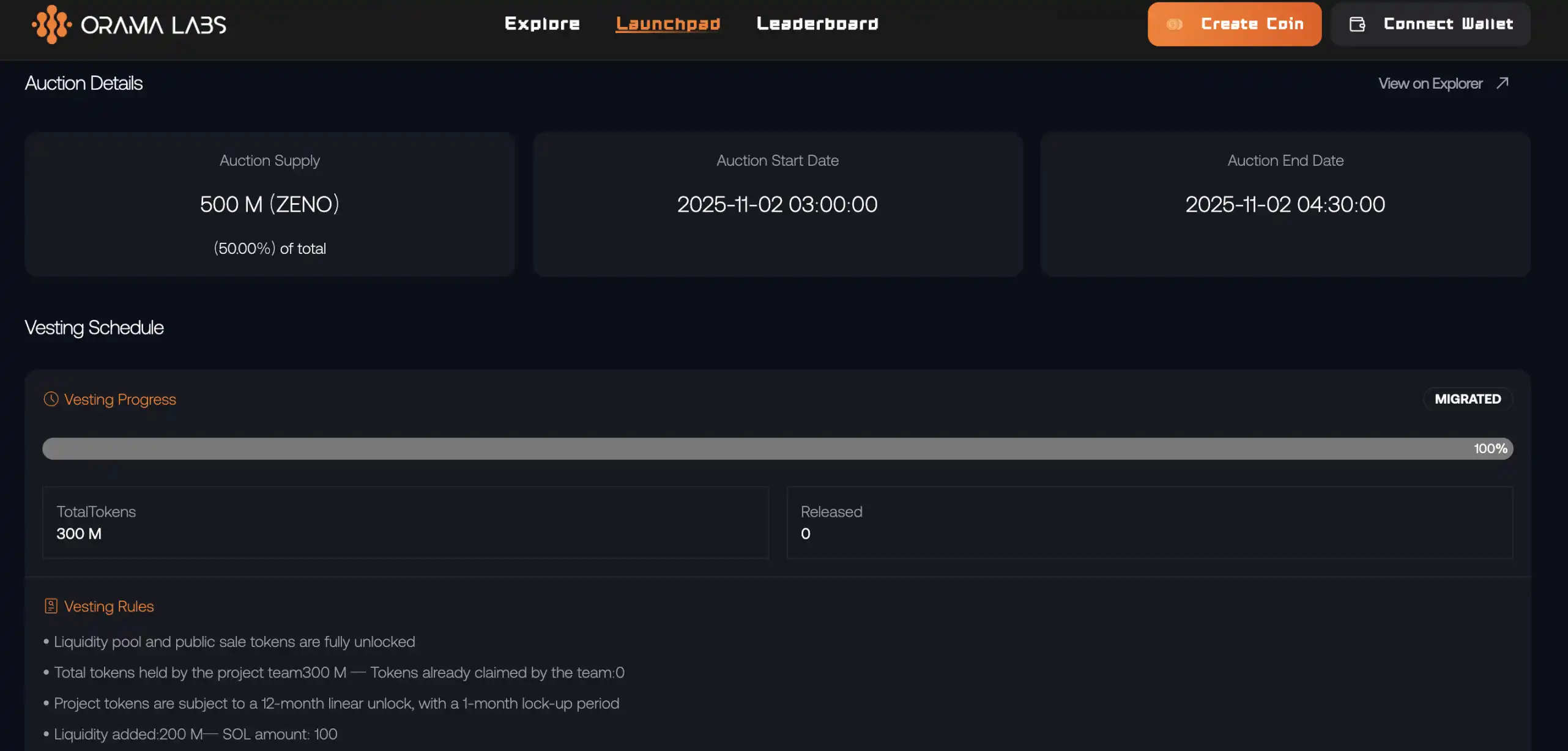
OramaPad's first project adopts the Crown model, where the project needs to have a sound business logic system and/or strong Web2 domain technical development capabilities. Additionally, its product must be highly practical, which Orama refers to as OCM (Onboarding Community Market). Unlike simple meme issuance, Orama essentially provides a replicable on-chain transformation path for Web2 enterprises or teams with mature business models and technical capabilities, and the first mover Zeno is no exception.
The Hardcore Tech of the Unreadable Document
Zeno is a project with a grand vision, so much so that if you only look at Zeno's documentation, you may not fully understand what the team is trying to achieve. It was only after the author communicated with the team that the full picture of this cyberpunk-style story became clear:
In short, Zeno aims to overlay a multi-layer virtual space for intelligent entities such as AI and robots in the physical space of human life, allowing all "intelligent entities," including humans, to live in the same space.
Imagine a scenario like this: One afternoon in the future, you are enjoying a leisurely time on the balcony in a lounge chair, with an AI butler connecting all the household appliances and a humanoid robot busy with household chores. Suddenly, feeling a bit bored, you want to play a virtual passing game with your other two brothers at home. So, you put on your VR/AR glasses, and in the world of glasses, the robot looks like a human, and the AI existing only in the network transforms into a humanoid. The robot sits on the sofa, and the AI sits on the floor. The three of you pass the virtual basketball while discussing what to eat tonight.
This is Zeno's ultimate vision, allowing carbon-based sentient beings and silicon-based intelligences to coexist in the same physical space.
The cyberspace many of us imagine may be a purely virtual space, such as the one depicted in the movie "Ready Player One," where people enter a new world through VR. Even our current interactions with AI, including the one with Zeno, are conducted through flat carriers like computers or smartphone screens. Zeno aims to directly bring these virtual spaces into real life, creating a state where the physical world and the digital world exist in an "overlay in the same spacetime." This integration allows digital content to be as "real and tangible" as physical existence, enabling humans, robots, and AI to achieve natural interaction in real scenes, building a mixed reality ecosystem where the virtual and the real coexist harmoniously.
Of course, the world we see may not be exactly the same as the one seen by robots and AI. For example, you may not want a robot to wander into your study room casually. In the world perceived by the robot, you can instead lock the door to the study room. Only when you "unlock" this "lock" would the robot be granted permission to enter.
Core to Spatial Anchors
Living under the same roof as Artificial Intelligence may sound very high-tech, but there is a significant premise: you need to establish a model of the real world in the virtual environment to achieve programmability.
First and foremost, you need to possess real-world reality data, a challenge currently being researched by many companies, including those in the autonomous driving sector. Take autonomous driving, for instance. With real-world map data of an entire city, autonomous driving AI does not need to roam the streets following cars to learn how to handle various situations. It can directly simulate on-road scenarios in the lab to evolve continuously.
Although the above does not represent what we call "spatial overlap," it is still a crucial application for building a model of the real world. Zeno's ultimate vision cannot be achieved in one step. The first thing to do is to collect real-world reality data.
Zeno has launched a program that allows users to use their everyday devices to help enter spatial data, supporting two types of devices: robots and glasses. As for smartphones, the team stated that Google's ARCore is mature enough and does not require secondary development. Users can directly use it with reference to compatible models. The data collected is used to build space algorithms developed independently by the Zeno team.
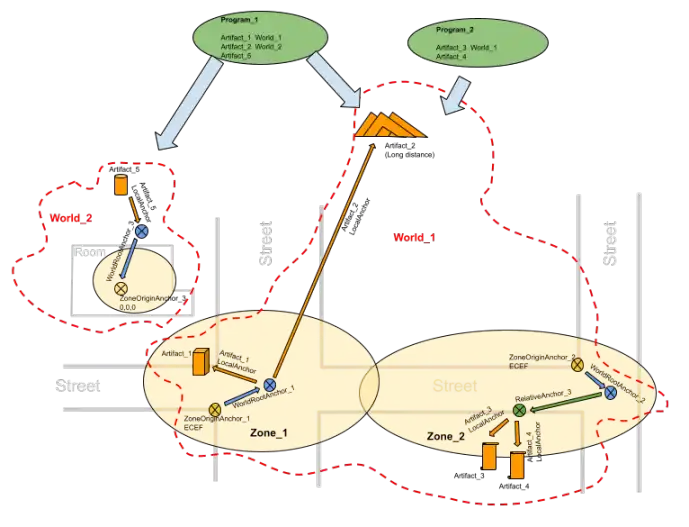
The core of building coexistence between the real world and the virtual world revolves around spatial anchors. From a technical realization perspective, the real world cannot be directly programmed. The connection between the real and virtual worlds is made by associating anchors in the real world and mapping out a virtual space based on physical space. In metaphorical terms, for robots and AI, the real world is like the ocean in the night, and these anchors are individual lighthouses that illuminate every area for silicon-based intelligences in the real world.
Zeno's first step in achieving its "ultimate goal" is to establish a full-stack platform. In addition to everyday electronic devices such as smartphones, the platform also utilizes professional equipment such as LiDAR, 360-degree cameras, and RGB cameras on mobile devices or XR headsets for data collection. The team stated that the Zeno platform will feature a powerful cloud-based visual world model and compute system capable of processing gigabytes of raw sensor data for large-scale areas (city-level / global-level) daily, building indexes for fast spatial queries. It will also parallel process data for small-scale areas (room-level / anchor-level) to achieve high-throughput real-time processing.
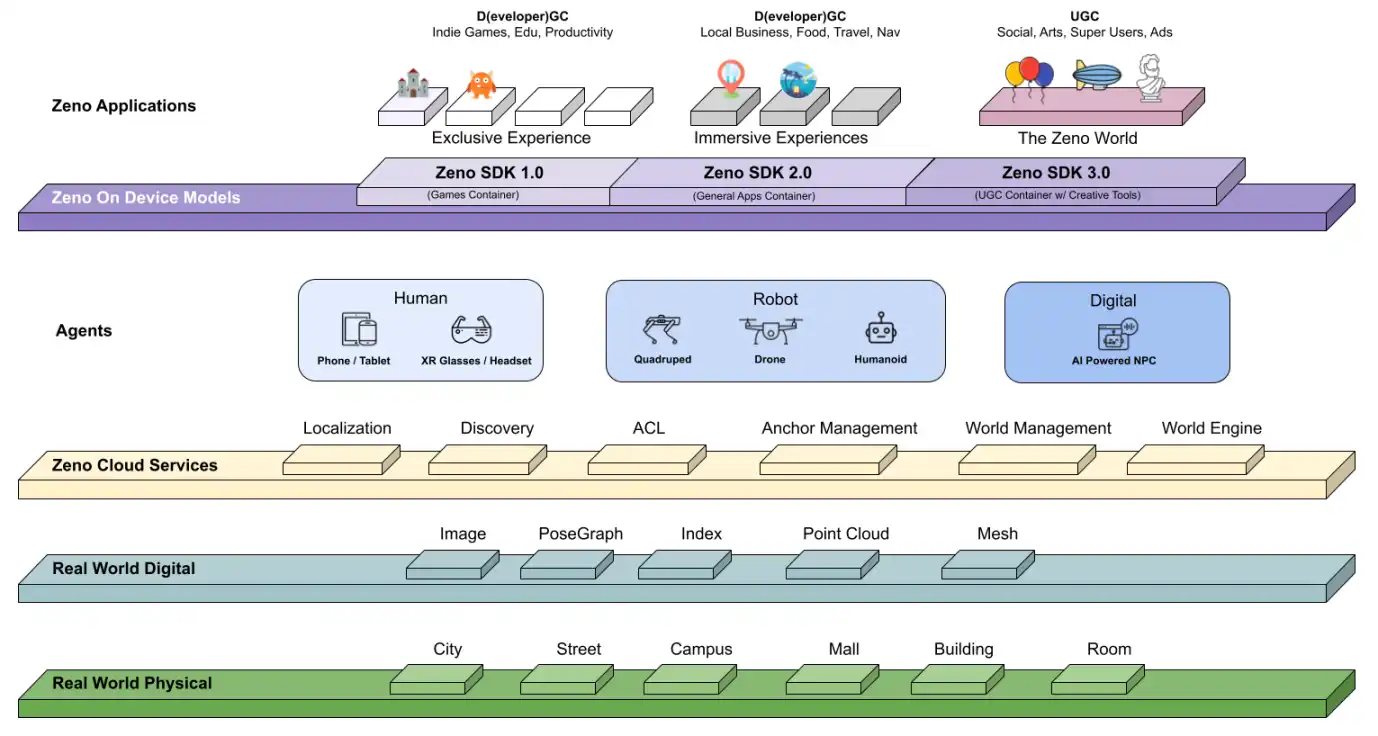
Furthermore, the system is equipped with self-learning capabilities to continually optimize through high-quality and third-party data. In the future, it will support hundreds of spatial queries per second, providing precise six degrees of freedom (6-DOF) positioning results, shared spatial anchor creation, rapid 3D visual reconstruction, real-time semantic segmentation, and other scene understanding functions. It is highly scalable and can be widely applied in various scenarios such as AR games, navigation, advertising, or productivity tools.
The validated spatial data and the built spatial intelligence infrastructure layer can be called by various decentralized applications for autonomous driving route planning, end-to-end model data training for robots, generating verifiable smart contracts for autonomous execution, spatial-form ad distribution, ultimately achieving spatial data-driven decision-making and higher-level applications.

Who is Behind Zeno?
Compared to some Web3 projects with vague visions, Zeno's goal, although sounding complex, is very practical. The reason why the technical implementation is described in such detail in the project documentation is that team members have been deeply involved in this field for many years.
Zeno's team members all come from DeepMirror, which is Chameleon Technology. If you are not familiar with Chameleon Technology, you may have heard of Pony.ai, a company listed on the Nasdaq with a market capitalization of $7 billion. Harry Hu, CEO of Chameleon Technology, was the former COO/CFO of Pony.ai.
Zeno's CEO, Yizi Wu, was an early member of Google X and was involved in the development of products such as Google Glass, Google ARCore, Google Lens, and the Google Developer Platform. At Chameleon Technology, he led the overall AI architecture and the development of the World Model.
The Zeno core team also includes Taoran Chen, who previously served as a research scientist at Horizon Robotics, holding dual doctoral degrees in mathematics from MIT and Cornell University, and Kevin Chen, who previously served as the CFO of Horizon Robotics and held executive positions at Fosun Group, JPMorgan Chase, and Morgan Stanley.
For the Zeno team, venturing into Web3 is more like a bold attempt by a tech-savvy Web2 team. The team described that the ZENO token will be used to incentivize users providing spatial data and teams or individuals adopting Zeno to build infrastructure development tools, applications, and games. In addition to the 5 billion tokens distributed in the launchpad, the team reserved 3 billion tokens, while the remaining 2 billion tokens will have liquidity pairs with 100 SOL obtained from the launchpad activity on Meteora.

Horizon Robotics' AR and game-integrated spatial application RealityGuard
When asked why they chose Web3 as their battlefield, Zeno told the author that spatial data itself is a highly decentralized digital asset that naturally fits into the Web3 environment. The spatial data collected by Zeno itself will also be securitized in the future and expanded through transactions using the ZENO token as currency within the ecosystem, with buyers being tech companies in need of spatial data. As for more applications of ZENO, they will be "further explored as the project progresses."
Through Zeno, it is believed that the DeSci platform has achieved concretization, where science is not necessarily an obscure and purely theoretical discipline, but rather a democratization of technology similar to Xiaomi, lowering the threshold for technology value investment, which is also one of the significant values of DeSci's existence.
-- Price
This content is provided for general informational purposes only and doesn't constitute financial, investment, legal, or tax advice. Any events, rewards, online promotions, or related information mentioned herein should not be considered a recommendation, solicitation, or invitation to purchase, sell, trade, or otherwise deal in any crypto assets. Crypto assets are highly volatile and may result in loss. The availability of WEEX services, products, and related events may vary by region. You are responsible for ensuring that your participation is in accordance with applicable local laws and regulations.
You may also like

Analyst: The Bitcoin daily Bollinger Bands have narrowed to a new low since early 2024, which may indicate a volatility of about 40%

Paradigm Invests $13.5 Million in the Brazilian Real Stablecoin Issuer Crown

Ethereum software bug triggers emergency fixes across major layer-2 networks

Kraken Owner Invests in Altcoin, Considers Further Purchases. You Should Recognize Him

Stablecoins offer sub-cent payments, Armstrong says, as critics flag risks

Analysis: Stablecoins, Payments, and Prediction Markets Have Become New Growth Points for Crypto Companies, but Profitability Remains Challenged

Nubank Suspends Crypto Withdrawals: What We Know So Far

Buffett's Successor Faces Setback, Google Holdings Show $3 Billion Unrealized Loss

Banking Outage in Japan: 128 Banks 'Frozen' at Once

Beyond APY: Saying Goodbye to Black Box Trust and Reassessing the Security Logic of ETH Staking

Argentine Bitcoiners Debut “The Genesis Of Satoshi Nakamoto” Artwork In Downtown Buenos Aires

Broadcom (AVGO) : AI Growth, Fund Positioning, and Guarantee Risk
Broadcom (AVGO) recently fell with the semiconductor sector, closing down 10.43% at $291.53 on November 5. The shares rebounded more than 4% in premarket trading on November 6. Concerns that election results could lead to tighter AI rules and slower data center approvals contributed to a broad sell-off, with a semiconductor index falling about 12%. The move appears tied mainly to sector sentiment and policy concerns, with no clear company-specific negative catalyst identified.
Institutional trading and AI growth expectations are also in focus. ARK funds sold about $134 million of Broadcom shares over two sessions while adding to SpaceX. Citi maintained its Buy rating and projected that Broadcom’s AI semiconductor revenue could reach $115 billion in fiscal 2027, roughly doubling year over year. Broadcom had approximately $179.2 billion in signed contracts as of the prior quarter, while analysts estimated fourth-quarter AI chip revenue at about $21.7 billion. These forecasts will need to be tested against future results.
Contingent guarantees are another point for investors to monitor. Broadcom is providing guarantees tied to Anthropic’s AI rack-leasing arrangement, involving about $29 billion in the first phase and a second-phase plan of up to $43 billion. Banks plan to issue $21 billion in bonds to support related chip financing. The guarantee amounts are not the same as debt already incurred, but they add a potential risk to assess. Broadcom is scheduled to report its next quarterly results on December 9, when management’s outlook for fiscal 2027 AI demand will be closely watched. This article is for informational purposes only and is not investment advice.

Netflix (NFLX) Stock Rebounds: Insider Sales, Advertising, and Growth Plans
Several Netflix executives sold company shares in early November 2026. Co-CEO Theodore Sarandos sold 27,312 shares from November 3 to 4, valued at about $1.81 million. CFO Spencer Neumann sold shares worth approximately $612,000. Co-CEO Gregory Peters realized about $1.69 million, including transactions related to tax withholding. Chief Legal Officer David Hyman and director Bradford Smith also reduced their holdings. Executive sales can have different reasons and should not be viewed on their own as a measure of the company’s outlook.
After recent pressure, Netflix shares rebounded more than 4% around November 4. Bill Ackman’s Pershing Square Capital Management allocated about 5% of its portfolio to Netflix, while new AI features and positive views on the company’s technology prospects helped sentiment. Netflix reported third-quarter 2026 revenue of $13.44 billion and earnings per share of $0.87, both above expectations, though its forward outlook remains a key focus.
Advertising is one of Netflix’s main challenges. Delays to key ad product features led the company to reduce its annual advertising revenue outlook from $3 billion to $2.7 billion. Viewer engagement has also faced pressure from changes in content appeal and competition from platforms such as YouTube. Netflix is pursuing growth through live events, gaming, and advertising, with plans to expand its ad-supported offering to 15 markets while adjusting its workforce by about 6% to improve margins. Investors may want to monitor advertising growth, engagement, and profitability. This article is for informational purposes only and is not investment advice.

Carvana Earnings: Record Sales, Strong Profit, and Insider Share Sales
Carvana reported third-quarter net revenue of $8.04 billion, up 42.4% year over year and above the $7.7 billion market estimate. Retail units sold reached a record 217,385, an increase of 39.4%. Net income rose to $483 million, while adjusted EBITDA reached a record $800 million, reflecting gains in both revenue and profitability.
Management expects full-year 2026 adjusted EBITDA to reach the upper end of its $2.7 billion to $3.0 billion range. Needham maintained its Buy rating, named Carvana a top pick in transportation technology, and set a $100 price target. Strong results and guidance have drawn investor attention, though continued performance will depend on sales, margins, and operating costs.
Insider transactions are also on investors’ radar. A regulatory filing indicates that CFO Mark Jenkins planned to sell 63,800 shares on November 2, 2026, valued at approximately $4.35 million. Since August, he has planned sales totaling 191,300 shares. An executive share sale alone does not determine a company’s outlook; investors may also consider earnings, cash flow, and future guidance. This article is for informational purposes only and is not investment advice.

FCEL Stock: Data Center Opportunity, Manufacturing Costs, and Lawsuit Risk
FuelCell Energy (ticker: FCEL) provides fuel-cell power solutions. Growing electricity demand from AI data centers could create new business opportunities, while proposed pauses on new data center approvals in some areas have raised concerns about project timelines. A 75-megawatt power project may be affected, and FCEL shares recently fell as much as about 17% in a single session amid policy concerns.
FCEL signed an agreement with Fit Energy to provide up to 380 megawatts of fuel-cell power solutions. Its backlog is approximately $3.6 billion, with about 97% of its sales pipeline related to data centers. The company also drew the second installment under a $49 million financing arrangement backed by an export credit agency, supporting a green energy project and clean-energy exports. Recent leadership changes include Matthew Latino becoming CFO, digital infrastructure executive Peter Hopper joining the board, and John Dansby leading manufacturing scale-up. Converting orders into revenue will depend on production capacity, costs, and project execution.
FCEL reported third-quarter revenue of about $33 million, down approximately 29% year over year, and a net loss of roughly $45.3 million. Product costs and manufacturing overhead for the Fit Energy agreement exceeded the contract pricing, resulting in an approximately $17 million contract impairment charge. Securities class-action allegations concern disclosures about manufacturing capacity and costs; the case remains in the legal process. The deadline to seek appointment as lead plaintiff is November 10, 2026. FCEL’s growth opportunities come with execution, financing, and litigation risks. This article is for informational purposes only and is not investment advice.

Democratic Party's AI Regulation Push Revealed: Plans for Intensive Legislation and Strict Scrutiny of Tech Giants

PFE Stock: Pfizer’s Q3 2026 Earnings, Business Strategy, and Dividend Outlook
PFE is the New York Stock Exchange ticker for Pfizer Inc. In the third quarter of 2026, Pfizer reported revenue of $16.58 billion and adjusted earnings per share of $0.87, both above market expectations. The company raised its full-year revenue outlook to $62 billion–$64 billion and its adjusted EPS guidance to $2.95–$3.05, pointing to stronger performance than previously expected.
Although demand for COVID-related products continues to decline, Pfizer’s non-COVID business is growing. Third-quarter sales reached $720 million for the cancer drug Padcev and $2.52 billion for Eliquis, up 25% year over year. Revenue from newer and acquired products rose 32%. Pfizer is expanding its oncology pipeline, entering the weight-loss treatment market through its acquisition of Metsera, and targeting approximately $9.7 billion in net cost savings by 2029. Cecile Guegan has also taken over as chief financial officer.
Investors are also watching Pfizer’s dividend and legal developments. The company declared a cash dividend of $0.43 per share, with an ex-dividend date of November 6, 2026. Analysts raised some earnings estimates and price targets following the quarterly results. Pfizer also faces ongoing legal scrutiny related to statements about COVID vaccine safety, while its subsidiary Mylan has sued Novo Nordisk over generic-drug patent issues involving Wegovy. Pfizer’s outlook depends on new-product growth, cost savings, patent matters, and litigation developments. This article is for informational purposes only and is not investment advice.

South Korea’s GOPAX halts crypto trading, withdrawals after hacking threat

Bhutan: A royal decree opens the future central bank's reserves in Gelephu to cryptocurrencies

AI Begins to Shake Google's Search Advertising Business Behind $500 Billion Market Value Erosion
What is the real challenge for South Korean exchanges now that the regulatory framework is in place?

What Is TLT? Long-Term Treasury Bonds After the Midterm Election

Former FBI Agent Pleads Guilty to Stealing $2.5M in Crypto From 35 Investigations

Mr&强 Discusses Bitget Forex Trading Upgrade with Up to 2000x Leverage

Breaking Down Bitcoin Trends: What Determines the True Value of L1?

Chainalysis Attack More Serious Than Expected: User Password Hashes and Active Tokens Leaked

U.S. Stocks Plunge $2.8 Trillion Overnight! Top Silicon Valley VC Reveals: 90% of Open Source Model Spending Goes to China

StockFi: Connecting U.S. Stock with the On-Chain Ecosystem to Reshape Asset Circulation

Cassius Cuvee on Market Euphoria, High Leverage, and How to Stay in the Game

What Do Tokenized Deposits Need to Compete with Stablecoins?
Analyst: The Bitcoin daily Bollinger Bands have narrowed to a new low since early 2024, which may indicate a volatility of about 40%
Paradigm Invests $13.5 Million in the Brazilian Real Stablecoin Issuer Crown
Ethereum software bug triggers emergency fixes across major layer-2 networks
Kraken Owner Invests in Altcoin, Considers Further Purchases. You Should Recognize Him
Stablecoins offer sub-cent payments, Armstrong says, as critics flag risks
Analysis: Stablecoins, Payments, and Prediction Markets Have Become New Growth Points for Crypto Companies, but Profitability Remains Challenged


