
Why Is Quant (QNT) Price Rising? The Clearing House Tokenized Deposit Deal Explained

 Prefer us on Google

Quant (QNT) is rising primarily because The Clearing House selected Quant to power an institutional network for clearing and settling tokenized bank deposits. Announced on September 24, 2026, the project connects blockchain-based money with established U.S. payment infrastructure. Traders interpreted the agreement as significant validation of Quant’s enterprise technology, although the announcement did not disclose commercial terms or prove that network adoption will create proportional demand for the QNT token.
The partnership deserves attention, but the market has moved faster than the evidence. Quant winning a role in critical banking infrastructure is materially more important than another proof-of-concept announcement. Still, a strong enterprise contract and a rapidly appreciating token are not automatically the same investment thesis. The missing link is measurable value capture: how much usage reaches Overledger, how much QNT that usage requires, and whether the resulting demand is meaningful relative to speculative trading.
The Bottom Line
- The Clearing House selected Quant for its On-Chain Money initiative on September 24, 2026.
- The planned network is intended to let regulated financial institutions clear and settle tokenized deposits.
- Industry coverage indicates that the system is designed to connect with existing U.S. payment rails, including RTP and CHIPS.
- QNT’s price response reflects institutional validation, limited market liquidity and aggressive momentum trading.
- The announcement does not disclose contract economics or establish a simple relationship between payment volume and QNT demand.
- Price feeds diverged unusually widely during the rally, underlining the risks of trading a fast and fragmented market.
- WEEX currently provides both QNT/USDT spot and perpetual-futures markets.
What Happened to Quant (QNT) on September 24, 2026?
The Clearing House announced that it had selected Quant to power its On-Chain Money initiative, described as an interoperable payments network through which financial institutions can clear and settle tokenized deposit transactions.
This matters because The Clearing House is not a crypto-native startup. It operates payment infrastructure used by regulated financial institutions in the United States, including the RTP real-time payment network. The announcement therefore places Quant’s technology inside a serious institutional payments project rather than an isolated blockchain experiment.
According to industry reporting, the proposed system is intended to connect blockchain-based settlement with existing fiat-payment infrastructure such as RTP and CHIPS. Initial use cases could include corporate treasury operations, liquidity management, cross-border payments and digital-asset settlement. Network availability is expected in the first half of 2027, subject to implementation progress and participating institutions.
That timeline is important. The announcement concerns infrastructure that is still being developed. The market is pricing an expectation of future usage—not reporting established production revenue or mature transaction volume.
How Will The Clearing House’s Tokenized Deposit Network Work?
A tokenized deposit is a digital representation of a commercial-bank deposit. Unlike an unbacked crypto asset, it remains a liability of the issuing bank. Its purpose is to bring some of blockchain’s programmability and settlement advantages into regulated banking.
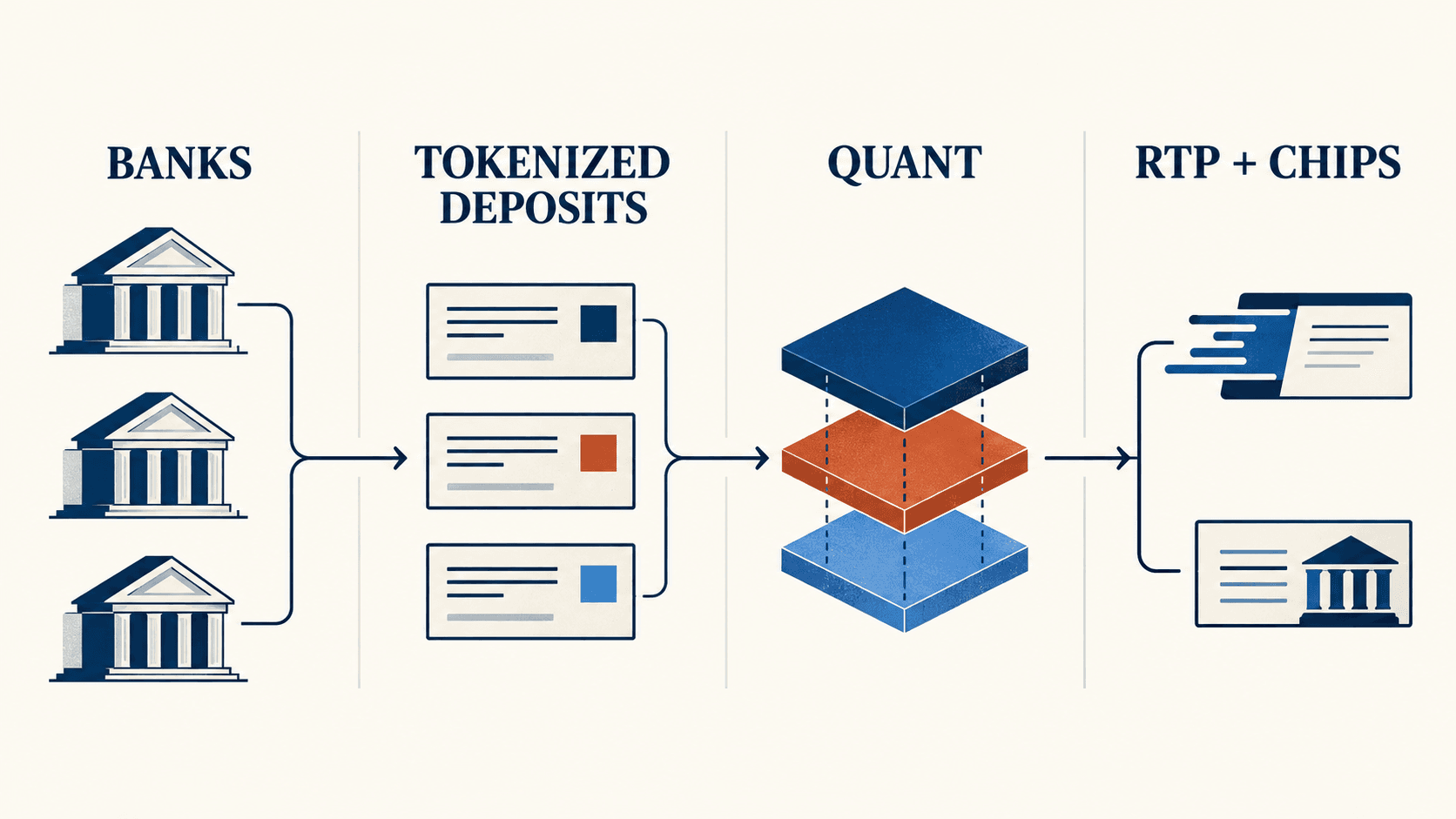
The planned workflow can be understood in four stages:
- A regulated bank issues or transfers a tokenized representation of a deposit.
- Quant’s infrastructure coordinates communication and transaction logic across participating systems.
- The transaction connects with existing bank-payment and settlement networks.
- Participating financial institutions reconcile the transfer within their compliance and operational frameworks.
Quant describes Overledger as infrastructure that helps enterprises manage digital assets and workflows across public and private blockchains while supporting interoperability, compliance and automation. Its institutional use cases include delivery-versus-payment, reconciliation and liquidity management.
The opportunity is not merely to place bank deposits on a blockchain. Banks already operate multiple ledgers, payment networks and compliance systems. The harder problem is making those systems communicate without forcing every participant onto one blockchain.
That interoperability layer is where Quant is trying to establish its value.
-- Price
Why Did the Quant (QNT) Price Rise So Sharply?
No single factor fully explains the rally. The price response appears to combine a credible fundamental catalyst with market-structure effects.
1. Institutional validation
The Clearing House partnership gives Quant a recognizable financial-infrastructure customer and a concrete institutional use case. For a token whose investment narrative depends heavily on enterprise adoption, this is more meaningful than a generic memorandum of understanding.
The announcement demonstrates that Quant’s technology passed at least part of the technical, operational and institutional selection process required for a major banking initiative.
2. A scarce and relatively illiquid trading market
When demand enters an asset with less market depth than Bitcoin or Ethereum, price can move disproportionately. A relatively modest amount of aggressive buying may consume available sell orders and cause abrupt repricing.
This is why crypto liquidity matters. A 50% or 100% move does not necessarily mean that an equivalent percentage of the token’s market capitalization entered the asset as new cash.
3. Narrative concentration
The announcement combines several themes the market already finds attractive:
- Tokenized real-world assets
- Bank-issued digital money
- Institutional blockchain adoption
- Interoperability
- Faster cross-border settlement
- Integration between crypto infrastructure and conventional finance
A catalyst that supports several narratives simultaneously can attract long-term investors, event-driven traders and short-term momentum buyers at the same time.
4. Momentum and forced positioning
Once QNT broke above previous price ranges, traders following volume and breakout signals may have accelerated the move. Short positions can also be forced to close during a rapid rise, creating additional market purchases.
That does not mean every part of the rally was a short squeeze. It means leveraged positioning can amplify a move that began with legitimate news.
How Much Did the Quant (QNT) Price Increase?
The exact answer depends on the exchange, data provider and measurement time.
During the September 28 session, different feeds displayed unusually different QNT prices and daily ranges. One market feed showed an intraday range of approximately $167 to $350, while CoinGecko displayed QNT near $187.52 with a seven-day gain of about 189%. Other trackers reported prices above $200 during portions of the session.
This divergence is not a minor technical detail. It reveals three risks:
- Prices were changing rapidly between observation times.
- Different platforms aggregate different exchanges and liquidity sources.
- Thin order books and extreme volatility can produce temporary dislocations.
For this reason, claims that QNT rose by a precise percentage should always identify the starting price, ending price, exchange and timestamp. Depending on those choices, a source could reasonably report a substantially different gain.
Data cutoff: September 28, 2026, approximately 14:40 UTC. The supplied Google Trends screenshot did not show an exact data-collection timestamp.
Is the Quant (QNT) Rally Supported by Token Utility?
QNT is the utility token associated with Quant’s Overledger ecosystem. Quant states that the token can be used in connection with access to its products and services, while Overledger documentation describes transactions as being powered by QNT. Corporate customers may also be offered fiat-payment options.
That last point complicates the investment thesis.
If an enterprise pays Quant in fiat, the customer may not need to acquire QNT directly on an exchange. Quant’s architecture or treasury process might still create token-related demand behind the scenes, but the public announcement does not specify:
- How much QNT will be required
- Whether tokens will be purchased from the open market
- Whether tokens are locked and for how long
- How transaction volume affects token consumption
- Whether fees scale with payment value or transaction count
- How revenue from the partnership flows to token holders, if at all
These are the central token utility and value capture questions. The partnership strengthens the case that Quant’s technology has enterprise relevance. It does not yet quantify the economic benefit accruing to QNT holders.
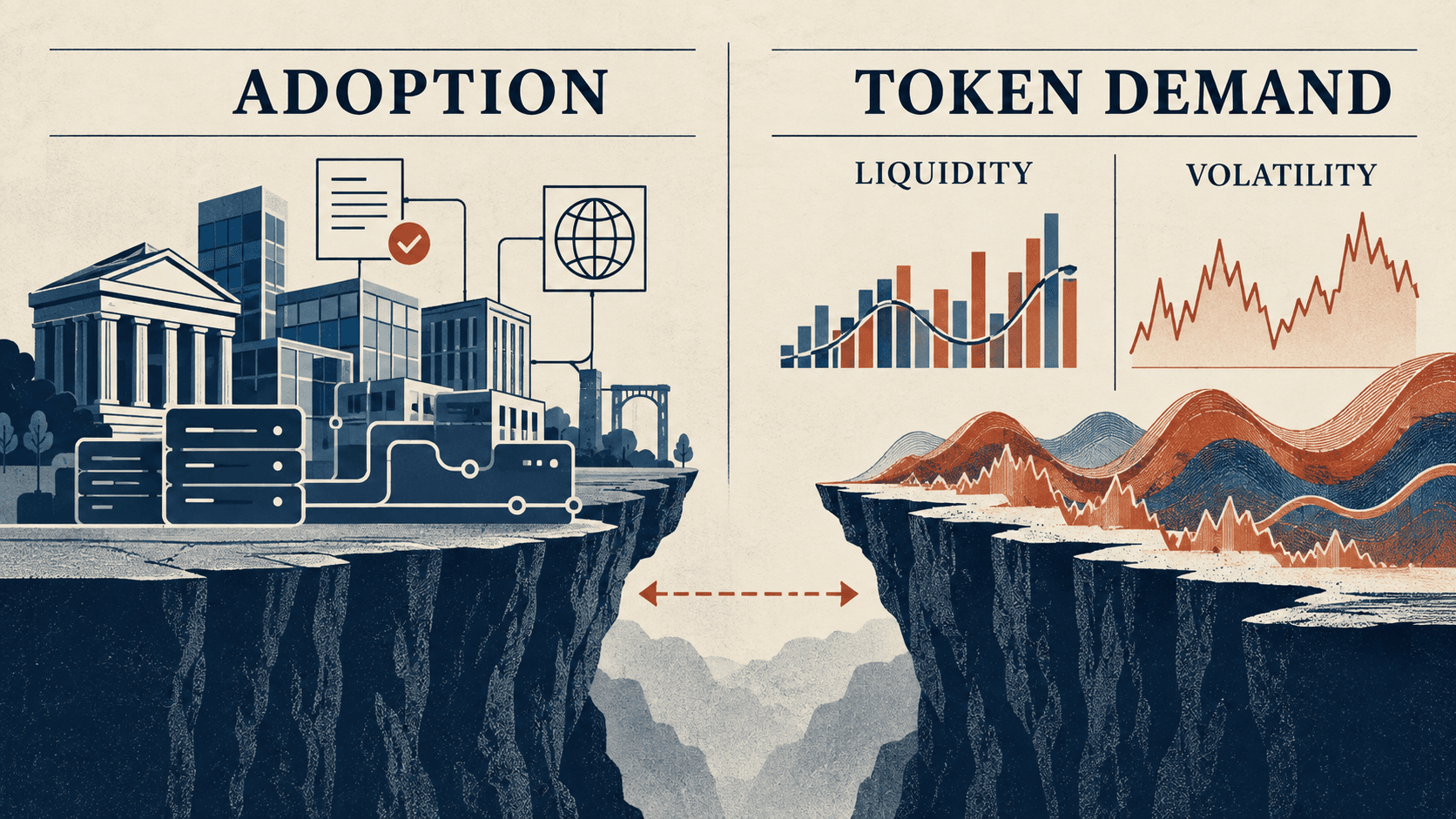
Institutional Adoption and QNT Demand Are Not the Same Thing
Investors should separate two related but distinct propositions.
| Proposition | Current evidence | What remains unknown |
|---|---|---|
| Financial institutions see value in Quant’s infrastructure | Supported by The Clearing House selection | Breadth of participating banks and production volume |
| The initiative could expand tokenized-deposit use | Supported by the stated project purpose | Adoption rate and implementation timeline |
| Overledger may process meaningful institutional activity | Plausible, but forward-looking | Actual transaction count and revenue |
| Greater network usage will increase QNT demand | Possible | Exact token-purchase and locking mechanism |
| The recent QNT valuation is sustainable | Not established | Revenue, usage and liquidity required to support it |
The first proposition is substantially better supported than it was before the announcement. The final two remain assumptions that need to be tested against future disclosures.
One independent market analysis reached a similar conclusion: the partnership is a notable real-world use case, but the direct relationship between adoption and QNT demand remains unclear because commercial terms have not been disclosed.
Is QNT a Stock or a Cryptocurrency?
QNT is a cryptocurrency token. It is not common stock in Quant Network, and holding QNT does not automatically provide equity ownership, dividends or a contractual claim on company revenue.
Searches for “QNT stock” can also reflect confusion with Quantinuum, a separate quantum-computing company. Quant Network and Quantinuum are unrelated businesses:
| Name | Category | Relevant asset |
|---|---|---|
| Quant Network | Blockchain interoperability company | QNT cryptocurrency |
| Quantinuum | Quantum-computing company | Private-company equity; not the QNT token |
| QNT | ERC-20 crypto asset | Utility token associated with Overledger |
This distinction matters because an enterprise partnership involving Quant Network can affect sentiment around QNT, but purchasing the token is not equivalent to investing in the company’s shares.
What Could Cause the Quant (QNT) Price to Fall?
The same market structure that accelerates a rally can accelerate a correction.
Delayed implementation
The proposed network is expected to become available in 2027. Enterprise infrastructure projects can face integration, regulatory and onboarding delays.
Limited public economic details
Neither the initial announcement nor available supporting materials disclose contract value, expected revenue or the precise relationship between the project and open-market QNT demand.
Speculative positioning
After a vertical move, late buyers may be relying on continued momentum rather than a valuation framework. If volume falls or the price loses a widely watched support level, exits can become crowded.
Price fragmentation
Large differences between exchange and aggregator prices make execution harder. Market orders may fill far away from a trader’s expected price, especially when liquidity is changing rapidly.
“Buy the news” exhaustion
The partnership may remain strategically important even if the token declines. Markets frequently price anticipated growth immediately, then wait months for operating evidence.
A falling QNT price would not prove that the project failed. Likewise, a rising price does not prove that the token has captured the project’s long-term economics.
How to Trade Quant (QNT) on WEEX
WEEX currently provides both spot and perpetual-futures access to Quant (QNT).
Buy Quant (QNT) in the spot market
Use the WEEX QNT/USDT spot market to exchange USDT for QNT.
- Sign in to your WEEX account.
- Deposit or purchase USDT.
- Open the QNT/USDT spot page.
- Choose a limit order if you want to specify the maximum purchase price.
- Check the estimated quantity and fee before confirming.
- Review the completed order in your spot account.
During an unusually volatile session, a limit order gives the trader more control than an unrestricted market order. It does not guarantee execution, but it can prevent an unexpected fill far above the displayed price.
Trade Quant (QNT) perpetual futures
The WEEX QNT/USDT perpetual-futures market allows eligible users to take long or short positions without owning the underlying token.
- Transfer USDT to the futures account.
- Open the QNT/USDT perpetual contract.
- Select isolated or cross margin.
- Set leverage conservatively.
- Choose a limit or market order.
- Define an invalidation level and stop-loss before entering.
- Monitor the funding rate, liquidation price and available margin.
Current WEEX materials indicate that QNT perpetual funding is settled at 00:00, 08:00 and 16:00 UTC. Funding can change, so traders should verify the rate shown on the live contract page before opening a position. (WEEX)
WEEX was running broader futures promotions during the research period, but no QNT-specific reward or fee discount was independently confirmed. Eligibility, supported contracts and campaign dates should therefore be checked on the relevant live promotion page rather than assumed.
What Should Quant (QNT) Traders Watch Next?
The next phase of the QNT story should be judged through evidence rather than partnership headlines alone.
Participating financial institutions
The number and profile of banks joining the initiative will indicate whether this becomes shared infrastructure or remains a limited launch program.
Production timeline
Progress toward the expected first-half 2027 availability window will be more informative than repeated announcements that contain no new implementation details.
Live transaction volume
Actual tokenized-deposit transactions would provide better evidence of adoption than projected use cases.
QNT value-capture disclosures
Investors need clearer information about licensing, token requirements, transaction fees, locking mechanisms and the treatment of fiat-paying enterprise customers.
Spot volume and derivatives positioning
A rally supported by durable spot buying is structurally different from one dominated by highly leveraged perpetual contracts. Traders should compare price with volume, funding and open interest rather than evaluating the chart alone.
Price agreement across exchanges
Narrower spreads and greater agreement among price aggregators would indicate that the market is becoming more stable. Continued large discrepancies would suggest persistent liquidity and execution risk.
Our View: The Partnership Is Real, but the Market Has Skipped Several Steps
The Clearing House announcement is one of the stronger pieces of institutional validation Quant has received. It attaches Overledger to a recognizable banking problem and gives Quant an opportunity to prove that interoperability can work beyond controlled demonstrations.
But QNT’s price action is behaving as if the market already knows the scale of adoption, revenue and token demand. It does not.
The intelligent bullish case is that Quant has gained a credible route into U.S. bank-payment infrastructure. The careless bullish case is that every tokenized dollar must automatically create equivalent QNT buying pressure. Those arguments are not interchangeable.
Until Quant or The Clearing House publishes more detail, the partnership should be treated as a meaningful operational milestone—not a blank cheque for any token valuation. Investors who understand that distinction are evaluating infrastructure. Traders who ignore it are mostly betting on momentum.
FAQ
1. Why is Quant (QNT) price rising?
Quant (QNT) rose after The Clearing House selected Quant to support an institutional tokenized-deposit network. Institutional validation, limited liquidity, momentum trading and speculative positioning amplified the market reaction.
2. What is The Clearing House’s agreement with Quant?
Quant was selected to power the On-Chain Money initiative, which is intended to help regulated financial institutions clear and settle tokenized deposit transactions while connecting blockchain systems with existing payment infrastructure.
3. Is QNT a stock?
No. QNT is a cryptocurrency utility token associated with Quant’s Overledger ecosystem. It does not represent common stock or direct ownership in Quant Network.
4. Does The Clearing House partnership require banks to buy QNT?
The public announcement does not establish that participating banks must purchase QNT directly from the open market. The technical and commercial relationship between network activity and token demand has not been fully disclosed.
5. Where can I trade Quant (QNT)?
Eligible users can access the QNT/USDT spot market or the QNT/USDT perpetual-futures market on WEEX. Availability can depend on jurisdiction and account status.
6. Is Quant (QNT) still risky after the institutional partnership?
Yes. The project remains under development, contract economics are undisclosed and QNT experienced extreme price volatility. Institutional adoption may strengthen Quant’s technology thesis without guaranteeing a particular token valuation.
Sources
- The Clearing House, “The Clearing House Partners with Quant to Advance the On-Chain Money Initiative,” September 24, 2026. (The Clearing House)
- Quant, partnership announcement and Overledger product materials, accessed September 28, 2026. (Quant)
- PYMNTS, coverage of Quant’s role in the institutional tokenized-deposit network, September 24, 2026. (pymnts.com)
- FinTech Futures, On-Chain Money implementation and payment-network coverage, September 25, 2026. (fintechfutures.com)
- CoinGecko and market price feeds, observed September 28, 2026. (CoinGecko)
- User-supplied Google Trends screenshot. The screenshot indicated rising interest in QNT-related queries but did not display an exact data timestamp.
This content is provided for general informational purposes only and doesn't constitute financial, investment, legal, or tax advice. Any events, rewards, online promotions, or related information mentioned herein should not be considered a recommendation, solicitation, or invitation to purchase, sell, trade, or otherwise deal in any crypto assets. Crypto assets are highly volatile and may result in loss. The availability of WEEX services, products, and related events may vary by region. You are responsible for ensuring that your participation is in accordance with applicable local laws and regulations.
You may also like

What Do Tokenized Deposits Need to Compete with Stablecoins?

Kalshi Raises $1 Billion, But Time is Running Out

The Pricing Gap in Prediction Markets: Why Are There Four Different Probabilities for the Same Election Outcome?

Who Will Be Making Your Investment Decisions in 2027?

Why Is Quant (QNT) Crypto Up Today? What Price and Volume Really Show
Why is Quant (QNT) up today? Review price and volume evidence, the banking partnership timeline, token-demand assumptions, and risks before trading.

Diverging Sentiment in Altcoins: How Whales Operate Amid Market Panic

The New PayPal Mafia: 10 Interns, $100 Billion

Quant (QNT) Price Prediction 2026–2030: Can Bank Adoption Drive a Return to $500?

DeepSigma launches RWA perpetuals demo with 77 traditional markets

The crypto job market accelerates: job postings triple to 1,241 in three months

QNT Price Surged 5x in September: Can Quant Actually Break $400
QNT price climbed from around $60 to as high as $372 in September before settling near $300, a move driven by Quant's selection for a major U.S. banking initiative. With RSI above 81 and a founder linked wallet moving millions in tokens, the next move hinges on whether $400 gets absorbed or rejected.

Mr&强 Claims QNT Rises 300% in a Week, Driven by Buying in Europe and the US
QNT Price Prediction October 2026: Can Quant Stay Above $300?
QNT price prediction for October 2026: Explore Quant’s Clearing House catalyst, recent rally, key support and resistance levels, and whether QNT can stay above $300.

Quant Secures Major Deal with US Clearing House: What Comes After the 300% Surge?
QNT Token Has Surged Sharply in a Week: What The Clearing House Deal Does and Doesn't Mean for Holders
QNT jumped after The Clearing House picked Quant to build a bank tokenized deposit network. The announcement is about the company, and how it reaches the token has not been disclosed.

Quant Provides Technical Support for The Clearing House's Tokenized Deposit Clearing Network

The Clearing House Selects Quant for US Tokenized Deposit Network

The Clearing House Chooses Quant to Support Tokenized Deposit Technology
WEEX AI Wars II: Round 2 Recap — Humans Just Broke the Leaderboard (Literally)
Round 2 of WEEX AI Wars II has closed, and Team Human didn't just win again — they posted returns north of 50,000%. Here's the full breakdown, how the gap to Team AI widened even further, and how to join Round 3's live $20,000 USDT prize pool.

WEEX AI Wars II: Round One Is Over, The War Has Just Begun
Round 1 of WEEX AI Wars II has closed with humans dominating the top of the leaderboard. Here's the full breakdown of the results, what's coming in Round 2, and how anyone — trader or spectator — can still get in on the action and start earning rewards.

Killa: Bitcoin Prices Move Ahead of Macroeconomic Changes

Cryptocurrency Arbitrage and Price Scanning: How Quants Identify Inefficiencies in Funding Rates and Spreads Using Trading APIs
The Leverage Frenzy of Borrowing to Invest in Stocks: Why Wall Street is Paying Attention to the Sharp Decline in the Korean Stock Market

Bitfire launches compliant crypto quant strategy as RWA assets top HK$2B

Jane Street Loses $15 Billion in July Due to AI Fund Collapse

Scale Labs Unveils AI Prediction Market Sandbox Agent Fit

Helio Protocol's XAUT ecosystem has reached a strategic cooperation with Dephy and APRO

Trump appoints Todd Blanche, the author of the cryptocurrency enforcement memorandum, as acting Attorney General
Polymarket Fee Surge Explained: Where Did 90%+ of Extreme Fees Come From?

Founder of DeepSeek's magic square quantitative strategy achieved a 56.55% return last year, with assets under management exceeding 700 billion yuan
What Do Tokenized Deposits Need to Compete with Stablecoins?
Kalshi Raises $1 Billion, But Time is Running Out
The Pricing Gap in Prediction Markets: Why Are There Four Different Probabilities for the Same Election Outcome?
Who Will Be Making Your Investment Decisions in 2027?
Why Is Quant (QNT) Crypto Up Today? What Price and Volume Really Show
Why is Quant (QNT) up today? Review price and volume evidence, the banking partnership timeline, token-demand assumptions, and risks before trading.
Diverging Sentiment in Altcoins: How Whales Operate Amid Market Panic




