
When Openclaw Founder Advises Young People to Stay Away from Crypto

 Prefer us on Google


Original Title: "When OpenClaw Founder Advises Young People to Stay Away from Crypto"
Original Author: Golem, Odaily Planet Daily
On February 27, when a user on the X platform asked OpenClaw founder Peter Steinberger for the "best advice for a 20-year-old," Peter Steinberger bluntly stated, "Don't waste time on cryptocurrency." As the founder of the current hottest AI product, Peter Steinberger has not hidden his disdain for cryptocurrency. He has warned cryptocurrency professionals not to harass him about it, and even mentioning Bitcoin in OpenClaw's Discord will result in a ban.
This harsh statement has sparked collective jokes and self-deprecation in the crypto community. However, unlike when the crypto market is in a downturn and cryptocurrency professionals chant "cryptocurrency is dead," when "don't waste time on cryptocurrency" is used as advice to young people by a top AI entrepreneur, this statement still stings the crypto industry.
It has put anxiety right in front of us — cryptocurrency is no longer the optimal solution for today's young people.
Recall 2011, when cryptocurrency OG, Bitcoin founder Chang Jiaoxian, suggested that college students spend all 6,000 RMB to buy Bitcoin, the response was considered one of the most powerful examples of the cryptocurrency industry's long-termism and suitability for young people to join. However, Chang Jiaoxian himself has not always stayed in the cryptocurrency industry. By 2023, Bitcoin had stopped publishing cryptocurrency-related information and shifted to publishing content in AI, metaverse, and other fields. In 2024, Chang Jiaoxian shifted to entrepreneurship in the AI field and completely disappeared from the crypto community.
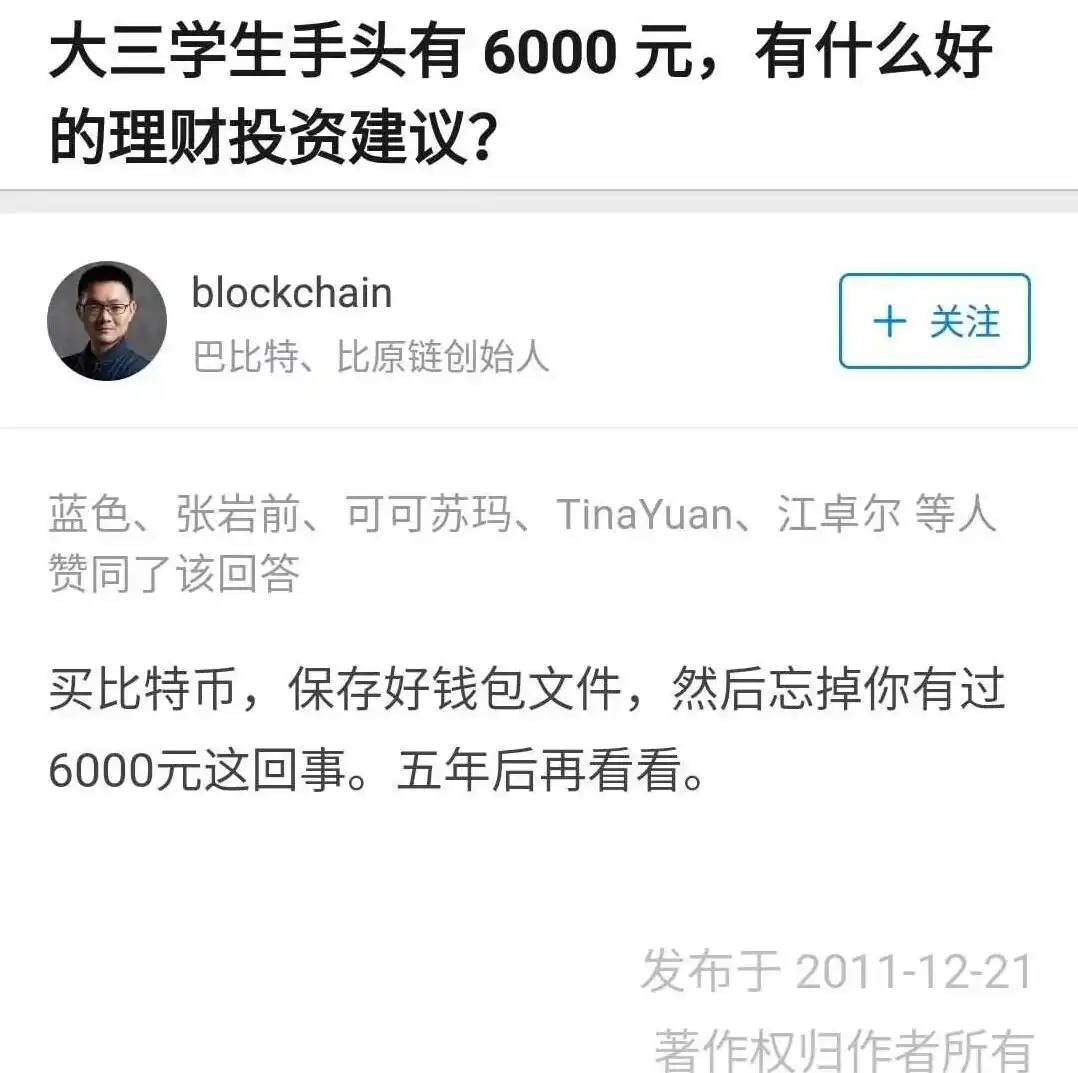
The preemptive Chang Jiaoxian has caused much controversy, and now the fact that the crypto community is being siphoned by AI has become indisputable. Talent is migrating, capital is being reallocated, and attention is shifting.
Talent Migration: OGs are Becoming AI Bloggers
Another cryptocurrency OG, Cobo co-founder and CEO Fish God, is also an early representative of the Bitcoin mining circle. As a multi-cycle survivor, Fish God often shares his personal understanding of market phases and investment insights on social media, which is highly welcomed in the crypto community.
However, recently Fish God has transitioned from a crypto OG to an AI blogger, with over 80% of the content on his social accounts in the past month being about OpenClaw, while crypto-related content is scarce. Fish God himself also humorously acknowledges his successful transition.

The Fish God's exploration and focus on AI have only remained at a personal level, with the company's business and personal career still primarily focused on crypto. Therefore, for now, we can interpret the Fish God's obsession with AI as a good habit of actively improving oneself during "market junk time" and keeping up with the cutting edge of the era. However, talent migration from crypto to AI is indeed happening.
One of zkSync's executives, Anthony Rose, announced on February 4th that after working for four years at Matter Labs, he will be leaving and most likely transitioning to AI. Nader Dabit, the Developer Advocate Director of EigenLayer, also announced on February 5th that he would be leaving EigenLayer to become a growth lead at an AI company, stating that he has "joined the future."
One of the most noteworthy recent examples of exiting the circle is Kyle Samani, the co-founder of Multicoin Capital, who announced his departure from the crypto industry to focus on AI, robotics, and other fields. Kyle Samani was known for his early bet on Solana, so his exit has somewhat shaken confidence in the crypto industry. Even more absurdly, on the day Kyle Samani left the circle, he also disparaged the cryptocurrency industry, saying, "Cryptocurrency is simply not as interesting as many people (including myself) once imagined."
Capital Migration: Native Crypto VCs Begin Allocating to AI
Native crypto VCs are also unwilling to waste more time on the crypto industry.
According to The Wall Street Journal on February 28th, the crypto venture capital firm Paradigm is planning to raise a new fund focused on AI and robotics, with a fund size of up to about $1.5 billion. Paradigm is one of the purest native crypto capitals, gaining fame in 2019 for investing in and incubating Uniswap. Since then, its early investments in other crypto projects (such as Lido, Optimism, dYdX, Blur) have also been successful, making this "research-driven" VC institution on par with a16z crypto.
It is precisely because of this that Paradigm's shift is significant.
If crypto is still in a period of rapid innovation, continuously producing projects capable of attracting billion-dollar investments, Paradigm would not need to establish a separate heavy-weight fund for AI. However, the reality is that the crypto industry's infrastructure narrative (such as L1, L2, DEX, etc.) has become highly intertwined, and the number of truly high-quality early-stage projects with "paradigm-shifting" potential is now few and far between.
The entire crypto VC space has run out of good projects to invest in. Looking at the data, it is clear that the number of venture capital deals in the crypto industry has been decreasing year over year for the past four years. In 2022, there were 1639 crypto primary market financing deals, which dropped to 829 deals in 2025. The share of early-stage financing has also decreased from 50% to below 35%.
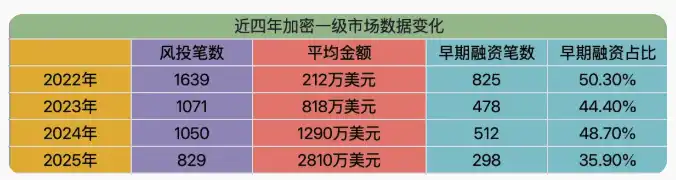
Source: One Year Later, What Can Still Be Traded in the Crypto Market?
When there are no viable investment options in the crypto industry, AI, as an industry at the forefront of the trend, naturally becomes the best destination for crypto capital deployment. From large foundational models to AI agents, from computing power chips to the robotics industry, AI can not only accommodate capital at scale but also continue to create growth narratives, making it the largest reservoir of global capital today.
For a VC managing over $12.7 billion in assets, the core proposition has never been about whether "faith is wavering" but rather about whether the "return function still holds." As the number of projects that the crypto industry can support decreases, a singular bet on crypto means an increase in portfolio risk and a decrease in return elasticity. In this scenario, continuing to insist on being "crypto-native" is irrational.
Therefore, Paradigm's proactive expansion into AI is also a trend-driven by the era, not a strategic issue of individual institutions but a signal of the industry stage.
Attention Shift: When Crypto Players Become Obsessed with AI
In terms of market attention, Crypto is an industry that knows best how to ride the waves, whether it's a political hot topic, technological frontier, or social headline. Whenever there's a buzz, you can always see projects or memes related to the hype circulating in the crypto community. Whenever the AI industry experiences a technological upgrade or product innovation, the crypto community always has related "Crypto+AI" projects or meme coin hype to attract market attention.
When OpenClaw went viral, although the crypto community was quick to find angles to ride the wave, such as hyping meme coins of the same name, commanding OpenClaw to trade tokens autonomously, and placing bets on market predictions to earn money, crypto players later began to become more pure, shifting from "how to crypto-fy OpenClaw" to "how to truly use OpenClaw."
Many crypto researchers started sharing continuous OpenClaw installation and usage tutorials, openly sharing their AI workflows, going into detail on how to train personal AI agents to help with coding, investment research, content generation, etc. Some crypto KOLs even started offering side gigs to install OpenClaw for novices at a fee.
Offline AI exchange events organized by the crypto community are also attracting a full house. One of the most popular offline events recently is the "Web4 China Tour" led by crypto OG Kongjian Ping, which took place from February 25 to March 8 in five cities in China. The main topics were OpenClaw and Agent, with hardly any crypto-related content.
This is no longer about riding the hype but a real shift in focus. Crypto players who pride themselves on being forward-thinking are starting to fear falling behind in the AI era.

Full House at Crypto Community's Offline AI Event
Why are crypto professionals so obsessed with AI?
The crypto community is already the most concentrated industry of "super-individuals," with a large number of independent developers, traders, and content creators. These individuals naturally seek to enhance tool efficiency to compensate for the inefficiency of human effort. Therefore, when AI can significantly amplify personal productivity, crypto players will be among the first to embrace it.
Furthermore, the core of crypto culture itself has a strong geek spirit and tech worship. Although in recent years the "technology narrative" has been diluted, most crypto players still believe that "foundational technology can change the world." Now, AI embodies a more revolutionary technological essence than blockchain, naturally sparking wild enthusiasm among crypto players.
Of course, a more practical reason is the crypto market's lull, with AI continuously creating "new things," while Crypto has been restructuring old narratives. There is no native crypto innovation, no significant wealth effect. The entire crypto community is hanging by a thread on market predictions and the tiny externality brought by RWA. At this time, the new discussion topics and cognitive stimuli provided by the AI industry, rather than seizing crypto attention, are more like filling the spiritual void of crypto players after the market's pace has slowed down.
-- Price
We Should Talk About Things Beyond Crypto and AI
Finally, returning to the beginning of this article, the reason why the statement from the OpenClaw founder drew attention from the crypto community was not because it was disdainful but because it articulated a fact that many crypto individuals are quietly validating through action—the smartest ones are reallocating their time.
We are now facing a period of declining wealth generation rates and explosive technological productivity.
On the one hand, as the crypto cycle slows down, Alpha shrinks, and the wealth growth curve flattens, crypto players who relied solely on "information gathering - chasing hot trends - yield farming" in the past year are experiencing diminishing marginal returns. On the other hand, AI is compressing the "time needed to solve problems," with tasks like coding, content creation, and other activities that used to require a significant time investment now being completed by models in minutes, far more efficiently than individual humans.
When the "process volume of pursuing outcomes" is highly condensed by AI, we may actually have more free time to engage in activities that are not driven by efficiency and profitability — seeking "carbon-based meaning," experiencing the world, establishing a cognitive system independent of market fluctuations, and constructing our own value system.
In the future of AI, what may truly differentiate people and create gaps between them are perhaps aesthetics, independent judgment, and personal meaning construction.
This content is provided for general informational purposes only and doesn't constitute financial, investment, legal, or tax advice. Any events, rewards, online promotions, or related information mentioned herein should not be considered a recommendation, solicitation, or invitation to purchase, sell, trade, or otherwise deal in any crypto assets. Crypto assets are highly volatile and may result in loss. The availability of WEEX services, products, and related events may vary by region. You are responsible for ensuring that your participation is in accordance with applicable local laws and regulations.
You may also like

SharpLink Deploys $400 Million ETH to Ether.fi and Lido

Important News from Last Night and This Morning (September 27 - September 28)

ConsenSys Announces Plan to Separate MetaMask and Institutional Business
ENA, SUI, and EIGEN Unlock Over $20 Million in Tokens This Week

ether.fi Removes Restaking From weETH, Nearing A Full EigenLayer Exit
Cryptocurrency venture capital firm Ethereal Ventures has disclosed for the first time that the total size of its two funds is approximately $150 million

Morning Report | Visa includes Polygon in its global stablecoin settlement program; MoonPay invests $100 million to acquire security company Sodot; Digital wallet platform Belo completes $14 million Series A financing
An Obscure Open Source AI Tool Alerted on Kelp DAO's $292 million Bug 12 Days Ago
46 minutes, $292 million stolen, DeFi faces development dilemma again

One Balance to Rule Them All: Gravitas' On-Chain Prime Broker Ambition

Sentient Reveals Tokenomics, How Will the Market Price It?
a16z crypto Promotes Guy Wuollet to General Partner
Ripple and SBI Team Up for RLUSD Stablecoin Launch in Japan by Early 2026
Latest Crypto Market Snapshot as of August 22, 2025 BTC Soars to $115,250.00 ETH Hits $4,450.75 XRP Climbs…

Ardoino’s 24/7 asset plan depends on buyers willing to wait for cash

Wallets, fintechs, and platforms target the freelancer market: why Argentina is a key market

Greece ends years of crypto tax uncertainty with new 10% levy on Bitcoin profits

Ethereum software bug triggers emergency fixes across major layer-2 networks

Kraken Owner Invests in Altcoin, Considers Further Purchases. You Should Recognize Him

Stablecoins offer sub-cent payments, Armstrong says, as critics flag risks

Analysis: Stablecoins, Payments, and Prediction Markets Have Become New Growth Points for Crypto Companies, but Profitability Remains Challenged
Nubank Suspends Crypto Withdrawals: What We Know So Far

Buffett's Successor Faces Setback, Google Holdings Show $3 Billion Unrealized Loss

Banking Outage in Japan: 128 Banks 'Frozen' at Once

Beyond APY: Saying Goodbye to Black Box Trust and Reassessing the Security Logic of ETH Staking

Argentine Bitcoiners Debut “The Genesis Of Satoshi Nakamoto” Artwork In Downtown Buenos Aires

Broadcom (AVGO) : AI Growth, Fund Positioning, and Guarantee Risk
Broadcom (AVGO) recently fell with the semiconductor sector, closing down 10.43% at $291.53 on November 5. The shares rebounded more than 4% in premarket trading on November 6. Concerns that election results could lead to tighter AI rules and slower data center approvals contributed to a broad sell-off, with a semiconductor index falling about 12%. The move appears tied mainly to sector sentiment and policy concerns, with no clear company-specific negative catalyst identified.
Institutional trading and AI growth expectations are also in focus. ARK funds sold about $134 million of Broadcom shares over two sessions while adding to SpaceX. Citi maintained its Buy rating and projected that Broadcom’s AI semiconductor revenue could reach $115 billion in fiscal 2027, roughly doubling year over year. Broadcom had approximately $179.2 billion in signed contracts as of the prior quarter, while analysts estimated fourth-quarter AI chip revenue at about $21.7 billion. These forecasts will need to be tested against future results.
Contingent guarantees are another point for investors to monitor. Broadcom is providing guarantees tied to Anthropic’s AI rack-leasing arrangement, involving about $29 billion in the first phase and a second-phase plan of up to $43 billion. Banks plan to issue $21 billion in bonds to support related chip financing. The guarantee amounts are not the same as debt already incurred, but they add a potential risk to assess. Broadcom is scheduled to report its next quarterly results on December 9, when management’s outlook for fiscal 2027 AI demand will be closely watched. This article is for informational purposes only and is not investment advice.

Netflix (NFLX) Stock Rebounds: Insider Sales, Advertising, and Growth Plans
Several Netflix executives sold company shares in early November 2026. Co-CEO Theodore Sarandos sold 27,312 shares from November 3 to 4, valued at about $1.81 million. CFO Spencer Neumann sold shares worth approximately $612,000. Co-CEO Gregory Peters realized about $1.69 million, including transactions related to tax withholding. Chief Legal Officer David Hyman and director Bradford Smith also reduced their holdings. Executive sales can have different reasons and should not be viewed on their own as a measure of the company’s outlook.
After recent pressure, Netflix shares rebounded more than 4% around November 4. Bill Ackman’s Pershing Square Capital Management allocated about 5% of its portfolio to Netflix, while new AI features and positive views on the company’s technology prospects helped sentiment. Netflix reported third-quarter 2026 revenue of $13.44 billion and earnings per share of $0.87, both above expectations, though its forward outlook remains a key focus.
Advertising is one of Netflix’s main challenges. Delays to key ad product features led the company to reduce its annual advertising revenue outlook from $3 billion to $2.7 billion. Viewer engagement has also faced pressure from changes in content appeal and competition from platforms such as YouTube. Netflix is pursuing growth through live events, gaming, and advertising, with plans to expand its ad-supported offering to 15 markets while adjusting its workforce by about 6% to improve margins. Investors may want to monitor advertising growth, engagement, and profitability. This article is for informational purposes only and is not investment advice.

Carvana Earnings: Record Sales, Strong Profit, and Insider Share Sales
Carvana reported third-quarter net revenue of $8.04 billion, up 42.4% year over year and above the $7.7 billion market estimate. Retail units sold reached a record 217,385, an increase of 39.4%. Net income rose to $483 million, while adjusted EBITDA reached a record $800 million, reflecting gains in both revenue and profitability.
Management expects full-year 2026 adjusted EBITDA to reach the upper end of its $2.7 billion to $3.0 billion range. Needham maintained its Buy rating, named Carvana a top pick in transportation technology, and set a $100 price target. Strong results and guidance have drawn investor attention, though continued performance will depend on sales, margins, and operating costs.
Insider transactions are also on investors’ radar. A regulatory filing indicates that CFO Mark Jenkins planned to sell 63,800 shares on November 2, 2026, valued at approximately $4.35 million. Since August, he has planned sales totaling 191,300 shares. An executive share sale alone does not determine a company’s outlook; investors may also consider earnings, cash flow, and future guidance. This article is for informational purposes only and is not investment advice.

FCEL Stock: Data Center Opportunity, Manufacturing Costs, and Lawsuit Risk
FuelCell Energy (ticker: FCEL) provides fuel-cell power solutions. Growing electricity demand from AI data centers could create new business opportunities, while proposed pauses on new data center approvals in some areas have raised concerns about project timelines. A 75-megawatt power project may be affected, and FCEL shares recently fell as much as about 17% in a single session amid policy concerns.
FCEL signed an agreement with Fit Energy to provide up to 380 megawatts of fuel-cell power solutions. Its backlog is approximately $3.6 billion, with about 97% of its sales pipeline related to data centers. The company also drew the second installment under a $49 million financing arrangement backed by an export credit agency, supporting a green energy project and clean-energy exports. Recent leadership changes include Matthew Latino becoming CFO, digital infrastructure executive Peter Hopper joining the board, and John Dansby leading manufacturing scale-up. Converting orders into revenue will depend on production capacity, costs, and project execution.
FCEL reported third-quarter revenue of about $33 million, down approximately 29% year over year, and a net loss of roughly $45.3 million. Product costs and manufacturing overhead for the Fit Energy agreement exceeded the contract pricing, resulting in an approximately $17 million contract impairment charge. Securities class-action allegations concern disclosures about manufacturing capacity and costs; the case remains in the legal process. The deadline to seek appointment as lead plaintiff is November 10, 2026. FCEL’s growth opportunities come with execution, financing, and litigation risks. This article is for informational purposes only and is not investment advice.

Democratic Party's AI Regulation Push Revealed: Plans for Intensive Legislation and Strict Scrutiny of Tech Giants
SharpLink Deploys $400 Million ETH to Ether.fi and Lido
Important News from Last Night and This Morning (September 27 - September 28)
ConsenSys Announces Plan to Separate MetaMask and Institutional Business
ENA, SUI, and EIGEN Unlock Over $20 Million in Tokens This Week
ether.fi Removes Restaking From weETH, Nearing A Full EigenLayer Exit
Cryptocurrency venture capital firm Ethereal Ventures has disclosed for the first time that the total size of its two funds is approximately $150 million




